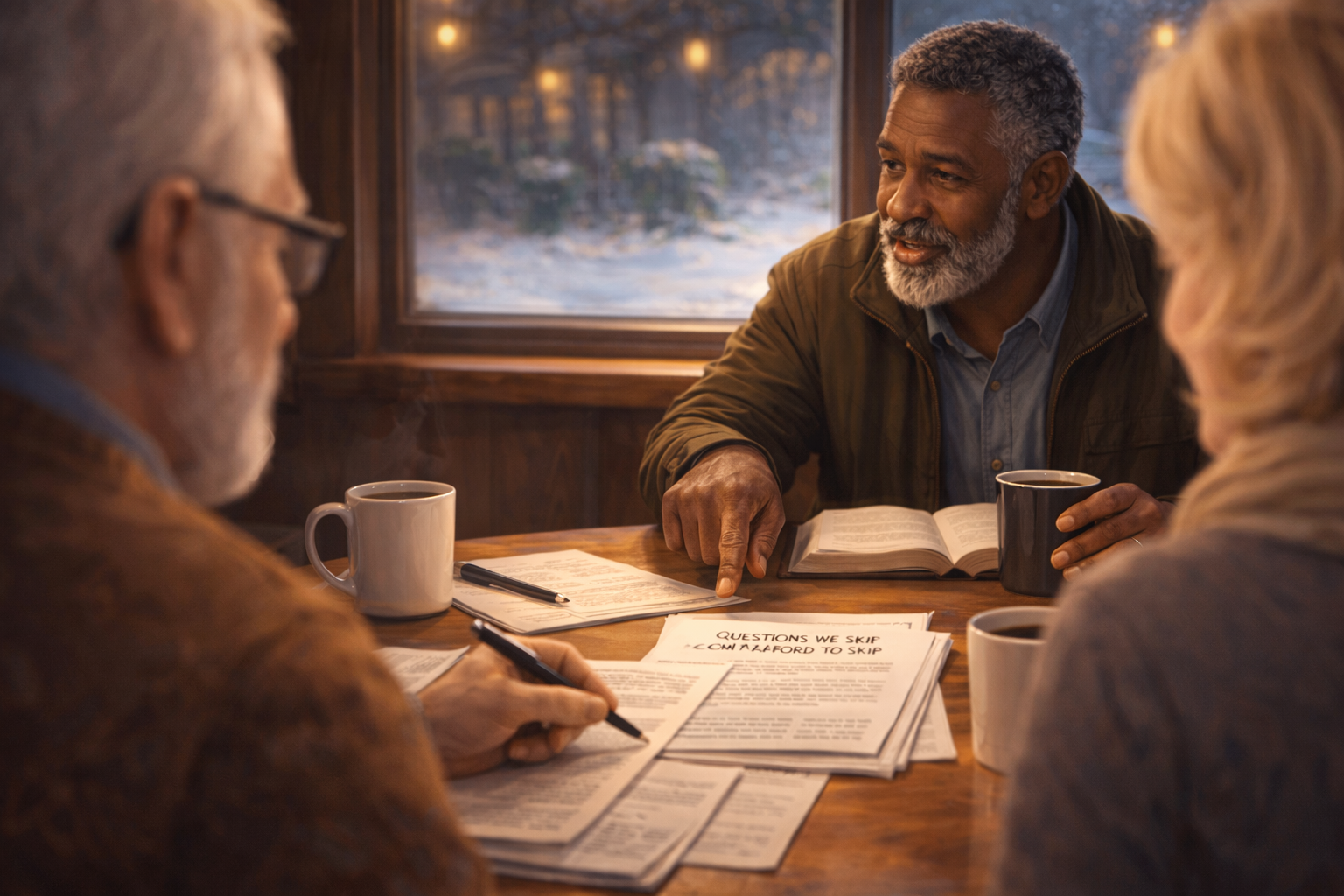
The morning had the kind of cold that didn’t shout—it just stayed. Winter light laid itself thin across the street outside The Shepherds Cafe, and the windows held a soft fog where the warmth inside met the day’s edge.
Elijah arrived first, as usual. He took the corner table that let him see the door and the parking lot without looking like he was watching. His glasses sat low on his nose, and when he lifted his mug, the steam curled around his short white beard like a quiet halo.
He set a small stack of papers beside his Bible—bank forms, a printed agenda, a blank page he’d titled “Questions We Can’t Afford To Skip.”
Jeremiah walked in a few minutes later, tall and steady, his salt-and-pepper beard catching the light when he turned his head. He carried himself like a man who didn’t enjoy conflict but didn’t run from it either. He nodded at Elijah, ordered black coffee, and sat down with the calm focus of someone who had already decided that today mattered.
Barbara came in last, scarf tucked neatly at her neck, short blonde-and-gray bob smoothed as if she’d refused to let the weather win. She held her phone in one hand and a small folder in the other. Her expression was warm, but tight—like she’d been thinking about the same problem for longer than she’d wanted to.
“Good,” she said, sliding into the seat beside Elijah. “You brought paper.”
Elijah’s mouth twitched. “I brought questions.”
Jeremiah wrapped both hands around his mug. “And we’re going to need both.”
For a moment, they sat without rushing the first words. The cafe played soft jazz low enough to be background, and somewhere at the counter someone laughed like they were trying to remember how to be human again after the holidays.
Barbara tapped her folder. “I printed the notes from last week. And I pulled the passages you mentioned.”
Elijah nodded. “We’ll start there.”
Jeremiah glanced from Barbara to Elijah. “Before we do, let’s name the thing plainly, so it doesn’t keep sneaking around the edges.”
Barbara’s eyes narrowed—not in anger, but in precision. “We’re setting up the new accounts today. And we’re trying to do it in a way that protects the church, protects the saints, and protects the name of Christ.”
Elijah opened his Bible without ceremony. “And protects our own souls. Because the quickest way to become cynical is to handle money without guardrails.”
Jeremiah leaned forward slightly. “That’s the part most people don’t say out loud.”
Barbara gave a small, humorless smile. “And the devil doesn’t need to invent a scandal if we hand him a messy process.”
Elijah didn’t argue. He only turned to a passage and read, quietly but clearly: “…for we have regard for what is honorable, not only in the sight of the Lord, but also in the sight of men” (2 Corinthians 8:21, NASB).
Jeremiah nodded. “That’s not a suggestion. That’s a standard.”
Barbara exhaled, and her voice softened. “I know some people hear ‘controls’ and think ‘mistrust.’ But it’s not that. It’s stewardship.”
Elijah looked up. “It’s love. Love doesn’t leave room for suspicion to grow.”
Jeremiah’s gaze stayed steady. “It’s also wisdom. Because even good people can drift when there’s no structure.”
Elijah slid the paper titled “Questions We Can’t Afford To Skip” toward the center of the table.
Barbara read the first line out loud. “Who has access?”
Jeremiah answered immediately. “More than one person needs to be involved—always.”
Barbara read the second line. “Who records transactions?”
Elijah answered. “Someone who isn’t the same person who initiates them.”
Barbara read the third. “Who reviews?”
Jeremiah said, “The elders review regularly. Not because we enjoy it. Because we answer to God.”
Barbara looked up. “And who communicates the procedures to the congregation?”
Elijah’s eyes shifted to her. He didn’t hesitate, but his answer landed with the calm clarity of conviction. “The men who are responsible will address the congregation.”
Barbara nodded without offense—only agreement. “Exactly. And I can support that without taking that role.”
Jeremiah’s tone warmed. “That’s the right division of work.”
Barbara tapped her folder again. “Here’s what I can do: I can write up an announcement for the men to read. I can prepare a bulletin article that explains the ‘why’ and the ‘how’ in plain language. I can make sure these procedures are available to church members through email. And I can post the same material on the poster boards so nobody has to guess.”
Elijah’s expression softened. “That’s not small help. That’s infrastructure.”
Jeremiah nodded. “And it prevents the grapevine from filling the silence.”
Barbara’s phone lit up with a reminder: 9:00 AM — bank appointment. She flipped it over.
“Let’s go,” she said.
Outside, the cold bit at their faces like a reminder. Barbara’s car started with a reluctant hum. She slid into the driver’s seat, Elijah took the passenger seat, and Jeremiah climbed into the back like a quiet guardian.
As they pulled away from The Shepherds Cafe, the heater began to push warm air through the vents. Barbara kept both hands on the wheel and her eyes on the road.
“Let me say something,” Jeremiah said from the back. His voice was low, careful. “Because I don’t want us to carry the wrong spirit into that bank.”
Elijah turned slightly. “Go ahead.”
Jeremiah looked out the window for a moment. “We are not doing this because we expect men to fail. We are doing this because we expect Satan to tempt. And because we expect ourselves to be humble enough to admit we’re not above it.”
Barbara’s grip tightened on the wheel. “That’s the kind of sentence the men need to say when they explain this.”
Elijah nodded. “And it needs to be said in a way that teaches, not accuses.”
Jeremiah’s voice stayed steady. “If the church can’t model integrity with its own resources, how can we teach the world anything about holiness?”
No one answered immediately, because the question didn’t need a debate. It needed obedience.
They arrived a few minutes early. Barbara parked, smoothed her scarf, and glanced back at Jeremiah. “Keep us calm.”
Jeremiah gave a small smile. “I’m calm. I’m just… serious.”
Elijah opened his door. “That’s calm for you.”
Inside, fluorescent lights made everything look a little more severe than it needed to. A receptionist greeted them and pointed them toward a small office. A few minutes later, a banker stepped in—polite, professional, ready.
Introductions were simple. No one tried to impress. Barbara did most of the practical talking—names, accounts, access, procedures. Elijah asked the questions that sounded boring until you realized they prevented disasters. Jeremiah watched faces, listened for assumptions, and occasionally leaned forward to clarify something that would have gone unspoken.
At one point the banker said, “So who will be the primary user?”
Barbara’s eyes flicked to Elijah, then to Jeremiah. “We don’t do ‘primary’ in the sense of solo. We do shared oversight.”
The banker blinked. “I see. So—two signatures required?”
Elijah answered. “Yes.”
Jeremiah added, “And regular review.”
Barbara said, “And clear reporting. Not because we’re worried about theft—because we’re serious about trust.”
The banker nodded, and her tone shifted slightly—less transactional, more respectful. “That’s… refreshing, honestly.”
Elijah didn’t smile for compliment’s sake. “It’s biblical.”
The paperwork continued. Account types. Authorized signers. Deposit procedures. Access settings.
Then a small question came up—one that sounded insignificant until it wasn’t.
The banker asked, “Will the church ever reimburse someone for benevolence assistance they paid out personally?”
Barbara’s eyes narrowed as if she’d heard a trap click. “Sometimes saints do that.”
Elijah spoke carefully. “We don’t want saints paying out of pocket and hoping it gets covered later. That creates confusion and pressure.”
Jeremiah’s voice came from the back of the office chair like a steady anchor. “And it tempts people toward private ‘hero’ stories rather than accountable care.”
Barbara nodded. “If someone sees a need, they should bring it to the proper men. We can respond quickly, but it needs to be clean.”
The banker’s pen paused. “So what’s your process?”
Elijah answered plainly. “A request is brought. The need is verified. Two people review. Assistance is given. A receipt is kept. A report is made. And the saints are cared for without drama.”
Jeremiah leaned forward. “And without turning benevolence into a performance.”
Barbara added, “And without the church becoming careless.”
The banker wrote something down, then looked up. “That’s unusually structured.”
Elijah didn’t apologize. “We’re not running a business. But we are handling holy things.”
By the time they walked out, the papers were signed, the procedures were set, and the next steps were clear. Barbara held the folder like it was fragile—not because it was complicated, but because it represented trust.
Back in the car, she laid the folder in the glovebox and shut it with a soft snap.
Jeremiah leaned forward from the back seat. “That glovebox is about to become the most honest place in the county.”
Barbara laughed once, short and genuine. “It’s going to become the most organized place in the county.”
Elijah looked out at the gray sky. “And if we keep it that way, we’ll prevent a lot of heartbreak.”
They drove back to The Shepherds Cafe without rushing. The morning traffic was light. The cold stayed cold. But something in the car felt warmer than the heater could account for.
When they returned, the cafe had filled in. A young couple sat near the window. An older man read a newspaper with a seriousness that suggested he still believed the world could be understood if you tried hard enough. The smell of coffee wrapped around them like welcome.
They sat again at their corner table. Barbara slid the folder out and placed it between them. Elijah set his Bible beside it, as if to make the point without saying it: this was not separate from faith. This was part of it.
Jeremiah folded his hands. “Now comes the harder part.”
Barbara’s eyebrows lifted. “The harder part than the bank?”
Jeremiah nodded. “Yes. The culture.”
Elijah leaned back slightly. “Explain.”
Jeremiah looked at both of them. “We can build good systems. But if the saints don’t understand why, they’ll misread it. They’ll think we’re becoming ‘corporate.’ Or they’ll think we’re reacting to rumors. Or they’ll assume someone did something wrong.”
Barbara nodded slowly. “So the men address it from the front—clearly, spiritually, and without drama.”
Elijah agreed. “A brief announcement. Scripture. The purpose. The guardrails. Then we move on.”
Barbara lifted her folder. “And I’ll support that in the ways that fit my role. I’ll draft the announcement for the men to read. I’ll write the bulletin article with the details so people can re-read it. I’ll email the procedures so members have it in writing. And I’ll put a clean copy on the poster boards, so nobody has to chase anyone down in the parking lot.”
Jeremiah’s shoulders relaxed a fraction. “That covers both clarity and accessibility.”
Elijah nodded. “And it keeps the line bright—men leading the assembly as Scripture teaches, and sisters doing substantial work that strengthens the whole body.”
Barbara’s expression softened. “I’m not trying to take the pulpit. I’m trying to take away confusion.”
Jeremiah smiled faintly. “That’s discipleship too.”
Elijah opened his Bible again, not theatrically—just naturally, like a man who didn’t trust his own wisdom without anchoring it.
He read: “…for we have regard for what is honorable, not only in the sight of the Lord, but also in the sight of men” (2 Corinthians 8:21, NASB).
Then he looked up. “We tell them: this is about being above reproach. Not just to avoid criticism—so the name of Christ is honored.”
Jeremiah nodded. “And we teach it as obedience, not as policy.”
Barbara took a sip of her coffee. “And we make it easy for the saints to find and understand—announcement, bulletin, email, and poster boards.”
Elijah’s eyes crinkled behind his glasses. “Simple. Clean. Repeatable.”
Jeremiah sat back, and his voice turned firm again, but not harsh. “Today was not glamorous. No one’s going to clap. No one’s going to write a poem about dual signatures.”
Barbara smirked. “I might.”
Elijah deadpanned, “Please don’t.”
Jeremiah continued. “But this is part of discipleship. It’s teaching the church what faith looks like when it touches paper and receipts and processes.”
Barbara looked down at the folder, then back up. “I’ll have the announcement draft and bulletin article ready today. You two can shape the wording the men will use to address the congregation, and I’ll make sure the written procedures are everywhere they need to be.”
Elijah nodded. “Bring it to the elders. We’ll keep it tight and biblical.”
Jeremiah’s gaze moved to the window, where winter light still looked thin and distant. “And we move forward without congratulating ourselves for doing what we were supposed to do.”
Barbara leaned back and looked between them. The cafe noise swirled around their quiet corner like a river around stones.
“You know what I love about days like this?” she said.
Elijah waited.
Jeremiah waited.
Barbara’s voice softened. “It’s not that we fixed everything. It’s that we chose honesty over convenience.”
Elijah nodded slowly. “And we chose to fear God more than we fear discomfort.”
Jeremiah’s eyes stayed on the glass. “And we chose to protect the church from the kind of trouble that doesn’t explode—it erodes.”
They sat in silence for a moment, not because they ran out of words, but because the best words had already been said.
Then Elijah closed his Bible and laid his hand on the folder like it was a covenant.
“Let’s pray,” he said.
Right there, in The Shepherds Cafe, with coffee cooling and jazz humming and winter pressing against the glass, they bowed their heads—not to perform, but to submit.
And in that quiet corner, integrity didn’t feel like a policy.
It felt like worship.