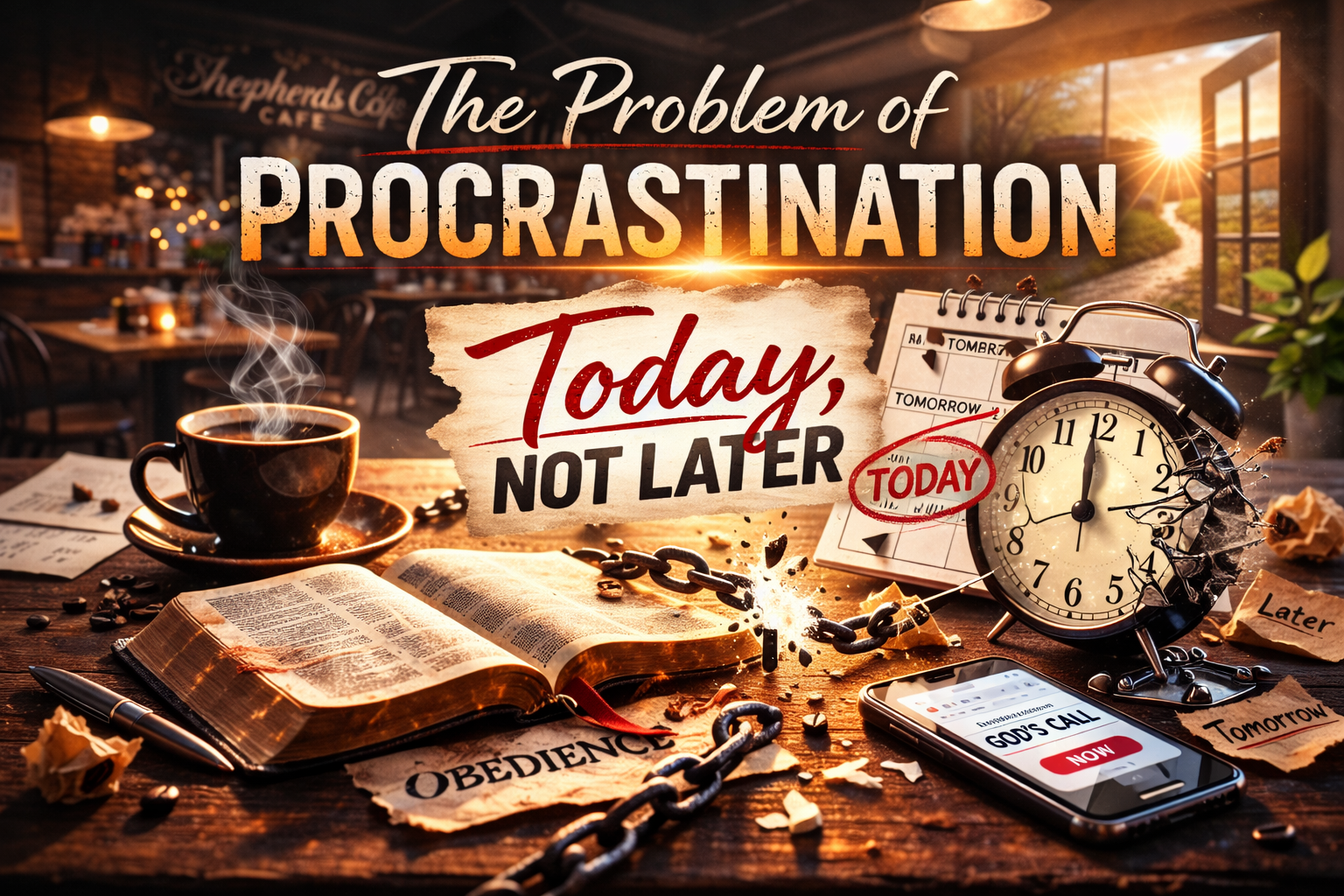
The late-morning crowd at The Shepherds Cafe had the familiar look of people trying to outrun their own calendars—phones out, keys on the table, coffee ordered “to go,” and eyes that said I’m busy even when I’m sitting down.
Barbara watched it all from behind the counter, scarf neat, hands moving with quiet efficiency. Elijah sat beneath the wooden café sign, glasses low, phone in hand, reading with the kind of focus that meant he wasn’t just passing time—he was letting truth aim at him. Jeremiah stepped in, shook off the chill, and slid into the booth across from Elijah.
“You’ve been quiet,” Jeremiah said. “What did you find?”
Elijah turned the phone so Jeremiah could see the title: “The Problem of Procrastination.”
Barbara’s eyebrows rose. “That’s not a ‘light reading’ title.”
“It’s not,” Elijah said. “It’s aimed straight at the phrases we hide behind—‘later,’ ‘tomorrow,’ ‘next time.’”
Jeremiah nodded slowly. “Those words can sound harmless. But they can also be spiritual sabotage.”
Elijah scrolled. “The devotional defines procrastination as delaying or putting things off. Sometimes delay is legitimate, but often it’s avoidance—of responsibilities, hard decisions, even people. And over time, it becomes a lifestyle that produces regret.”
Barbara set down two mugs and said, “Most people don’t realize procrastination isn’t just bad time management. It’s a way of dodging accountability.”
Elijah read the first reason the devotional gives: procrastination robs you. It cuts you off from opportunities “just out of sight.” It cites Proverbs about diligence and explains how putting things off can mean missing chances that won’t be there tomorrow.
Jeremiah’s voice was steady. “That’s true in work, but it’s even more true in spiritual life. Obedience has moments. And moments expire.”
A man at a nearby table—calloused hands, tired eyes—looked up like the word had snagged him. “I’ve missed opportunities,” he admitted. “Not because I didn’t care… I just kept thinking I had time.”
Jeremiah didn’t shame him. He nodded. “That’s the lie procrastination sells: plenty of time.”
Elijah scrolled again. “Second reason: procrastination roots you. Every time you put something off, you sink deeper into laziness. The devotional quotes Proverbs about the lazy man who won’t plow because it’s winter and ends up with nothing, and the one who invents excuses like ‘a lion in the road.’ It warns that repeated avoidance shapes your character—into someone underdeveloped, angry, even depressed.”
Barbara’s mouth tightened, not judgmental—just honest. “Avoidance doesn’t stay a habit. It becomes an identity if you feed it.”
Jeremiah nodded. “People don’t wake up one day and decide to be spiritually dull. They practice delay until delay becomes default.”
Elijah looked down and read the third reason: procrastination assumes you have time. It quotes, “Do not boast about tomorrow, for you do not know what a day may bring forth” (Proverbs 27:1), and explains that assuming control of time is a great evil because only God controls time—our lives are like vapor.
Jeremiah leaned back. “That’s a needed correction. Tomorrow is promised to no one.”
Barbara’s voice softened. “Especially not for the things that matter most.”
Elijah scrolled to the section that made the booth go quiet. “It uses Felix in Acts 24. Paul reasons with him about righteousness, self-control, and the judgment to come—Felix becomes frightened and says, ‘Go away for the present, and when I find time I will summon you.’ The devotional says the opportunity was there… and delay helped him avoid the decision that would have changed his eternal life.”
Jeremiah’s eyes held a seriousness that didn’t need volume. “That’s one of the most terrifying sentences in the Bible: when I find time.”
The man at the next table swallowed. “So what’s the answer?”
Jeremiah answered like a brother, not a lecturer. “Do the hard thing first. Not the easy thing first. That’s practical repentance.”
Elijah nodded. “The devotional ends with that exact push: if ‘putting off’ is your lifestyle, decide now, not later, to ask God for help and change—then start doing the hard stuff first. And it warns: if you’re putting off becoming a Christian, you have no guarantee you’ll have tomorrow.”
Barbara rested her hands on the counter. “Most people want motivation,” she said. “What they need is a decision.”
Jeremiah looked around the café—at the rushed, the weary, the distracted, the quietly convicted. “The devil doesn’t always drag people into outright rebellion,” he said. “Sometimes he just keeps them busy and postponing until their hearts get used to never obeying immediately.”
Elijah slid his phone into his pocket. “The takeaway is uncomfortable,” he said. “But it’s merciful: delay can cost more than time. It can cost opportunities… and sometimes eternity.”
Barbara gave a small, steady nod. “Then don’t walk out of here saying ‘later.’ Walk out saying ‘today.’”
And the cafe returned to its normal sounds—cups, chairs, quiet conversation—but a few people left with a different kind of urgency: not panic, but wisdom that finally stopped negotiating with the clock.