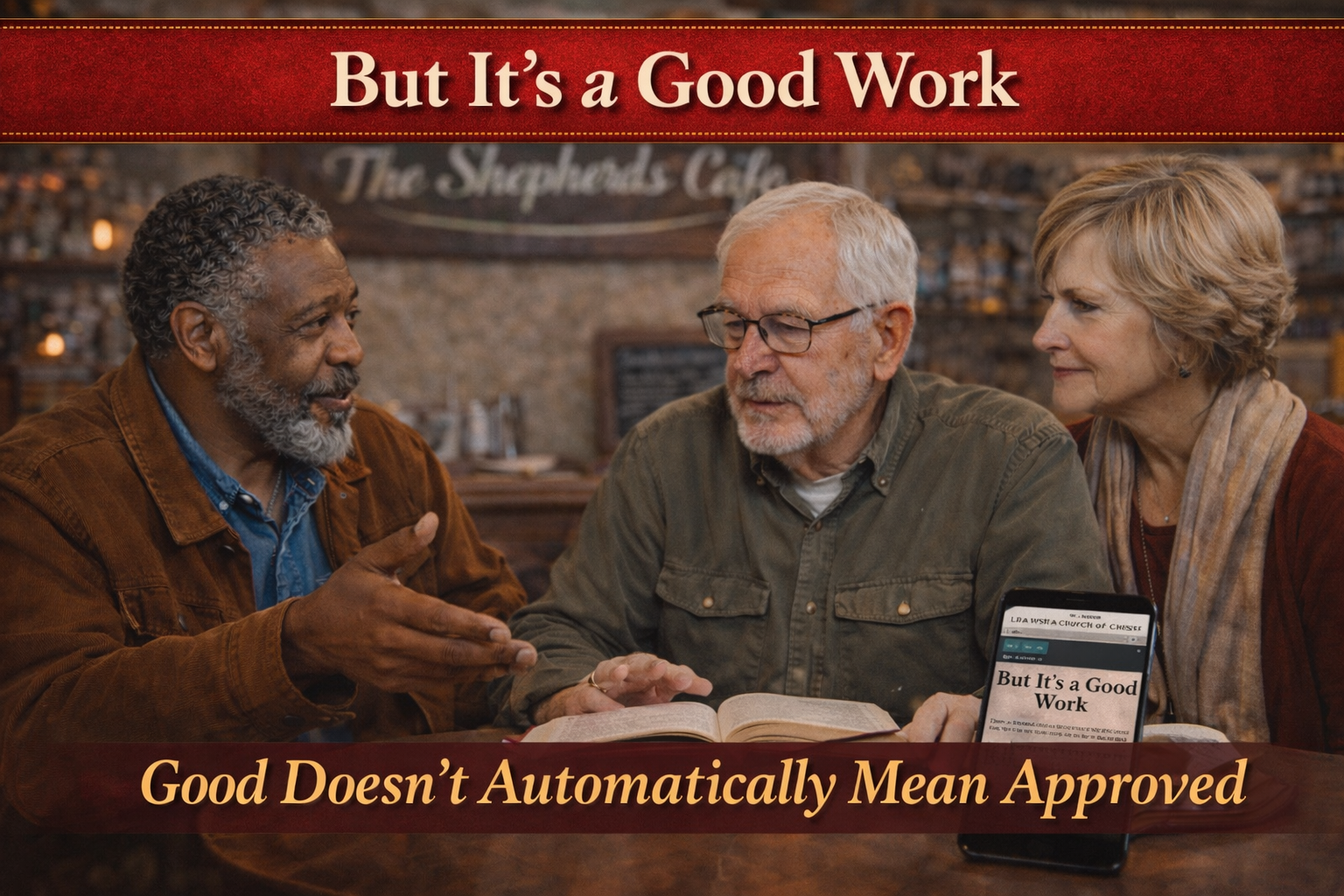
The morning rush at The Shepherds Cafe came in waves—steel-toed boots, briefcases, tired eyes, and people running on coffee and habit. Behind the counter, Barbara kept things moving with calm efficiency, scarf in place, smile ready. But she noticed something else too: how often people tried to solve spiritual questions with a simple phrase.
“But it’s a good work.”
Elijah was seated at the corner table, glasses low, scrolling slowly. Jeremiah arrived, set his Bible down, and looked at Elijah’s face.
“You’ve got that look,” Jeremiah said. “What are you reading?”
Elijah turned the phone. “La Vista. The article is titled ‘But It’s a Good Work.’”
Barbara raised an eyebrow from the counter. “That phrase causes more trouble than folks realize.”
Jeremiah sat across from Elijah. “Read me the point.”
Elijah summarized what he’d just read: when discussions arise about what the church is authorized to support, some respond, “But it’s a good work,” and they use that to justify church-funded efforts like orphan homes, schools, food pantries, sports programs, and similar enterprises.
Jeremiah nodded. “The question isn’t whether it’s good. The question is: who is responsible—the individual Christian or the local church treasury?”
Elijah pointed at the article again. “That’s exactly what the author asks. He notes that Scripture encourages good works, but those commands are often directed to individuals, not the church acting as an institution.”
A younger man nearby—new to the cafe, Bible open, notebook out—leaned over slightly. “So are you saying Christians shouldn’t do those good things?”
Jeremiah answered immediately. “No. Christians should be devoted to good works. The issue is authority and roles. God assigns responsibilities. When we blur them, we end up building a religious system God never designed.”
Barbara poured coffee into a fresh mug. “So you’re talking about the difference between personal charity and congregational work.”
“Exactly,” Elijah said.
Jeremiah’s finger tapped the table once. “And Scripture gives us a cautionary story: King David.”
Elijah glanced down and read, “David wanted to build a house for the Lord. It was a sincere, noble idea—but God’s response was basically, ‘Where did I ever command that?’ The article uses that to show that good intentions don’t create authority.”
Jeremiah nodded. “A good motive can still be a wrong action—if God hasn’t authorized it.”
Barbara’s tone was practical. “That’s hard for people because ‘good’ feels like it should automatically mean ‘approved.’”
Jeremiah opened his Bible. “But Scripture doesn’t teach ‘approved because it feels good.’ It teaches ‘approved because God said so.’”
Elijah continued, “Then the article brings up the ark being transported on a new cart. David’s plan looked smart and even considerate. Uzzah reached out to steady the ark and died. The point is: they didn’t seek God according to His ordinance.”
The young man’s eyes widened. “That story always scared me.”
“It should sober you,” Jeremiah said, not harshly. “It teaches us that sincerity isn’t the same as submission.”
Barbara leaned in slightly. “What was the takeaway?”
Elijah read the line that stuck: David later admitted the problem wasn’t that they didn’t mean well—it was that they didn’t do it God’s way.
Jeremiah let that sit for a moment, then said, “That principle protects the church from turning into a catch-all charity organization just because the community has endless needs. If we go down the road of ‘Where do we stop?’ we never stop.” The article makes the same point with examples—a fire department, an ambulance service, even things that are undeniably helpful—yet still not necessarily the work God assigned to the church.
Barbara nodded. “So what does God say the church is supposed to do?”
Jeremiah answered with the steadiness of a man who has repeated it for years. “The church is to preach the gospel, edify the saints, and care for needy saints as Scripture authorizes—while individual Christians do a wide range of good works as lights in the world.”
Elijah lifted the phone again. “The article closes by stressing authority: ‘Whatever you do in word or deed, do all in the name of the Lord Jesus’—meaning by His authority.”
Barbara set the mug down and said what everyone in the cafe needed to hear: “If it’s a good work, then do it. But don’t use the Lord’s name to fund what the Lord didn’t assign.”
Jeremiah smiled slightly. “That’s it. The church doesn’t have to apologize for being the church. And Christians don’t have to outsource personal compassion to a church treasury.”
The young man looked down at his notes. “So the real question isn’t ‘Is it good?’”
Jeremiah nodded. “The real question is: Has God authorized the church to do it? And if He hasn’t—then the ‘good work’ still needs doing… just in the right lane.”
Elijah took a sip of coffee. “Good intentions are common. Submission is rare.”
Barbara glanced around the room—at the people rushing, at the people lingering, at the ones quietly listening. “Maybe that’s why God gave us patterns,” she said, “because we’re always tempted to improve what doesn’t need improving.”
Jeremiah closed his Bible. “And because the church, when it stays in its assignment, becomes unmistakably what Christ built—nothing more, nothing less.”
Elijah slid his phone into his pocket and looked out at the wet street beyond the window. “A good work,” he said, “isn’t the same as an authorized work. And learning the difference protects both the church’s mission and the Christian’s conscience.”