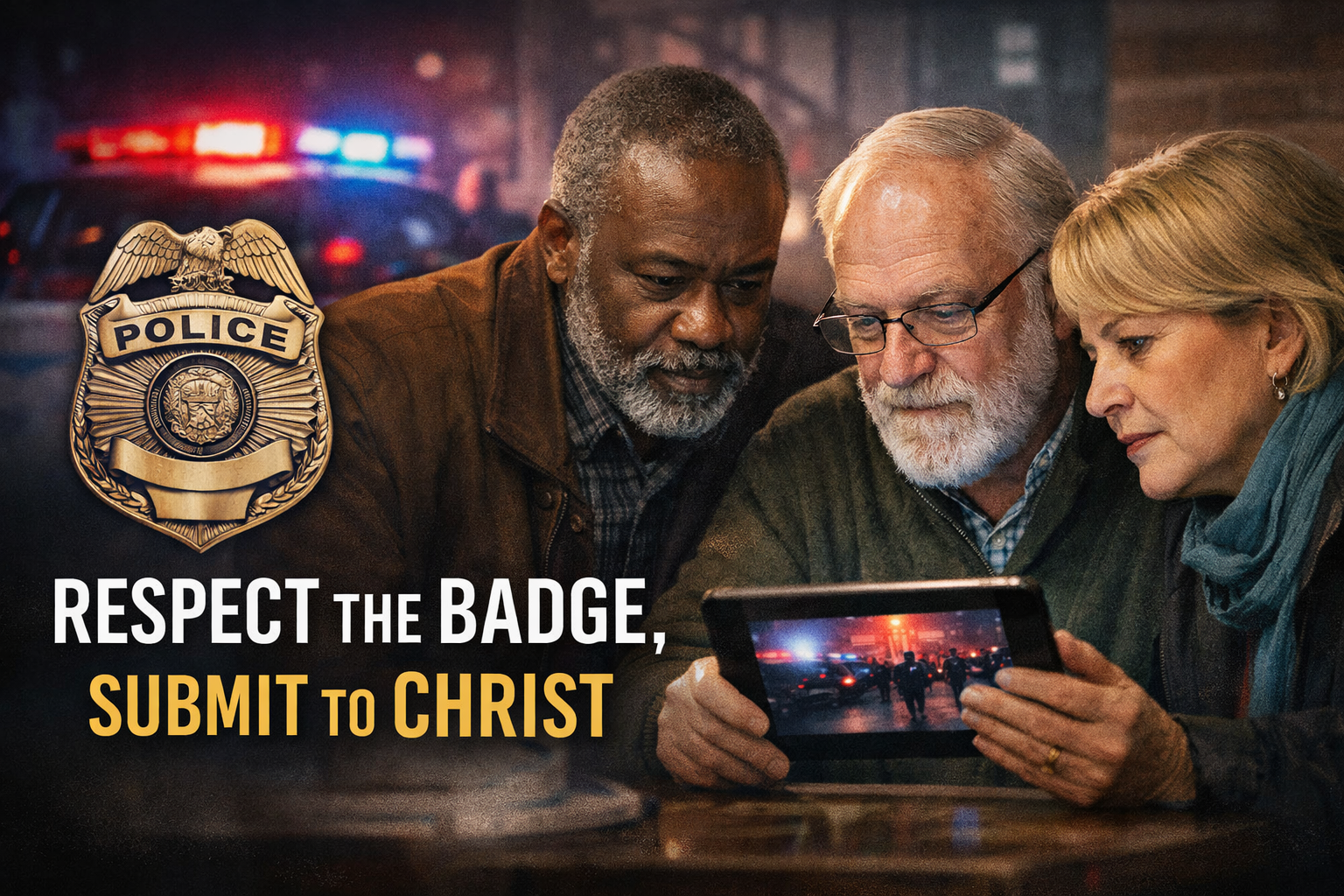
The winter air outside The Shepherds Cafe had that sharp, metallic bite that makes people talk faster than they think. Inside, the café was steady—soft jazz, warm lights, the quiet clink of mugs—like the world had agreed to pause for a moment.
Elijah sat near the window, glasses low, a legal pad open but untouched. Jeremiah—an older Black man with a salt-and-pepper beard—sat across from him, phone face-down on the table as if he’d already learned that staring at it wouldn’t make anything better. Barbara slid into the seat beside Elijah, scarf in place, her short blonde-gray bob tucked neatly behind one ear. She set a thin folder down like a boundary line.
“We’ve got brethren arguing,” Barbara said, voice low but direct. “Not small disagreements. The kind that harden into factions.”
Jeremiah nodded once. “And it’s not just arguing. It’s accusing. People are taking a headline, picking a side, and calling it righteousness.”
Elijah didn’t look up yet. “Say it plainly. What’s the topic?”
Jeremiah tapped the phone with two fingers but didn’t pick it up. “A protest. An officer. A death. Everybody’s convinced they already know what happened. And they’re preaching online like they’re eyewitnesses.”
Barbara opened her folder. Inside were two pages—one looked like a draft bulletin note, the other like a short statement for a brother to read aloud in the assembly. She didn’t push them forward yet. She just let them sit there, visible.
Elijah finally raised his eyes. “We are going to need to remind people of a few biblical sentences they don’t like right now.”
Jeremiah’s expression tightened. “Which ones?”
Elijah’s voice stayed calm, but there was no softness in it—only clarity.
“These: We must obey the law of the land. And: respect officials. And: know that the government does not bare the sword in vain.”
Barbara blinked, then gave a small nod. “That last line—people quote it, but they don’t like what it means.”
Jeremiah exhaled through his nose. “And you know somebody’s going to hear that and assume we’re saying government is always right.”
Elijah reached for his pen, then paused. “No. We’re saying Scripture is always right. There’s a difference.”
Barbara finally slid the first page forward. “I drafted something. But it needs the distinction spelled out—civil disobedience versus just… lawlessness.”
Jeremiah leaned in, reading. Elijah didn’t read yet. He stared at the blank space on his pad, as if he was deciding what the congregation needed most—not emotionally, but spiritually.
“Elijah,” Jeremiah said, quieter now, “help me say this without sounding like we’re endorsing every action an official takes.”
Elijah nodded. “We won’t endorse sin. But we will endorse God’s order.”
He tapped his pen once. “First, we teach what Romans 13 actually teaches: governing authorities are guardians of the law in the sense that they restrain evil and maintain public order. They are not God. They are accountable to God. But they are not irrelevant. Scripture says the civil authority is a real instrument in a fallen world.”
Barbara interjected gently, “And that’s where the phrase comes in.”
Elijah nodded. “Yes. The government does not bare the sword in vain.”
Jeremiah’s eyebrows lifted slightly. Barbara’s mouth opened as if she was going to correct him, then she stopped—because she knew he was doing something intentional.
Elijah glanced at them. “And before anyone repeats it wrong for the next ten years—Scripture’s wording is ‘bear,’ not ‘bare.’ But the meaning is the point: government has coercive power to punish wrongdoing. That should sober Christians. Not inflame them.”
Jeremiah leaned back. “So, when someone is out there threatening, vandalizing, or trying to ‘settle’ things by force…”
Elijah finished the thought. “They are not practicing righteous protest. They are courting the sword. And they should not be surprised when authorities act, because God said authorities do not carry that sword for decoration.”
Barbara’s voice was steady. “And when an officer abuses authority?”
Elijah didn’t dodge it. “Then the officer sins—and should be investigated, restrained, and judged according to law. Christians can demand justice through lawful means without becoming lawless ourselves.”
Jeremiah nodded slowly. “That’s the line. Lawful means. Not mob means.”
Barbara slid the second page forward. “But people also want to talk about civil disobedience. Some are quoting it like a license.”
Elijah’s pen finally moved. He wrote one sentence on the pad in block letters:
DISOBEDIENCE TO SIN IS NOT DISOBEDIENCE TO LAW.
He looked up. “Civil disobedience is not the same as violating law because you’re angry. Biblically, civil disobedience is rare, reverent, and willing to accept consequences. It happens only when the government commands what God forbids—or forbids what God commands.”
Jeremiah’s eyes sharpened. “So Acts 5:29 territory.”
Elijah nodded. “Exactly. ‘We must obey God rather than men.’ That’s civil disobedience. But even then, the Christian posture is not contempt. It’s conscience.”
Barbara added, “Meaning: you don’t spit on the officer and then call it ‘courage.’”
Jeremiah’s mouth tightened into the faintest smile. “And you don’t break windows and call it ‘justice.’”
Elijah set the pen down. “Now, we bring in what people are missing: Jesus provides a framework for resolving disputes. That’s what people need to know and believe.”
Barbara straightened slightly. “You mean Matthew 18.”
“Yes,” Elijah said. “Not ‘post first, verify later.’ Not ‘gather a crowd, then humiliate.’ Jesus says: go to the person. Privately. Clearly. If that fails, take witnesses. If that fails, involve the proper authority.”
Jeremiah held up a hand. “And that applies beyond personal squabbles?”
Elijah answered immediately. “It applies to the Christian instinct. Jesus trains us away from spectacle. He trains us toward truth, process, and reconciliation. And when the dispute is public and criminal, the ‘proper authority’ includes the lawful channels God established—investigations, courts, evidence.”
Barbara nodded. “So we tell people: stop trying cases on social media.”
Jeremiah glanced at his phone again, still face-down. “Because a clip can’t cross-examine a witness.”
Elijah’s voice stayed even. “And because outrage is not a fruit of the Spirit.”
Barbara tapped the paper. “How do we present this to the congregation without sounding political?”
Elijah looked at her kindly, but firmly. “We do not speak as a party. We speak as disciples. The message is not ‘trust the state’ or ‘distrust the state.’ The message is: Christians obey God—and therefore we obey lawful authority, respect officials, refuse violence, refuse slander, and pursue truth through the paths God allows.”
Jeremiah’s posture softened. “We can say: obey the law of the land… and still say: every authority stands under God’s judgment.”
Elijah nodded. “Correct.”
Barbara lifted her pen. “I’ll tighten the bulletin note. It will include the exact sentences you said—so nobody can claim we’re being vague.”
Jeremiah stood and pulled on his coat. “And I’ll ask one of the brothers to read the short announcement in the assembly. You can write it, Barbara—just like always.”
Barbara gave a small, satisfied nod. “Good. Because this needs to be heard, not just forwarded.”
Elijah gathered the pages and folded them neatly, like he was putting tools back in a box.
“One last thing,” he said, stopping them before they stood fully. “We don’t teach this to win an argument. We teach it to keep the church from becoming a mirror of the world.”
Jeremiah paused at the edge of the table. “And to keep our brethren from confusing courage with chaos.”
Barbara slid her folder back under her arm. “And to keep people from believing a lie: that Jesus is irrelevant to public conflict.”
Elijah looked at both of them, calm and unshaken.
“Jesus isn’t irrelevant,” he said. “He’s the only one who can teach sinners how to seek justice without becoming unjust.”
Outside, the cold waited. Inside, the path forward was still hard—but at least it was clear: obey the law of the land, respect officials, remember that the government does not bare the sword in vain, and when conflict rises, trust Jesus’ framework more than the world’s fury.