Part 1 — The Folder on the Table
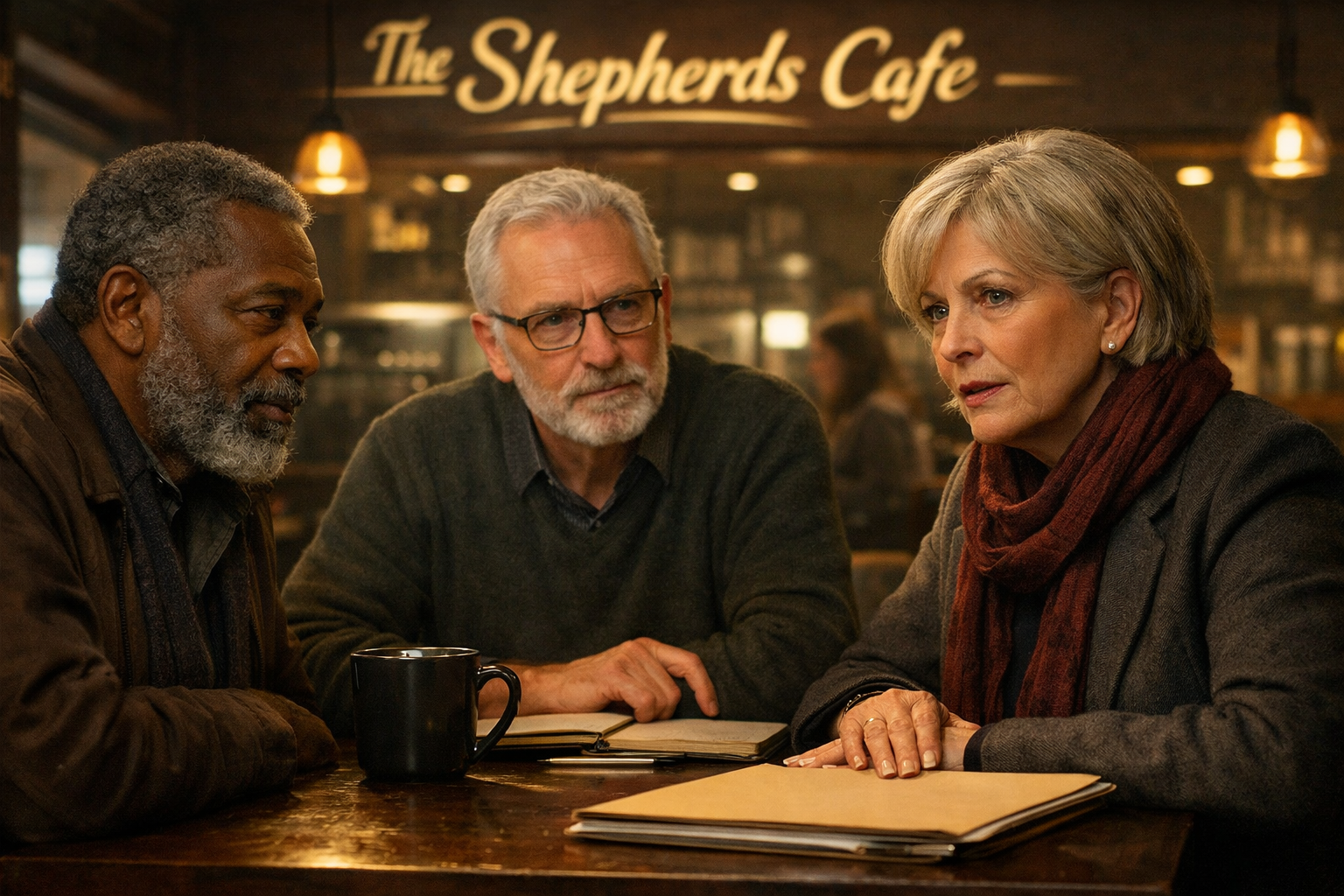
The bell over the door of The Shepherds Cafe gave its soft, familiar chime, the kind that usually sounded like relief—like the building itself was saying, Come in. Breathe a minute.
Outside, the January sky hung low and pale, and the street looked rinsed clean by a steady, cold drizzle. Inside, it was warm enough to loosen shoulders. Pendant lights glowed over the counter. The espresso machine hissed like a quiet kettle. Somewhere in the back, dishes clinked in a rhythm that felt almost dependable.
Elijah sat in his usual spot, a small notebook open beside a coffee cup he seemed to refill out of habit more than thirst. Rectangular glasses rested low on his nose. His short white beard caught the café light when he turned his head.
Jeremiah sat across from him, older and steady, his salt-and-pepper beard framing a face that had learned how to watch people without staring. He wasn’t reading. He rarely read in public unless he meant to disappear. Today he was doing what he did best—being present on purpose.
Elijah glanced up from his notes. “You’re quiet.”
Jeremiah gave a slight shrug. “I’m listening.”
“To what?”
Jeremiah lifted his chin a fraction toward the front door. “To the room. And to what isn’t being said.”
Elijah followed his glance and nodded once, as if he understood. The café had a way of collecting burdens. Sometimes they arrived loud. Sometimes they arrived carrying themselves like they were fine—until they sat down.
The bell chimed again.
Barbara stepped inside.
She didn’t rush. She didn’t look scattered. But she did look focused—the way a woman looks when she’s holding something together with both hands and will not allow it to slip.
She wore her scarf, neatly arranged, and her short blonde-gray bob was tucked behind one ear. Under her arm was a slim folder, the kind you’d use for documents you didn’t want bent. In her other hand, she held her phone, not like a casual accessory, but like something she’d been staring at too long.
Elijah stood halfway, instinct more than effort. “Barbara.”
Jeremiah didn’t stand, but his eyes sharpened. “That’s not your usual face.”
Barbara tried to smile. It didn’t quite make it. “No,” she said, then walked directly to their table as if she didn’t trust herself to stop and talk to anyone else.
She sat down carefully and placed the folder on the table between them.
It made a soft sound—paper and plastic meeting wood—but it landed with weight. The kind of weight that changes the temperature of a conversation.
Elijah’s hand hovered near his notebook, then pulled back. “All right,” he said gently. “Talk to us.”
Barbara looked down at the folder as if she didn’t want to open it in public, even here. Then she looked up again, eyes steady but tired.
“I’m worried,” she said. “About our women.”
Jeremiah’s voice stayed calm. “All of them?”
Barbara shook her head. “Not all. But enough. And especially the younger ones.”
Elijah leaned forward just a little. “What happened?”
Barbara’s fingers pressed the edge of the folder, flattening it as if she was pressing down a rising tide. “Nothing happened in one moment,” she said. “That’s the problem. It’s happening in a thousand small moments.”
Jeremiah nodded once. “Those are usually the dangerous ones.”
Barbara glanced toward the counter, where two young women laughed softly over a laptop. Their laughter wasn’t wrong. Nothing about them was wrong. And yet Barbara watched them like a grandmother watches a toddler near a stairwell—not angry, not judgmental, just alert.
“They’re being shaped,” Barbara said quietly. “By language. By categories. By a way of thinking that sounds like ‘help’ but functions like… like a religion.”
Elijah’s eyebrows rose slightly. “A religion.”
Barbara nodded. “Not with hymns. With slogans. Not with prayer. With affirmations. Not with worship. With sessions.”
Jeremiah stayed still, but his gaze did that subtle shift it always did when he realized a conversation was about to go deeper. “Say it plain, Barbara.”
Barbara’s jaw tightened, and when she spoke again her voice held a hard clarity—controlled, but not detached.
“They’re starting to talk like they’re case files,” she said. “Like they’re nothing but symptoms. Like their behavior can’t be corrected because it’s ‘how their nervous system works.’ Like repentance is the same thing as shame.”
Elijah’s expression turned sober. “Where are they getting that?”
Barbara didn’t answer immediately. She set her phone on the table, face down, like she didn’t want it listening.
“From everywhere,” she said. “But mostly from the one place that never sleeps and never stops preaching.”
Jeremiah’s eyes narrowed. “Their feeds.”
Barbara nodded once. “Their feeds.”
Elijah leaned back, absorbing it, then leaned forward again as if he didn’t want the moment to get abstract. “Give me an example. Something specific you’ve heard.”
Barbara inhaled, slow. “I listened to a young woman explain why she snapped at her mother. No sorrow. No ownership. She said, ‘I was dysregulated.’ As if that was the end of the matter.”
Jeremiah’s tone stayed steady, but it sharpened. “So the label becomes the shield.”
“Yes,” Barbara said. “And then nobody can call anything sin. Nobody can call anything selfish. Nobody can even call anything unloving. Everything is a ‘response.’ Everything is a ‘trigger.’ Everything is ‘valid.’”
Elijah didn’t argue. He didn’t scoff. He looked at Barbara with the kind of seriousness that meant he believed her.
“And you said this is affecting older women too,” he said.
Barbara hesitated, and that hesitation was more revealing than any speech. “Some,” she admitted. “Not because they’re online all day. But because they’re tired, and this worldview offers them a permission slip to withdraw from everything hard while still feeling righteous about it.”
Jeremiah nodded slowly. “A counterfeit righteousness.”
Barbara opened the folder.
Inside were printed pages covered in highlighted lines. Charts. Notes in the margins. A few screenshots blurred just enough to keep names private. At the top of one page, Barbara had written in neat, old-school handwriting:
TOOL OR LORD?
Elijah read the words and looked up at her. “You’ve been studying.”
Barbara’s eyes held his. “I had to. Because it’s not just a trend. It’s a language. It’s a worldview. And it’s walking into the church dressed as compassion.”
Jeremiah’s voice lowered. “And compassion without truth becomes something else.”
Barbara nodded. “It becomes permission.”
The room felt quieter at their table now. Not because the café got silent—people still talked, cups still clinked—but because all three of them had turned toward the same realization: this wasn’t a private struggle inside one person. It was a cultural catechism reshaping hearts.
Elijah tapped the folder gently with the back of his knuckle. “What do you want us to do with this?”
Barbara didn’t answer right away. Instead, she slid one sheet toward them—only one—like she was giving a preview, not the whole case.
On it were two columns: phrases on the left that sounded modern and safe, and on the right Barbara’s brief translation of what those phrases did to the soul. Some of the translations were simple. Some were blunt.
Elijah’s eyes moved across the page, then stopped.
He looked up, and for the first time that morning, his voice carried a quiet edge.
“Barbara,” he said, “someone is teaching our women a new doctrine.”
Barbara held his gaze. “Yes,” she said. “And if we don’t address it carefully, we’ll either lose them to it… or we’ll push them deeper into it by speaking without wisdom.”
Jeremiah leaned forward, elbows near the table now, fully engaged. “Then we need wisdom,” he said. “And we need Scripture.”
Barbara nodded once, firm. “And we need to start with the women—before this becomes the air they breathe.”
Elijah glanced down again, then back up. “What’s the first sign?” he asked. “If you had to name it, what’s the earliest smoke?”
Barbara stared at the page for a moment, then looked at them with a kind of protective urgency.
“The first sign,” she said, “is when a woman stops saying, ‘I sinned,’ and starts saying, ‘That’s just how I am.’”
Jeremiah’s eyes hardened slightly—not with anger, but with alarm. Elijah’s pen sat untouched.
Barbara drew a slow breath, then added, almost as if she dreaded the next sentence.
“And I have a list of the words they’re using to justify it.”
She tapped the folder again.
“And it’s longer than it should be.”
End of Part 1