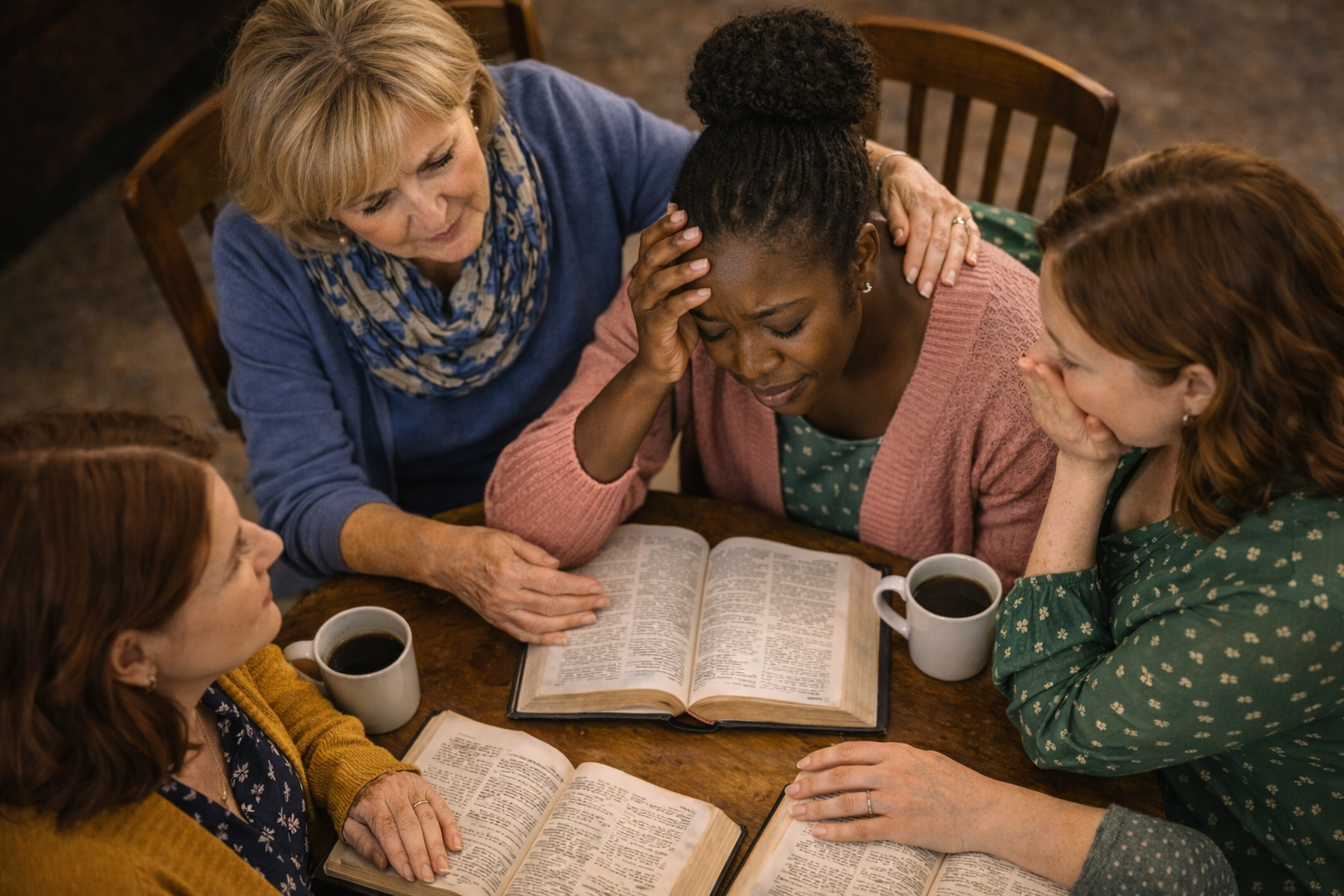
Barbara chose a different corner of The Shepherds Cafe this time—one farther from the window, away from foot traffic, where conversation could stay private. When the ladies from church arrived, she didn’t start with small talk. She started with a question that landed where most women actually live day to day.
“Ladies,” she said, “can we be honest? How many of you have had a moment lately where you thought, ‘I’m doing what’s right… so why do I still feel so alone in it?’”
The looks around the table answered before anyone spoke.
Monique’s eyes narrowed like she’d been caught. “That thought has been chasing me,” she admitted.
Tanya nodded once. “Yes. Especially when I’m trying to do good and nobody seems to notice—or they notice and still expect more.”
Beth didn’t say anything, but her throat tightened. Barbara saw it and didn’t force it. She just let the silence make room.
Barbara opened her Bible and laid it flat, as if she were setting a solid foundation on the table.
“I want to talk about something that hits women hard, and it’s not shallow. It’s not trendy. It’s spiritual. The topic is this: when you feel unseen.”
They all leaned in.
“Women carry a lot that never gets a public moment,” Barbara said. “Faithfulness at home. Quiet obedience. Emotional labor. Prayers nobody hears. Tears nobody sees. And if we’re not careful, we start measuring our value by visibility.”
She paused, then went straight to Scripture.
“Do you remember Hagar?” she asked. “She’s not a main character in most people’s minds. But God made her a main character in a moment when she thought she was disposable.”
Barbara turned the pages and read: “Then she called the name of the LORD who spoke to her, ‘You are a God who sees’… (Genesis 16:13, NASB).”
Barbara let the words settle. “Hagar didn’t say, ‘You are a God who fixes everything instantly.’ She said, ‘You are a God who sees.’”
Tanya breathed out slowly. “That’s… powerful.”
Barbara nodded. “Because being seen by God is not a small comfort. It’s the difference between collapsing and continuing.”
Monique asked, “But what do you do when you know God sees, but you still feel overlooked by people?”
Barbara didn’t dodge it. “You do what Scripture trains you to do: you stop trying to be paid by human applause.”
She flipped to a passage many women had heard, but not always in the right tone. “Colossians 3:23–24. ‘Whatever you do, do your work heartily, as for the Lord rather than for men… It is the Lord Christ whom you serve’ (NASB).”
Then she said plainly, “When people become your scoreboard, you will always feel cheated. Because people are inconsistent, distracted, selfish, and limited. Even good people.”
Beth finally spoke, barely above a whisper. “But it hurts.”
Barbara’s face softened. “Of course it hurts. God never told you to pretend it doesn’t. He told you where to take it.”
She turned again. “Psalm 56:8 says God keeps count of our wanderings and puts our tears in His bottle. That’s not poetry to impress you. That’s God telling you, ‘Nothing about you is overlooked.’”
Monique’s eyes glistened. “I need that.”
Barbara continued. “Here’s the danger for women who feel unseen: bitterness. Not loud bitterness—quiet bitterness. The kind that turns into sarcasm. The kind that makes you withdraw. The kind that makes you stop doing good because you’re tired of being the one who does it.”
Tanya nodded, a little too quickly. “Yes.”
Barbara leaned forward. “So we’re going to make this practical. I want to give you three questions that act like a heart-check when you’re feeling invisible.”
She wrote them down, one by one.
1) Who am I trying to impress right now?
Barbara said, “If the honest answer is ‘people,’ then you already know why your heart is unstable.”
2) What would faithfulness look like if nobody ever thanked me?
She held their gaze. “Because that is the level of faithfulness Jesus lived.”
3) What am I believing about God when I feel unseen?
Barbara’s voice stayed steady. “Sometimes the hidden belief is: ‘If God cared, my life would look different.’ That belief will poison your prayers.”
Beth stared at the table. “That’s exactly what I’ve been thinking.”
Barbara didn’t scold her. She shepherded her. “Then we replace that belief with truth.”
She opened to Matthew 6. “Jesus says your Father sees what is done in secret. Not ‘might see.’ He sees. And He rewards. But His reward isn’t always the kind we can post. Sometimes His reward is strength. Peace. Protection. Wisdom. Sometimes it’s the ability to keep loving without turning hard.”
Monique asked, “So how do we keep from getting bitter?”
Barbara answered quickly, like she’d practiced this in real life.
“First, name the pain without making it your identity. You’re not ‘the overlooked woman.’ You’re a daughter of God who’s going through a season.”
“Second, stop negotiating your obedience based on people’s response. If your obedience rises and falls based on recognition, you’re not stable—you’re managed.”
Tanya gave a small laugh. “Managed. That’s accurate.”
“Third,” Barbara said, “put one ‘unseen’ act of love back into your week on purpose. Not to prove something. Not to earn. Just to keep your heart soft.”
Beth looked up. “Like what?”
Barbara smiled. “A note to someone who’s struggling. A quiet meal for a sister who’s overwhelmed. A prayer list you actually use. A kind word when you’d rather go silent. Something small that reminds your soul: I am not living for people—I am living for the Lord.”
The café was quiet enough that they could hear the soft hum of the refrigerator behind the counter. Barbara lowered her voice.
“Let me tell you what I believe,” she said. “Some of the most powerful Christian women in a congregation are the ones nobody applauds. The ones who keep showing up. The ones who keep praying. The ones who keep loving. The ones who keep their faith when it would be easier to retreat.”
She reached across the table, palm up, not touching anyone, just offering steadiness.
“God does not forget. People forget. God doesn’t.”
Then she read one more passage, and she read it like a promise meant for weary hearts: “Therefore, my beloved brethren, be steadfast, immovable, always abounding in the work of the Lord, knowing that your toil is not in vain in the Lord” (1 Corinthians 15:58, NASB).
Barbara looked at each of them. “Not in vain. Not unseen. Not wasted.”
Tanya swallowed. “I think I’ve been living like it was wasted.”
Barbara nodded once. “Then today we change that.”
She closed her Bible gently. “Ladies, before we leave, I want each of you to do one brave thing: say out loud one area where you feel unseen. No speeches—just one sentence. Then we’re going to pray with specificity.”
Monique went first. “I feel unseen in my marriage.”
Tanya’s voice shook. “I feel unseen as a mother.”
Beth hesitated, then said, “I feel unseen by everyone… and I’ve started to believe God is distant.”
Barbara didn’t flinch. She just said, “Thank you for telling the truth. Now we bring the truth to the One who sees.”
And right there in the quiet corner of The Shepherds Cafe, Barbara bowed her head and prayed like a woman who knew exactly where to take the ache of being overlooked.
“Father, You are the God who sees. You see the unseen burdens. You see the quiet obedience. You see the tears that don’t make it into conversation. Strengthen these women where they are tired. Guard them from bitterness. Teach them to serve You with a steady heart, and remind them that nothing done in Your name is wasted. Help them to believe what is true—not what pain whispers. In Jesus’ name, amen.”
When they lifted their heads, the problem wasn’t magically solved.
But the lie had been confronted.
And for a faithful woman, that’s often where victory begins.