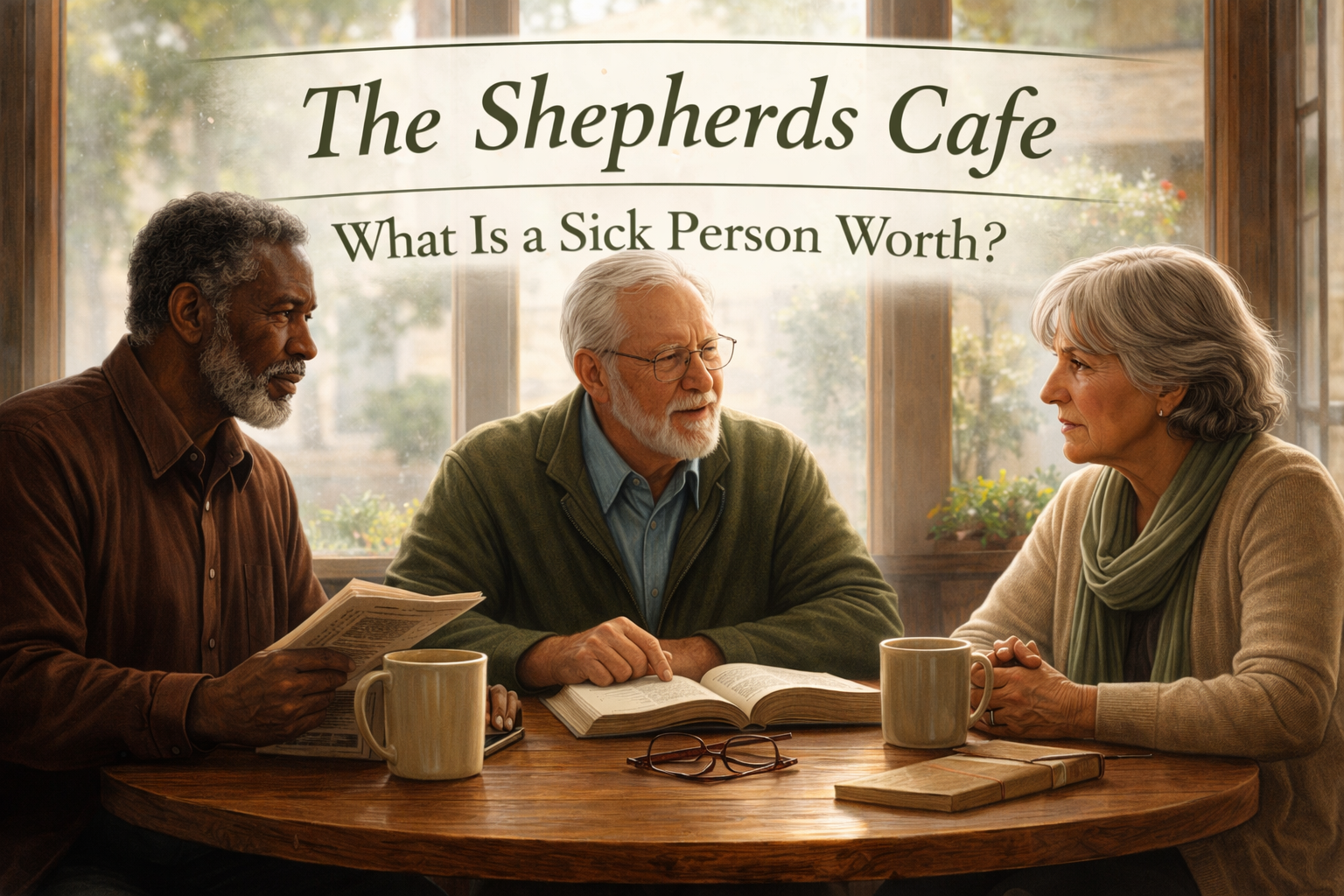
The lunch crowd had thinned out, leaving The Shepherds Cafe quieter than usual. Sunlight came through the front windows in long pale bars, catching the steam above Barbara’s tea. Elijah had a folded article beside his coffee. Jeremiah was already in Ecclesiastes, though one finger held his place in James.
Barbara noticed the article first. “That look on your face usually means the world has said something revealing again.”
Elijah gave a slight nod. “It has. A public figure was arguing that healthcare should not be treated like a luxury. Strip away the politics, and there is a serious moral question underneath it.”
Jeremiah looked up. “A question people usually avoid until sickness walks into their own house.”
Barbara sat down slowly. “Which question?”
Jeremiah answered without hesitation. “What is a sick person worth when they can no longer produce, impress, pay, or keep up?”
Barbara exhaled. “That is a hard question.”
“It is also an honest one,” Elijah said. “A culture can talk about compassion all day long. But watch what happens when someone becomes expensive, inconvenient, elderly, disabled, chronically ill, or emotionally draining. Then you find out what people really believe.”
Barbara wrapped both hands around her mug. “And too often the answer is ugly. People are praised while they are strong, useful, attractive, or independent. But once they become needy, many are treated like a burden.”
Jeremiah turned to James. “Scripture never allowed God’s people to think that way. James condemns favoritism. Jesus repeatedly moved toward the weak, the diseased, the grieving, and the unwanted. The Lord did not measure human value by market value.”
Elijah added, “That is one of the sharpest differences between biblical thinking and worldly thinking. The world often asks, ‘What can this person contribute?’ Scripture asks, ‘How should I love the person made in the image of God?’”
Barbara nodded. “And that touches more than hospitals. It affects how families treat aging parents, how congregations care for the shut-in, how people speak about the disabled, how patient we are with long recoveries, and whether we disappear when someone’s life gets complicated.”
Jeremiah smiled faintly. “Exactly. This is not merely a public-policy issue. It is a discipleship issue.”
A server passed their table carrying soup to an older man eating alone in the corner. For a moment the three of them watched in silence.
Then Elijah said, “The danger in prosperous societies is not only greed. It is selective compassion. We do not mind helping the wounded person who can recover quickly and thank us eloquently. But long-term need tests the heart.”
Barbara gave a quiet laugh without humor. “Anyone can be generous for an afternoon. It takes character to be faithful for months.”
Jeremiah pointed gently at the page in front of him. “Pure and undefiled religion is not measured by slogans. It is seen in visitation, mercy, holiness, and endurance. The gospel trains people to stay near suffering without running from it.”
Barbara looked down. “I think that is what unsettles people. Care is costly. It interrupts schedules. It drains energy. It demands tenderness when you would rather stay efficient.”
“And that,” Elijah said, “is why it exposes whether love is real.”
Jeremiah closed James and rested a hand on the Bible. “The church must never adopt the world’s scale of worth. A brother with dementia is not worth less. A widow with medical bills is not worth less. A child with profound needs is not worth less. A saint whose body is failing is not worth less. If anything, the obligation to love becomes more visible.”
Barbara’s eyes softened. “That is the kind of truth people need to hear before hardship arrives, not after.”
Elijah nodded. “Because once suffering enters the home, bad theology collapses fast. The idea that strong people matter more than weak people does not survive the bedside of someone you love.”
Jeremiah said, “And one day, unless the Lord returns first, each of us will stand on the side of need rather than the side of strength. We should live now by the mercy we hope to receive then.”
Barbara smiled at that, though it was a serious smile. “So the real question is not whether care costs something.”
“No,” Elijah said. “The real question is whether we still believe people bear God’s image when caring for them becomes difficult.”
Outside, cars moved steadily past the cafe windows. Inside, the old truth remained where it had always been: human dignity does not rise and fall with youth, health, income, or usefulness. And any society—or any church—that forgets that truth has already begun to lose something far more valuable than money.