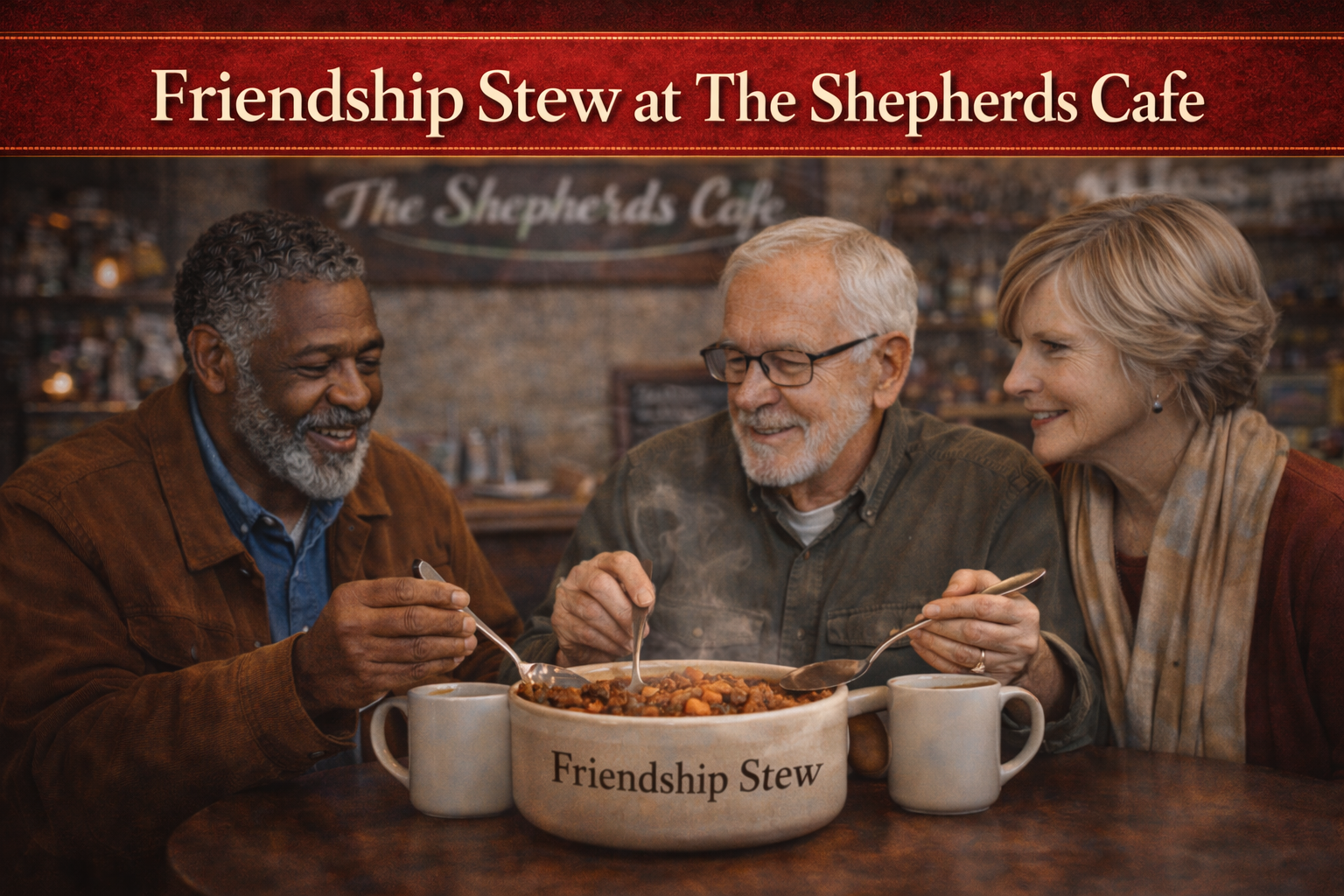
The front door of The Shepherds Cafe swung open with a familiar chime, and the warmth inside met the cold like a welcome. The lunch crowd had thinned into the quieter hours—when people talked slower, listened longer, and didn’t mind a little silence between sips.
Barbara was behind the counter, scarf neat, hands busy, eyes observant. Elijah sat near the wooden sign that read The Shepherds Cafe, glasses low on his nose, phone in hand. Jeremiah arrived and slid into the booth across from him like he’d been there all morning.
“You’ve got that look,” Jeremiah said. “The one that says you found something worth chewing on.”
Elijah turned his phone toward him. “BibleTalk.tv. A Monday Morning Devotional titled ‘Friendship Stew.’”
Barbara smiled faintly. “That already sounds like our kind of lesson.”
Elijah scrolled. “It’s built off an article about long-term friendships and the ‘ingredients’ that make them last. The devotional lists three big ones: hard times together, hospitality around food, and forgiveness.”
Jeremiah leaned back. “That’s not romantic. That’s real.”
A young man at the next table—hoodie, Bible open, earbuds dangling but unused—looked up. “Hard times make friendships?”
Jeremiah nodded. “Hard times reveal whether you had a friendship or just convenience.”
Elijah read the first heading aloud: “Going through hard times together—depressions, illness, death, wars, burdens—those are the cement.”
Barbara stopped wiping the counter for a second. “That’s true. You can have a lot of acquaintances. But the friend who stays when your life gets ugly—now you’ve found something rare.”
Jeremiah opened his Bible and didn’t rush the words: “Be devoted to one another in brotherly love… rejoicing in hope, persevering in tribulation… Rejoice with those who rejoice, and weep with those who weep.” (Romans 12:10–15)
He looked up. “That’s not optional Christian behavior. That’s the culture God wants in His people.”
Elijah tapped the screen again. “It also ties in: ‘Bear one another’s burdens, and thereby fulfill the law of Christ.’ (Galatians 6:2). Friendship isn’t a vibe. It’s shared weight.”
The young man nodded slowly. “So what’s the next ingredient?”
Elijah read it: “Sharing food and hospitality together. It points to Romans 12:13—‘practicing hospitality’—and says long-term friendships don’t happen in a vacuum. They happen when people actually spend time together, often around a table.”
Barbara gave a small laugh. “A cafe is basically a friendship factory… if people stop staring at their screens long enough.”
Jeremiah’s eyes softened. “Hospitality is spiritual. In Scripture, a shared meal isn’t just calories—it’s closeness. It’s why withdrawing table fellowship is one of the strongest relational boundaries the church can draw.” He nodded toward Elijah’s phone.
Elijah pointed to the line: it references how severing ties included “not even to eat” with someone in certain disciplinary contexts (1 Corinthians 5:11).
Barbara’s tone turned practical. “So if you want better friendships, you don’t start with speeches. You start with time. Invite somebody. Sit down. Share bread. Ask real questions.”
Jeremiah nodded. “Exactly. And that’s where most people lose it—because time is expensive.”
Elijah scrolled again. “Third ingredient: forgiving each other. It quotes Ephesians 4:32—‘Be kind… tender-hearted, forgiving each other, just as God in Christ also has forgiven you.’”
Jeremiah didn’t soften the edge. “Friendships don’t end because someone fails. They end because pride refuses forgiveness.”
The young man hesitated, then asked, “What if the offense was real? Like… what if it really hurt?”
Barbara answered before the men did, voice steady. “Then it takes real forgiveness. Not pretending it didn’t happen. Not letting it become your identity. Forgiveness is how you refuse to keep bleeding on people who didn’t cut you.”
Jeremiah nodded once, approving. “Forgiveness doesn’t deny the wound. It denies the wound the right to rule you.”
Elijah looked up from the phone. “The devotional says something striking: the friendship grows deeper every time forgiveness and reconciliation are practiced. And it connects that to Jesus as the ultimate friend—present in trouble, nourishing through Word and Spirit, drawing us closer through repeated forgiveness.”
Jeremiah’s face settled into something reverent. “That’s the heart of it. Jesus isn’t just a Savior who signs papers. He’s a Friend who stays.”
Barbara glanced around the cafe—the lone patron at the window, the couple sharing headphones, the tired man stirring sugar like he was thinking about old names. “Most people want fellowship,” she said. “They just don’t know what it costs. They want the result without the recipe.”
Jeremiah said, “And the recipe is exactly what we just read: shared burdens, shared tables, shared forgiveness.”
Elijah tucked his phone away. “It’s simple,” he said. “Not easy. Simple.”
Jeremiah closed his Bible gently. “If someone wants long-term friendships in the church, they’ll have to do what the early disciples did: show up, open their lives, and keep showing up—especially when it’s inconvenient.”
Barbara slid a fresh mug onto the counter, as if sealing the lesson with something warm. “Friendship stew,” she said. “Simmered, not microwaved.”
And for a moment, the cafe felt like more than coffee and conversation. It felt like a reminder that God didn’t design Christians to survive alone—and that real fellowship, like real faith, is made over time.