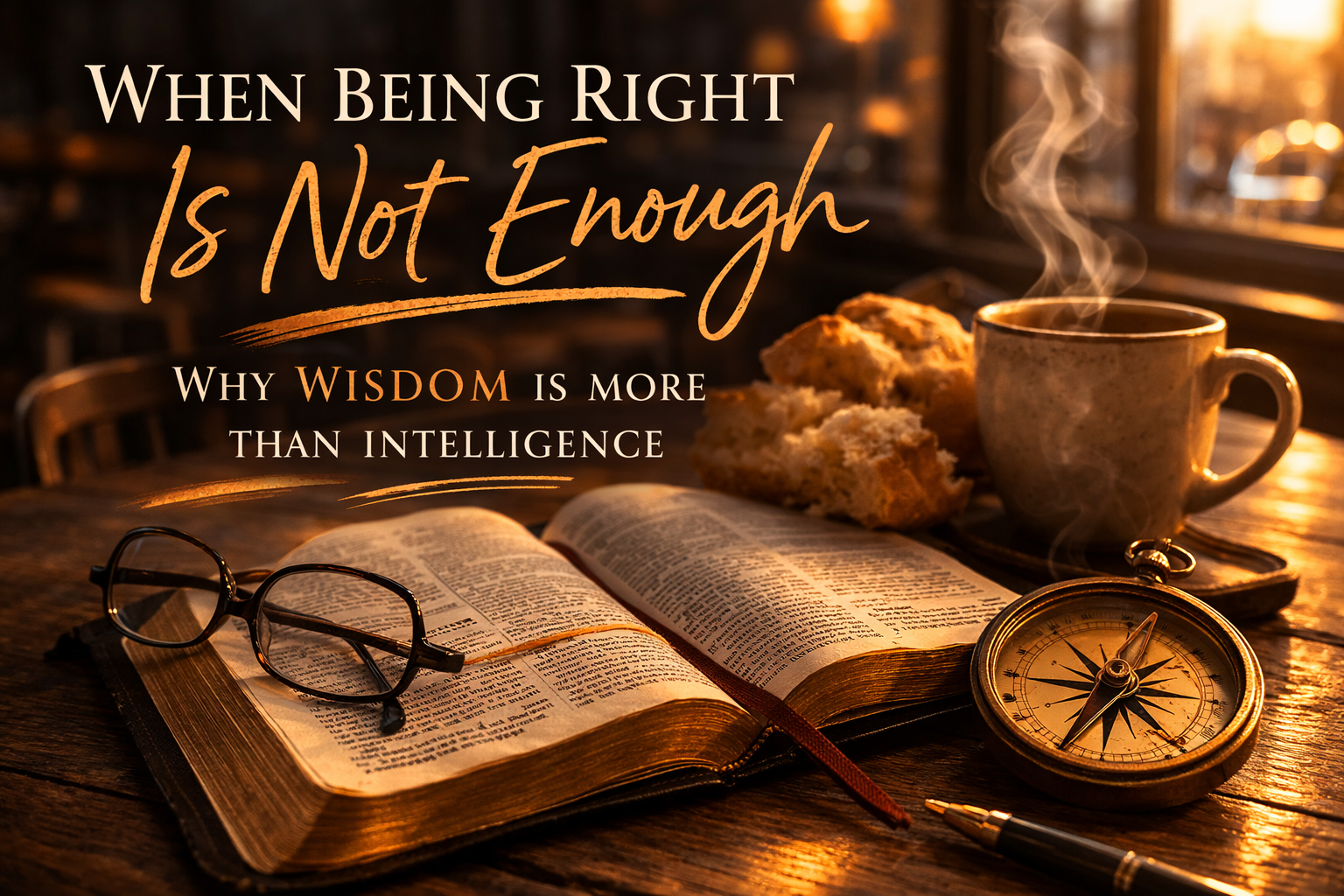
The morning crowd at The Shepherds Cafe had thinned enough for the room to settle into a calm rhythm of clinking cups and low conversation. Elijah sat near the front window with a Bible open beside his coffee. Jeremiah came in a few moments later, carrying that thoughtful look that usually meant his mind had already been working long before his feet reached the table.
Barbara followed close behind, scarf neatly in place, setting down her cup with a soft smile. “You two look like you’re either solving the world’s problems or making them worse.”
Jeremiah chuckled. “Today’s topic may do both.”
Elijah looked up. “I was thinking about how much people admire being smart.”
Barbara pulled out her chair. “That’s because smart gets noticed.”
“It does,” Elijah said. “Quick answers, sharp opinions, polished arguments, impressive credentials. People respect that. Sometimes they fear it. Sometimes they worship it.”
Jeremiah nodded. “And yet Scripture keeps forcing us to ask a harder question. What good is being smart if a man still does not know how to live?”
Barbara stirred her coffee slowly. “That’s the difference, isn’t it? Smart can help you solve a problem. Wisdom tells you whether the problem is worth solving in the first place.”
Elijah smiled. “Exactly. I’ve known people who could analyze anything, debate anything, and outthink nearly everyone in the room. But they still made a wreck of their homes, their relationships, and their souls.”
Jeremiah leaned back. “Ecclesiastes says something uncomfortable about that. Solomon had more insight than most men could dream of. He examined life from every angle. He had resources, experiences, opportunities, and intellect. Yet he came to see that knowledge by itself could not rescue life from emptiness. ‘Because in much wisdom there is much grief; and increasing knowledge results in increasing pain.’”
Barbara lifted an eyebrow. “That verse can confuse people.”
“It can,” Jeremiah said. “But I do not hear Solomon condemning wisdom itself. I hear him exposing the limits of human understanding when it is left to itself. The more clearly you see life ‘under the sun,’ the more clearly you see how broken it is. Knowledge can diagnose. It cannot redeem.”
Elijah tapped the open page with one finger. “That is one of the great failures of modern pride. We keep acting as though enough information will save us. Better systems, better data, better strategies, better theories. But the heart of man still resists God.”
Barbara nodded slowly. “Which is why some of the smartest people in the world can still be fools in the sight of God.”
Jeremiah gave a quiet laugh. “Paul said much the same thing in 1 Corinthians. The world, through its wisdom, did not come to know God. That alone should humble every generation. Human brilliance can split the atom, map the genome, build corporations, shape governments, and still fail to bow before the cross.”
The cafe door opened and shut as a few customers came through, but the three remained fixed on the discussion.
Elijah said, “What strikes me is that the cross never flatters human pride. It tells me I am not my own answer. That I cannot reason my way into righteousness. That my greatest need is not to be admired, but forgiven.”
Barbara smiled faintly. “That’s why the gospel offends people who want to look self-sufficient. It does not ask us to be impressive. It asks us to repent.”
Jeremiah turned toward her. “And that is where wisdom begins.”
Barbara looked at him knowingly. “Proverbs.”
He nodded. “‘The fear of the Lord is the beginning of wisdom.’ Not the admiration of men. Not high intellect. Not self-confidence. Not eloquence. The beginning is reverence before God.”
Elijah folded his hands. “Luke 12 proves the point too. The rich man in Jesus’ parable was no idiot. He was productive, strategic, forward-looking. He saw growth, made plans, built bigger barns. Every business book might call him successful.”
“But God called him a fool,” Barbara said.
“Yes,” Elijah replied. “Because he knew how to store grain, but not how to prepare for eternity. He knew accumulation, but not accountability. He could manage resources, but not his own soul.”
Jeremiah’s voice grew more sober. “That parable should frighten every capable person. It is possible to be disciplined, efficient, educated, and admired while being a spiritual disaster.”
A silence settled over the table for a moment.
Barbara finally spoke. “That may be one of the most dangerous traps for serious people. The more competent we are, the easier it becomes to trust competence. The more successful we are, the easier it becomes to mistake success for approval.”
Elijah looked out the window before answering. “And Solomon is the warning sign standing right in the middle of Scripture. A man gifted with extraordinary wisdom still drifted when his heart stopped fully belonging to God. That tells me knowledge does not keep a man faithful. Submission does.”
Jeremiah added, “Daniel gives the better example. He had knowledge, discipline, and discernment, but all of it stood under loyalty to God. He did not separate intelligence from holiness.”
Barbara smiled. “That is the kind of man or woman I want around me. Not just clever people. Faithful people. The kind whose judgment is governed by truth, whose mind is clean, whose words are measured, whose life has moral weight.”
Jeremiah opened his Bible and said, “James puts flesh on wisdom better than almost anywhere else. Wisdom from above is pure, peaceable, gentle, reasonable, full of mercy and good fruits.”
Elijah nodded. “That verse destroys the idea that wisdom is just being able to win arguments. Some people can slice through a room with their words and call it intelligence. James would ask whether their speech is pure. Gentle. Merciful. Productive.”
Barbara gave a firm nod. “A sharp tongue is not proof of wisdom. Sometimes it is proof of pride.”
Jeremiah smiled. “And being the loudest in the room is not the same as being the clearest. Nor is being informed the same as being transformed.”
Elijah’s expression softened. “That may be the real test. Has truth changed me? Has the fear of God shaped my decisions? Do I speak more carefully? Love more sincerely? Repent more quickly? Walk more humbly?”
Barbara looked at both men. “So perhaps the issue is not whether a Christian should be smart. Of course we should grow, learn, study, and think carefully. The issue is whether what we know has been surrendered to God.”
“That’s it,” Jeremiah said. “Scripture never glorifies ignorance. But neither does it worship intellect. It places knowledge under obedience.”
Elijah closed his Bible gently. “Ecclesiastes ends where it must. ‘Fear God and keep His commandments.’ After all the searching, all the observing, all the analysis, Solomon arrives there. Not because thought is useless, but because thought alone is not enough.”
Barbara smiled. “That sounds like the kind of conclusion modern people do not want.”
Jeremiah gave a small grin. “Then modern people need it all the more.”
A server passed by and topped off Elijah’s coffee. He thanked her, then looked back at the table.
“I suppose I’ve come to see it plainly,” he said. “Being smart may get a person noticed. It may open doors. It may win arguments. But wisdom is what keeps a man from wasting his life.”
Barbara leaned back. “And wisdom is what helps a woman build a home with patience instead of pride, counsel people without crushing them, and endure sorrow without losing perspective.”
Jeremiah added, “Wisdom prepares a soul for judgment. Smartness rarely thinks that far.”
The three sat quietly for a moment, not because the conversation had run out, but because it had landed where it needed to land.
At last Barbara spoke with a soft firmness. “Then perhaps that is the question worth asking. Not, ‘How can I appear more impressive?’ but ‘Am I becoming the kind of person who fears God and walks in His ways?’”
Elijah smiled. “That is the better question.”
Jeremiah lifted his cup. “And the better ambition.”
Outside, the morning carried on as usual. Cars passed. People hurried. Schedules pressed. Opinions multiplied. But inside The Shepherds Cafe, one truth stood quietly above the noise: a mind may be brilliant and still lost, but a heart that fears God has begun to be truly wise.