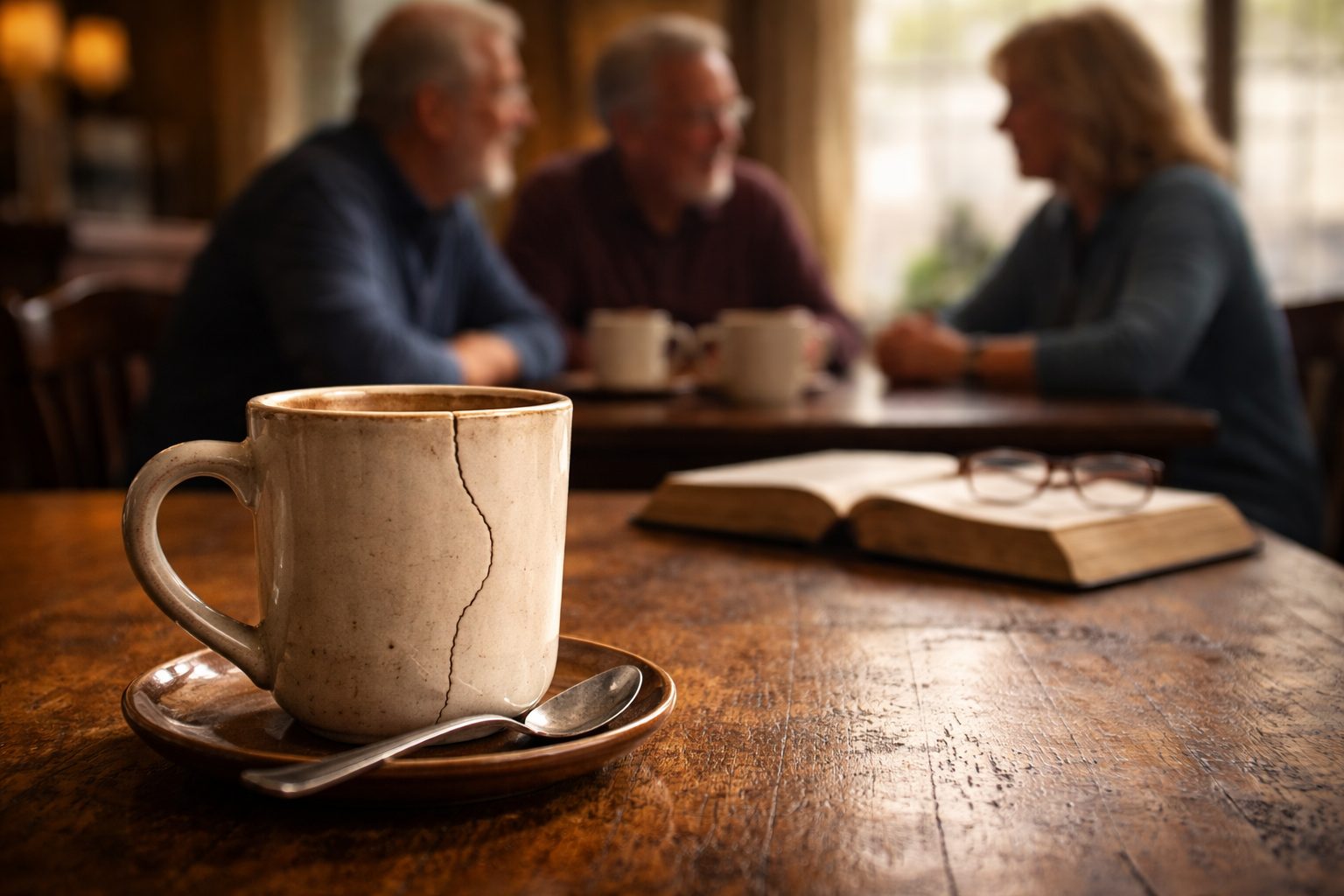
The afternoon crowd at The Shepherds Cafe had thinned enough for the room to breathe. Sunlight leaned through the front windows, and the quiet hum of dishes, soft music, and low conversation gave the place its usual calm. Elijah sat at the corner table with a Bible open beside his coffee. Jeremiah came in next and noticed Barbara already at the counter, studying two mugs the owner had set aside.
When the three of them settled down, Barbara placed one of the mugs in the center of the table.
It was simple, off-white, and plainly old. A thin crack ran from the rim halfway down the side.
Jeremiah looked at it and said, “That cup has seen better days.”
Barbara smiled. “So have most people.”
Elijah glanced at the mug. “Did they mean to throw it out?”
“The owner said he noticed the crack this morning,” Barbara replied. “He was about to get rid of it, but I asked to keep it for a little while.”
Jeremiah folded his arms. “I have a feeling that cup is about to become today’s lesson.”
Barbara looked at him over her glasses. “You are learning.”
She turned the mug slightly so the crack caught the light.
“A lot of people live this way,” she said. “They look whole enough from a distance, but when you get close, you can see the fracture.”
Jeremiah nodded slowly. “Disappointment. Grief. Sin. Regret. Betrayal. Shame. Sometimes years of it.”
“And sometimes,” Elijah added, “the crack is not caused by one dramatic event. Sometimes it comes from pressure over time.”
Barbara traced the line in the mug with one finger. “That may be the harder kind. A person keeps carrying burdens quietly. He still goes to work. Still shows up at worship. Still speaks politely. But inwardly, he is wearing thin.”
Jeremiah looked down into his coffee. “There are a lot of people like that.”
“There are,” Elijah said. “And many of them think their usefulness to God has ended because they know where the crack is.”
That settled over the table.
Barbara said, “The world often treats brokenness like disqualification. If there is damage, hide it. Replace it. Discard it. But Scripture tells a different story. God has always worked through cracked vessels.”
Jeremiah looked up. “Like who?”
“Moses,” Barbara said first. “A man with fears and hesitations. David, with deep moral failure and deep repentance. Peter, bold one moment and broken the next. Paul, who carried weakness he pleaded to have removed.”
Elijah nodded. “And 2 Corinthians 4 says, ‘We have this treasure in earthen vessels.’ Not polished steel. Earthen vessels. Frail, common, breakable. The power is from God, not from us.”
Jeremiah leaned back. “So the point is not pretending we are uncracked. The point is knowing what we carry.”
“Exactly,” Elijah said.
Barbara lifted the mug carefully. “A crack in a cup matters. But it matters even more what is in the cup. If Christ is in view, if faith is real, if repentance is active, if grace is at work, then weakness is not the end of the story.”
Jeremiah gave a faint smile. “That is good, because some people are experts at hiding cracks and strangers to healing.”
Barbara nodded. “Yes, and hiding is not healing. Covering pain is not the same as bringing it to God.”
For a moment, the three sat quietly. A server passed by, filled a nearby table, and moved on.
Elijah finally spoke. “There is another danger. Some people start identifying themselves by the crack. It becomes the main thing they know about themselves. Their wound becomes their name.”
Jeremiah said, “The divorced one. The failed one. The addict. The anxious one. The one who fell.”
Barbara answered softly, “But in Christ, the crack is real without being supreme.”
That line held.
Elijah closed his Bible gently. “The gospel does not deny damage. It answers it. Christ does not save flawless people. He saves sinners. He binds up the brokenhearted. He restores what pride, rebellion, sorrow, and this hard world have torn.”
Jeremiah looked again at the mug. “So what do we do with the cracks?”
Barbara smiled. “We stop hiding them from God. We stop using them as excuses. And we stop assuming cracked means useless.”
Elijah added, “Then we let the Lord shape humility, compassion, and endurance through them. Some of the gentlest Christians are people who know exactly where they have been broken.”
Jeremiah laughed quietly. “So maybe the cracked cup is not the wrong cup for the table after all.”
Barbara set it down carefully. “Not if it still reminds people of grace.”
The owner walked by and glanced at the mug. “You all done with my damaged merchandise?”
Elijah looked at him and said, “That depends. Are you throwing it away, or keeping it as a sermon illustration?”
The owner grinned. “For this crowd, I should probably keep it.”
Barbara lifted her coffee. “That would be wise.”
Outside, the light had softened, and inside The Shepherds Cafe, the cracked cup remained on the table a little longer.
Not because damage is beautiful in itself.
Not because pain should be romanticized.
But because sometimes the clearest proof of God’s grace is not a life with no fractures, but a life that still holds truth, mercy, and faith in the hands of Christ