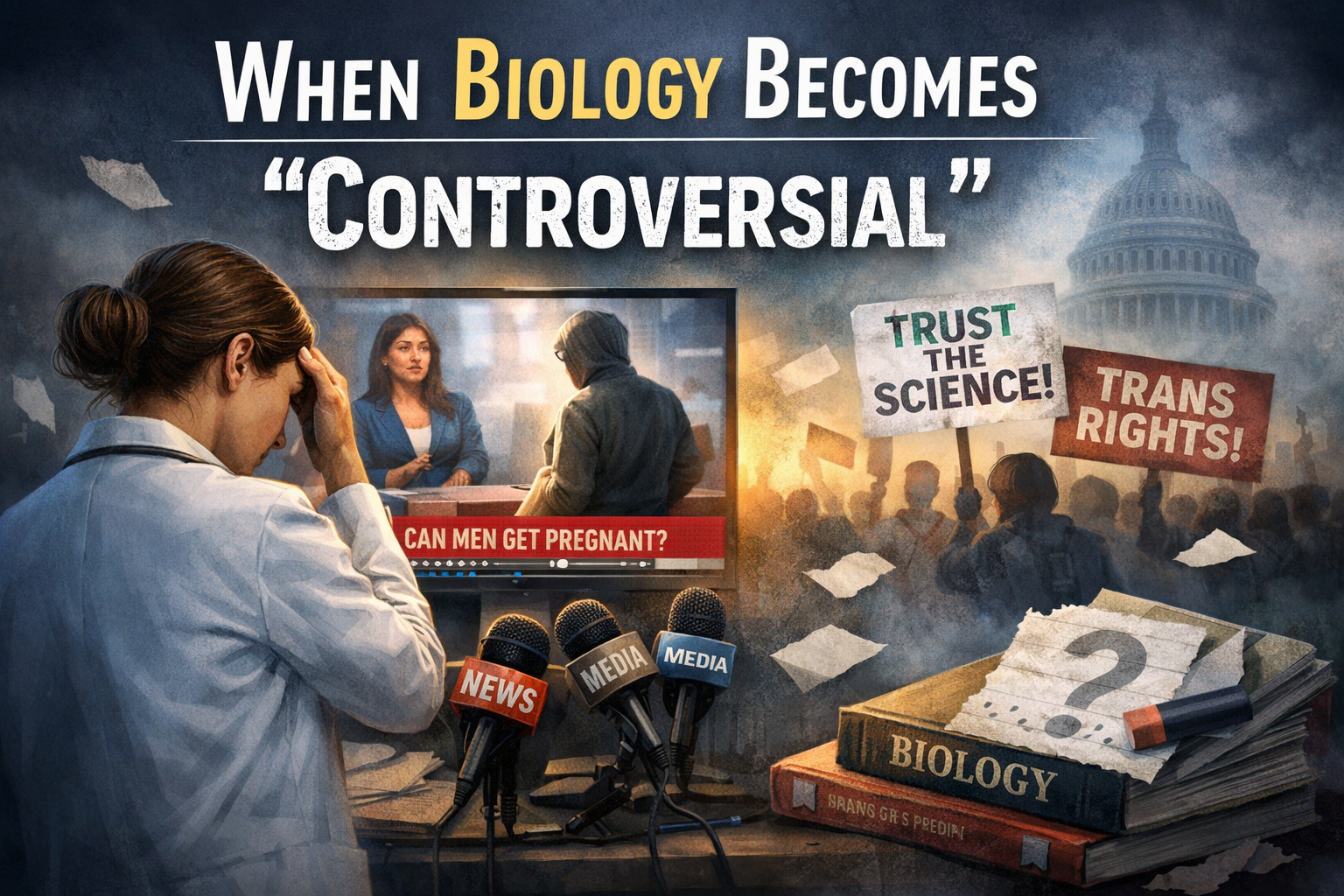
The first thing Dr. Lena Hart noticed wasn’t the camera.
It was the silence.
The studio lights were hot enough to make her collar itch, but the air felt cold—sterile, like a surgical suite right before the first cut. Across from her, a young anchor sat with a polished smile and a stack of cue cards that looked heavier than they should have. Behind the glass, a producer held up two fingers, then one, then pointed.
Live.
“Dr. Hart,” the anchor began, voice soft, careful, as if every syllable had to pass an inspection. “You’re an OB-GYN. You deliver babies. You treat pregnancy complications. You’ve testified in front of the state medical board. So I’m going to ask a straightforward question that’s become… controversial.”
A tiny pause. The anchor glanced down and back up.
“Can men get pregnant?”
Dr. Hart didn’t blink. She’d answered thousands of questions in her career—about cervical insufficiency, ectopic pregnancies, placenta previa, fetal distress. She’d answered questions in grief and questions in joy. She’d answered questions at 3:00 a.m. with blood on her shoes and adrenaline in her veins. She’d answered questions from terrified fathers, from teenagers who didn’t want to call their parents, from women whose faces were drained pale by the ultrasound’s truth.
But this question wasn’t medical.
It was social. It was legal. It was reputational. It was radioactive.
The studio was so quiet she could hear the buzzing of the light.
Dr. Hart’s mind ran a fast inventory—like a pilot scanning gauges during turbulence.
If she said, “No,” she could be clipped into a ten-second viral hit. People would call her courageous. People would call her hateful. A hospital administrator might summon her for a “values alignment conversation.” A colleague might stop making eye contact. Her email would become a battleground. The board might “review her professionalism.”
If she said, “Yes,” she would be lying. Not a “different perspective.” Not “a nuanced truth.” A lie. A lie dressed in a white coat.
If she tried to split the difference—biology versus identity—she’d be accused by both sides of cowardice. And cowardice is the one sin the internet never forgives.
She swallowed. “Pregnancy is complex,” she began.
The anchor nodded too quickly, like someone grabbing a handhold. “Of course.”
Dr. Hart continued, “We have to consider the patient in front of us. We want to use language that makes people feel safe. Medical care should be compassionate.”
The anchor leaned in, then asked again, gently but firmly, as if reading a script that had to be completed to unlock the next segment.
“Doctor, with respect—can men get pregnant?”
Dr. Hart stared at the anchor’s pen. She could feel her heartbeat in her fingertips.
“I’m not here to get pulled into political talking points,” she said. “I’m here to help patients.”
The anchor’s smile thinned. “Understood. But you’re a physician. This is a factual question.”
Dr. Hart forced a small, professional laugh that sounded foreign in her own ears. “I think what we’re seeing is that definitions are evolving.”
There it was. The escape hatch.
The producer behind the glass exhaled, shoulders dropping in relief. The anchor nodded as if they’d completed a safe landing. The segment moved on.
And somewhere in America, a million people watched a doctor—an OB-GYN—decline to say what every biology textbook had said for generations.
Two days later, the consequences began arriving like mail you can’t stop.
At the clinic, the front desk staff had printed out social media posts and taped them to the break-room wall. Half were praise. Half were venom. Some contained threats. One had a photo of her kids walking into school—pulled from a parent’s Facebook page, “just to prove we know who you are.”
A pregnant patient who had followed Dr. Hart for years—three miscarriages, finally a heartbeat—sat stiffly on the exam table and didn’t joke the way she used to.
“I saw you on TV,” the woman said, eyes narrowed. “Are you… are you going to tell me the truth in here?”
Dr. Hart felt heat climb up her neck. “Of course I will.”
The woman’s voice trembled. “Because it didn’t sound like it.”
That night, Dr. Hart sat in her kitchen after the house was quiet. She opened her laptop and watched the clip again. It was worse the second time. Not because of the outrage. Because of the emptiness.
She hadn’t protected compassion.
She’d protected herself.
Her phone buzzed with a text from a colleague: Admin wants to meet tomorrow. “Just to check in.”
Another buzz: a friend from residency. You okay?
Another: her mother. Honey, why didn’t you just answer the question?
Dr. Hart stared at the screen until the letters blurred. In her mind, she heard the voice of her old anatomy professor—stern, relentless: If you can’t name the thing, you can’t treat the thing.
She finally closed the laptop, rested her elbows on the table, and whispered to nobody, “What have we done?”
The next morning, the “check-in” meeting wasn’t really a check-in.
The administrator was kind. That made it worse. Kindness can be a velvet glove over a steel rule.
“We support you,” he said. “We really do. But you have to understand, Lena—this is a sensitive climate. We have to protect the organization. We have to protect patient trust.”
Dr. Hart almost laughed. Patient trust. As if trust could be maintained by refusing to speak plainly.
He slid a document across the table. “We’d like you to take a brief training on inclusive language and media engagement.”
“Media engagement,” Dr. Hart repeated.
“Yes. And we’d like you to sign the updated professional conduct statement.”
She skimmed it. The words were polished. The meaning was blunt: Do not contradict approved language in public.
For a moment she imagined signing it and going back to work and pretending the world made sense. She imagined continuing to deliver babies and ignoring the fact that the culture was asking her to deny the basic categories her entire field depends on.
Then she imagined ten years from now.
She imagined a generation trained to treat reality like clay—molded by feelings, stamped by institutions, and defended with penalties.
And she imagined medicine becoming less about truth and more about compliance.
Dr. Hart slid the paper back. “I can’t sign this.”
The administrator’s eyes widened, just enough to reveal the real stakes. “Lena, please don’t make this harder than it needs to be.”
“It’s already hard,” she said quietly. “Because you’re asking me to become a liar.”
He leaned back. “No. We’re asking you to be respectful.”
She met his gaze. “Respect isn’t the same as surrendering language. And compassion isn’t the same as pretending.”
The room held its breath.
That week, Dr. Hart started noticing something she hadn’t wanted to see before: this wasn’t just about one doctor and one question.
It was about what happens when a nation loses the courage to name obvious things.
Short-term consequences (the kind you feel immediately)
Confusion spreads fast. If professionals won’t define basic terms, ordinary people stop trusting them. Patients start wondering what else is being softened, hidden, or politicized.
Institutions become brittle. When reality is negotiable, policies multiply. HR documents swell. Training sessions expand. Fear becomes the invisible manager in every room.
Speech becomes strategic instead of sincere. People stop saying what they believe and start saying what keeps them safe. That doesn’t produce unity; it produces resentment and quiet rebellion.
The vulnerable get used as shields. When debate turns into a moral performance, real people—especially those struggling with identity, mental health, or trauma—become props in someone else’s argument.
Long-term consequences (the kind that shape a civilization)
Science loses its authority because it abandons its backbone. If biology becomes a matter of “evolving definitions,” then medicine becomes less reliable—because reliable care requires stable categories.
Law becomes arbitrary. When words don’t have fixed meaning, the strongest institution sets the meaning, and dissent becomes punishable. That’s not freedom; that’s soft coercion with polite signage.
Children inherit a fog instead of a map. If adults won’t say what is real, kids learn that truth is a popularity contest. That breeds anxiety, identity confusion, and a constant hunger for validation.
A culture that can’t speak truth can’t repent. Repentance requires reality: naming what is. If you can’t say “this is true,” you eventually can’t say “this is wrong.” And when wrong can’t be named, it can’t be corrected.
That last thought haunted her most.
Because she knew—deep down—this wasn’t merely a modern argument. It was an ancient temptation: to trade truth for comfort, clarity for applause, conviction for safety.
Scripture had names for that trade.
“Woe to those who call evil good, and good evil; who substitute darkness for light and light for darkness.” (Isaiah 5:20)
“They exchanged the truth of God for a lie.” (Romans 1:25)
And then the balancing command, the one people either weaponize or ignore:
“Speaking the truth in love.” (Ephesians 4:15)
Truth without love becomes cruelty. Love without truth becomes deception. A society trying to survive on deception is not in a dream—it’s in a slow-motion nightmare.
On Friday, Dr. Hart did something she hadn’t done in years: she wrote.
Not a press release. Not a defensive statement. A simple letter to her patients, posted quietly on the clinic’s website and printed at the front desk.
She didn’t rant. She didn’t insult. She didn’t call anyone names.
She just told the truth.
She wrote that pregnancy is the biological function of the female reproductive system. She wrote that every patient—without exception—will be treated with dignity. She wrote that compassion means you don’t mock people, and it also means you don’t mislead them. She wrote that clear language is a form of care, not an act of hatred.
And at the bottom she wrote a sentence that felt like stepping out of a fog into clean air:
“Reality is not an enemy. It is the ground we stand on together.”
By Monday, the clinic’s leadership asked her to remove the letter.
She refused.
Two weeks later, she resigned.
A month later, a smaller practice hired her—one that cared more about competence than compliance. It wasn’t glamorous. It didn’t come with awards. It came with peace.
And one afternoon, a young nurse—new to the field, eyes bright with idealism—asked her in the hallway, “Dr. Hart… why did you risk so much just to say something everyone already knows?”
Dr. Hart paused, then answered with the simplest line she could manage:
“Because when everyone already knows it, but nobody will say it, that’s when the collapse has already started.”
She softened her voice.
“And because truth—handled with kindness—is still one of the most merciful things you can give a frightened world.”
If you want, I can write a second version that’s sharper and more satirical (still without cruelty), or one that’s more pastoral—set in a church counseling setting—showing how Christians can respond without losing either courage or compassion.