One of the dangers I believe the church must confront is the way worship expectations have been quietly reshaped by entertainment culture. I do not mean that Christians have necessarily stopped believing in God or openly rejected the authority of Scripture. In many cases, the shift is more subtle than that. We have simply lived so long in a world of constant stimulation that many of us have started expecting worship to function the same way everything else in modern life functions. We are surrounded by scrolling, streaming, swiping, flashing images, short clips, emotional hooks, polished presentations, and endless novelty. That environment trains the mind and heart. The problem is that it does not stop at the sanctuary door. It comes in with us.
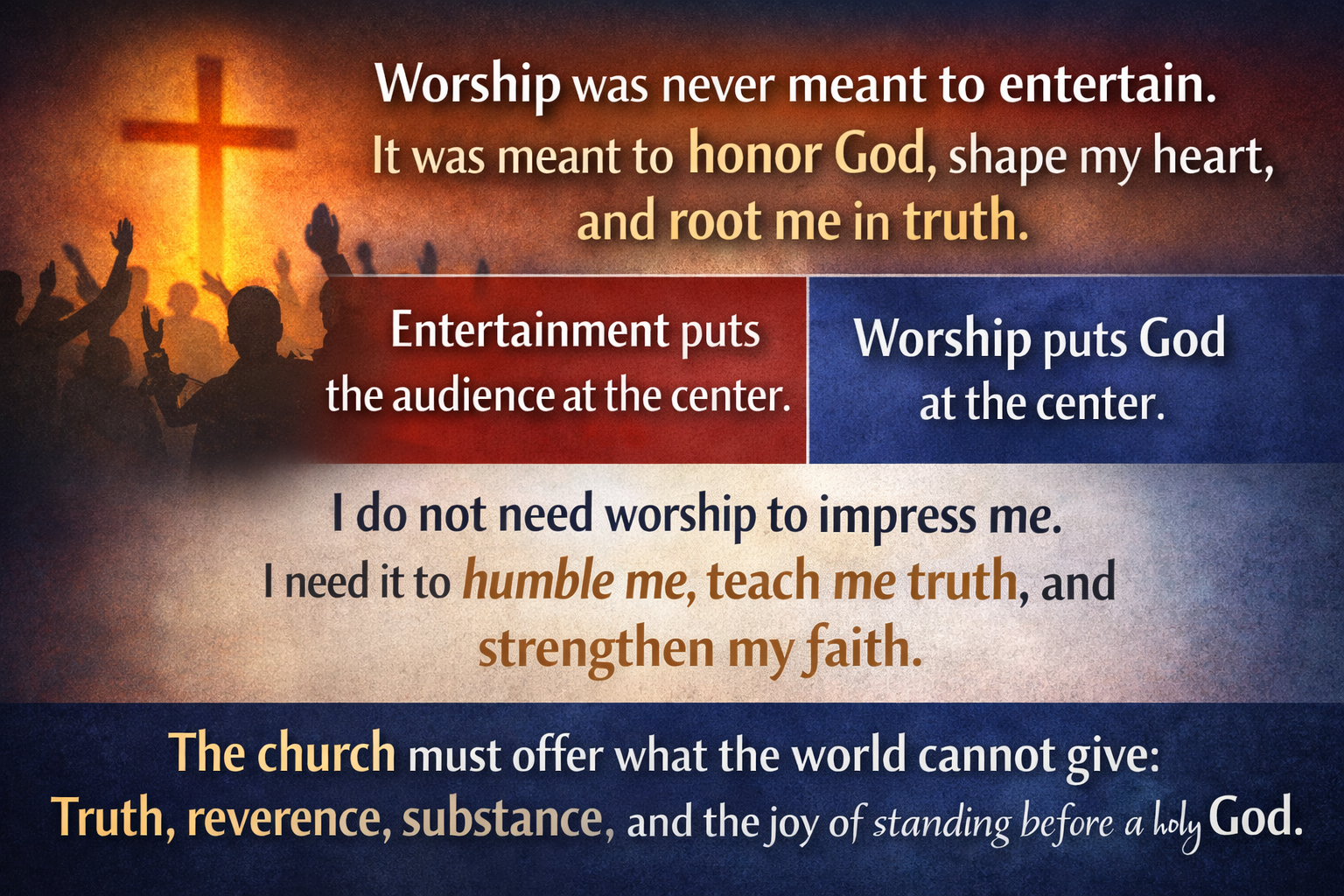
I have become more convinced that many Christians now assess worship with assumptions they may not even realize they have absorbed. People often ask themselves questions like, Was it engaging enough? Did it move me? Was it dynamic? Was it polished? Did it keep my attention? I understand why those questions come naturally in our time, but I do not believe they are the right questions to begin with. Worship was never designed to entertain me. It was never meant to compete with the world’s media, concerts, productions, or digital experiences. Worship is meant to honor God, shape my heart, and root me in truth.
When I come to Scripture, I find a very different framework. Jesus said that “true worshipers will worship the Father in spirit and truth” (John 4:23, NASB). That passage helps anchor me. Worship is not defined by emotional intensity, creative polish, or atmosphere. It is defined by sincerity and truth. Paul says that in the assembly all things are to be done “for edification” (1 Corinthians 14:26, NASB). That means the purpose is spiritual strengthening, not spectacle. Hebrews 12:28 tells me that I am to offer “acceptable service with reverence and awe” (NASB). Reverence and awe are not optional features of worship. They belong at the center of it.
That is why I believe the church must resist a consumer approach to worship. Entertainment asks what I got out of the experience. Worship asks whether God was honored according to His will. Entertainment trains me to expect constant intensity. Worship teaches me submission, patience, and attentiveness. Entertainment puts the audience at the center. Worship puts God at the center. Those two ways of thinking are not merely different preferences. They come from fundamentally different worldviews.
The biblical worldview starts with God, not man. God is holy whether I feel emotionally stirred or not. God is worthy whether the atmosphere feels powerful or not. Worship is my response to who He is. Romans 12:1 reminds me to present my body as “a living and holy sacrifice” to God, which is my spiritual service of worship (NASB). That verse does not sound like consumption. It sounds like surrender. It sounds like sacrifice. It sounds like a life being laid before God. That is why I cannot reduce worship to what feels impressive in the moment.
The cultural context around us helps explain why this issue matters so much. We live in a time when church attendance is weak compared to earlier generations, and convenience increasingly shapes religious habits. More people are accustomed to observing spiritual things from a distance, on demand, and on their own terms. At the same time, many Christians are being formed far more by media habits than by disciplined devotion. That combination creates real spiritual risk. If convenience, preference, and emotional payoff become the standards by which I judge worship, then I am already moving away from a biblical understanding of it.
I think this explains why simple biblical acts of worship can begin to feel unimpressive to modern people. Scripture reading can seem too plain. Prayer can feel too slow. Congregational singing can feel too ordinary. The Lord’s Supper can feel too quiet. Preaching can be judged more by style than by substance. I have seen how easy it is for people to call something “powerful” simply because it created a strong emotional response, even when very little biblical truth was actually driving it. That concerns me deeply.
I do not say that because I want worship to be cold, lifeless, or careless. I am not arguing that worship should be dull. I am saying something more important than that. I am saying that worship must never be governed by the values of entertainment. I do not need worship to impress me. I need it to humble me. I need it to teach me truth. I need it to expose sin, strengthen faith, and direct my attention to the holiness of God. Real worship often works in deeper ways than excitement does. It steadies me. It convicts me. It forms patience in me. It teaches me to value substance over sensation.
For that reason, I believe I need to ask better questions when worship is over. Instead of asking, Did I enjoy that, I need to ask, Was God honored? Was truth taught clearly? Did this help form reverence in me? Did it encourage obedience? Did it direct attention to Christ? Did it build up the saints? Those are far better questions because they are rooted in Scripture rather than in consumer instinct.
If the church does not confront entertainment-shaped expectations, I believe we will continue producing people who are easily impressed but not deeply formed. They will crave atmosphere more than truth, excitement more than obedience, and emotional moments more than spiritual maturity. That is not strength. That is shallowness with religious language attached to it. The church does not need to outdo the world at performance. It never will. What the church must offer is something the world cannot give me: truth, reverence, substance, and the sobering joy of standing before a holy God.