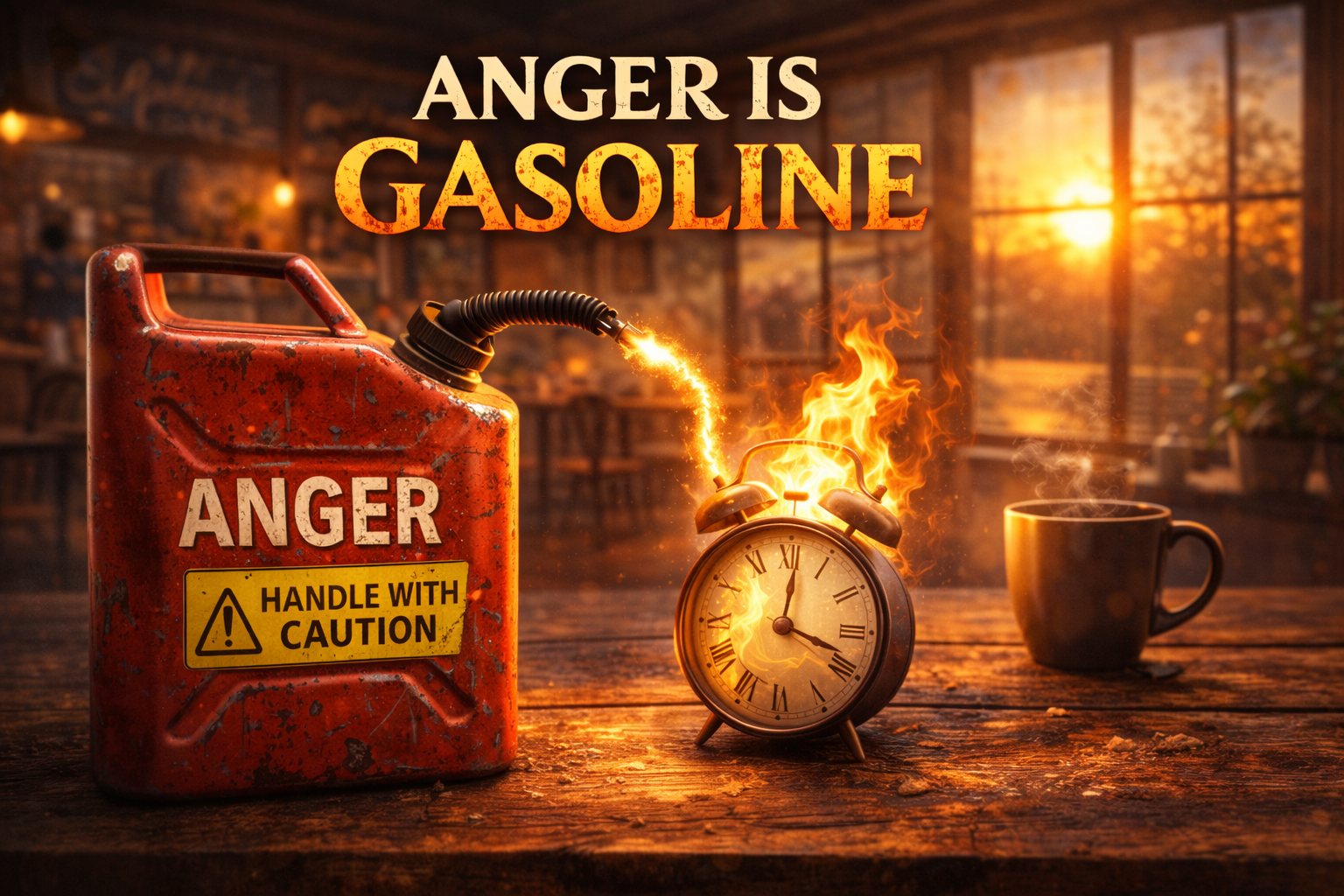
The late-day light at The Shepherds Cafe was the kind that made everything feel exposed—like dust in the air had nowhere to hide. The rush had passed. What remained were a few quiet tables, a soft hum of conversation, and one man by the window whose jaw stayed tight even when he wasn’t speaking.
Barbara noticed him first. She always did.
Elijah sat beneath the café’s wooden sign, glasses low, phone in hand. Jeremiah slid into the booth across from him, Bible already open. Elijah didn’t ease into it.
“I found another La Vista piece on anger,” he said, turning the screen. “Short. Sharp. It’s called ‘Handle with Caution.’”
Jeremiah read the first line and gave a slow nod. “That’s a warning label, not a title.”
Barbara set two coffees down and listened. “If anger had a smell,” she said, “it would be gasoline—one spark and the whole room changes.”
Elijah pointed to the article. “That’s exactly the image it uses: anger like gasoline—volatile, explosive, dangerous. And it says we’re watching a ‘volcano of rage’ in the world right now.”
Jeremiah’s eyes shifted toward the man by the window. “And plenty of that volcano lives inside good people who don’t know what to do with it.”
The man didn’t look up, but he heard every word.
Elijah read on. “The author says Scripture gives at least two guidelines for managing anger.”
Jeremiah said, “Let me guess: slow to ignite, quick to extinguish.”
Elijah smiled once. “Exactly. First guideline: be slow to anger, because the anger of man does not achieve the righteousness of God.”
Barbara murmured, “That verse should be taped to every steering wheel.”
Elijah continued. “Second guideline: be angry, and yet do not sin—and don’t let the sun go down on your anger, and don’t give the devil an opportunity.”
Jeremiah leaned back. “So: long fuse, short shelf-life.”
Barbara nodded. “Most people do the opposite. Short fuse, long memory.”
The man by the window finally spoke, voice low. “I can be slow to anger at work. I can hold it together. But when I get home… it comes out.”
Jeremiah didn’t flinch. “Then you’re not lacking anger control. You’re lacking anger closure.”
Elijah pointed at the screen again. “That’s the line in the article: James teaches a long fuse. Paul teaches extinguishing anger by day’s end. In other words—slow to anger, but quick to end it.”
Barbara turned her towel in her hands. “That’s hard because ending anger usually requires something people avoid—humility.”
Jeremiah nodded. “And action. Apology. Conversation. Forgiveness. Or at least prayer that refuses to rehearse the offense.”
The man stared at his mug. “So what if I’m angry for a legitimate reason?”
Elijah answered carefully. “The article acknowledges anger can be appropriate—Jesus Himself showed righteous anger—yet it warns how easily it slides into sin.”
Jeremiah added, “Righteous anger moves you toward what is right—truth, correction, protection. Sinful anger moves you toward payback and pride.”
Barbara said it the way only Barbara could—simple and unescapable: “Anger can be a dashboard light. But you don’t drive by the dashboard.”
The man exhaled, like his shoulders had been waiting all day to drop. “So what do I do tonight?”
Jeremiah leaned forward. “You apply the brakes—before the crash.”
And he laid it out like a plan a man could actually execute:
Slow the ignition: when you feel the heat rise, stop talking for ten seconds. That alone saves marriages. End it before bed: if you need to make something right, do it while you still can. If you can’t fix it tonight, pray and choose not to replay it. Don’t host it: unresolved anger isn’t just emotional—it’s spiritual risk. Paul says it gives the devil room.
Barbara nodded toward the man. “Go home and be the first one to soften. That’s strength.”
Elijah locked his phone and slid it aside. “Putting safety barriers around anger,” he said, “isn’t weakness. It’s wisdom. The article calls anger one of the most dangerous emotions known to man—so treat it like something hazardous.”
The man stood slowly, as if he didn’t want to spill anything—coffee, pride, or regret. “I’m going to try,” he said.
Jeremiah nodded. “Don’t try. Decide. Slow to anger. Quick to end it.”
And for the first time since he walked in, the man’s jaw unclenched—like someone had finally shown him where the exit was.