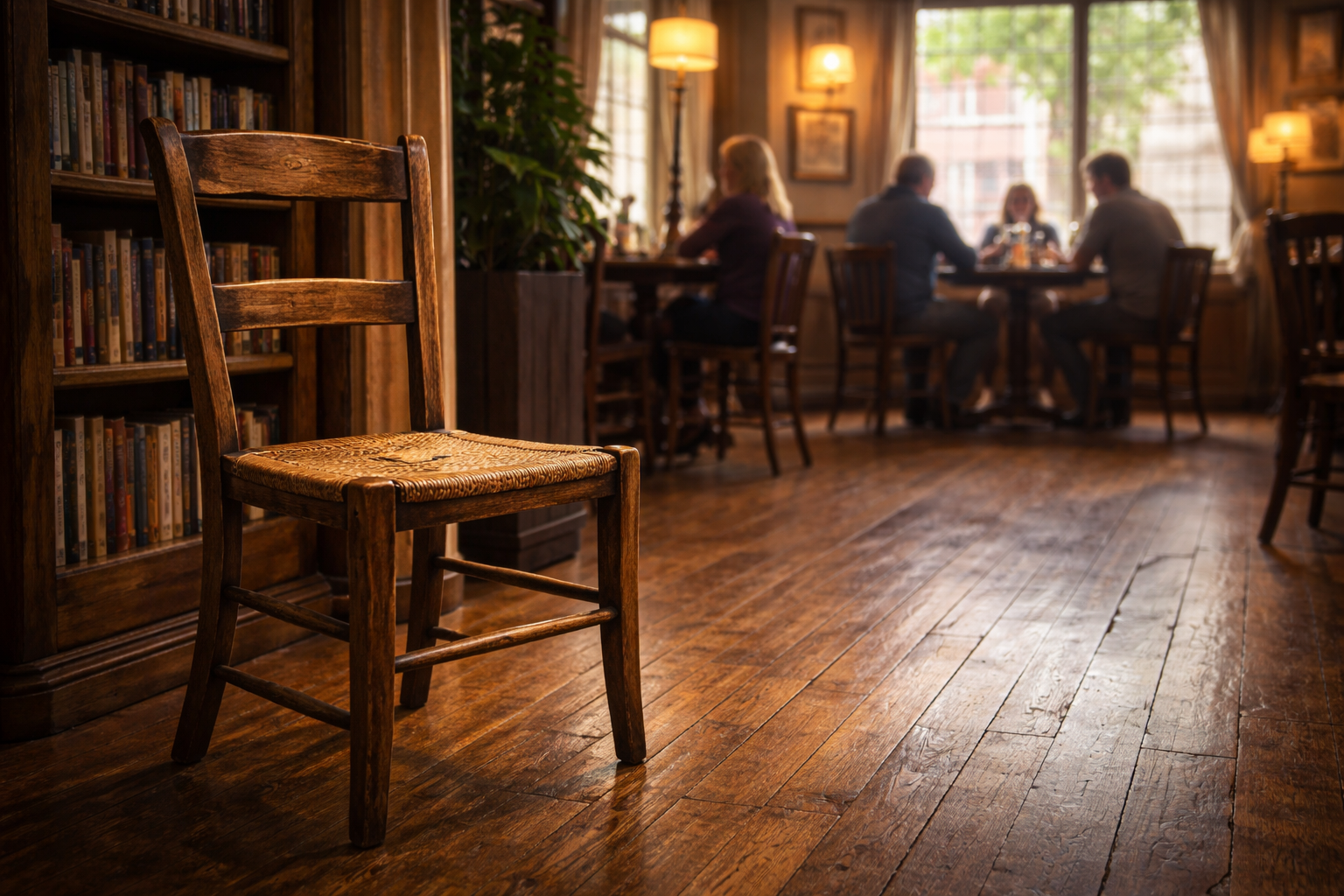
The lunch hour had not quite started at The Shepherds Cafe, but the room was already filling with the slow, familiar rhythm of the day. Cups clinked. A few quiet conversations rose and fell. Sunlight came through the front windows in long stripes across the floor, and for once there was no storm outside, no rattling glass, no threatening sky. Everything looked calm.
But calm is not always the same as peace.
Elijah had arrived first, as usual, and had taken his place near the back corner. Jeremiah came in a few minutes later and stopped halfway to the table.
“Well,” he said, narrowing his eyes a little, “that chair is still there.”
Barbara, just behind him, followed his gaze. Near the wall by the bookshelf sat an old wooden chair with a split cane seat and one slightly crooked leg. It had been there for weeks. Not broken enough to throw away, but awkward enough that nobody wanted it. Customers kept shifting around it. Staff kept working around it. Every few days someone would mention that it ought to be moved, repaired, or replaced. Yet there it remained, quietly in the way.
Barbara smiled as she took off her scarf. “That chair has become a sermon.”
Jeremiah pulled out his seat. “It has become an irritation.”
Elijah glanced toward it and said, “Usually those are not far apart.”
Jeremiah chuckled. “You know what I mean. Everybody sees it. Nobody deals with it. They just keep adjusting themselves around it.”
Barbara sat down and looked again at the old chair. “That sounds familiar.”
Elijah folded his hands. “Because it happens in families, friendships, and congregations all the time.”
Jeremiah leaned back. “One bad habit. One unresolved wound. One growing resentment. One awkward truth nobody wants to address. It sits there in plain sight, and instead of dealing with it directly, people just keep learning how to move around it.”
Barbara nodded slowly. “And the longer it sits, the more normal it starts to feel.”
That landed heavily.
The chair by the wall had become so common that most people no longer noticed it first. They noticed the inconvenience it caused. They noticed how it narrowed the walkway, how it forced a server to take an extra step, how it made the corner feel cramped. But the chair itself had almost disappeared into the background.
Elijah said, “That is the danger of tolerated disorder. What should have been corrected early becomes accepted through repetition.”
Jeremiah looked down at the table. “That happens in the heart too. A person knows he is carrying envy, pride, bitterness, lust, selfish ambition, or dishonesty. At first it troubles him. Then, if he refuses to repent, he starts building his life around it. He rearranges his thoughts to protect it. He makes excuses for it. He avoids conversations that might expose it. Before long, he is no longer fighting the sin. He is accommodating it.”
Barbara’s expression grew more serious. “And then people wonder why relationships feel strained and service feels cold. They wonder why joy has thinned out. They wonder why worship feels formal but not alive. Sometimes the answer is not complicated. There is a chair in the room that nobody wants to move.”
A young man working on a laptop at the next table glanced up briefly, then back down, though it was clear he was listening.
Elijah spoke carefully. “Scripture does not call us to manage sin. It calls us to put it away. Ephesians 4 does not say to leave bitterness in the corner and work around it. It says, ‘Let all bitterness and wrath and anger and clamor and slander be put away from you, along with all malice.’ That is decisive language.”
Jeremiah nodded. “The problem is that decisive obedience feels costly.”
Barbara answered, “It is costly. Honest repentance usually is.”
She stirred her coffee, though she had not put anything in it.
“It costs pride,” she continued. “It costs self-justification. It costs the right to keep telling your favorite version of the story. It may cost an apology. It may cost a hard conversation. It may cost admitting you have been wrong for a long time.”
Elijah added, “And that is why neglected problems remain in place. People would rather keep stepping around them than humble themselves enough to remove them.”
Jeremiah pointed lightly toward the old chair. “That thing is not only in the way. It is shaping movement in the room. Everybody near it has to adjust.”
“Elaborate,” Elijah said.
Jeremiah did. “A neglected sin or unresolved conflict never stays isolated. It affects the people around it. One man’s arrogance changes the tone of a family. One woman’s bitterness can chill a friendship. One stubborn refusal to reconcile can create tension across an entire congregation. Even when others are not the cause, they still feel the effects.”
Barbara nodded. “Exactly. Hebrews warns about a root of bitterness springing up and defiling many. Not just one. Many.”
For a moment, nobody spoke.
The server passed by with a tray of drinks, adjusted her path to avoid the chair, and kept going.
Barbara watched her and said quietly, “There it is again. Everybody adapting to something that should have been dealt with.”
Elijah looked toward the window, then back to the table. “There is another side to this. Some people do not move the chair because they have convinced themselves the issue is too small to matter.”
Jeremiah gave a dry laugh. “Until somebody trips over it.”
“Correct,” Elijah said. “Small tolerated disorders often create larger consequences later. Song of Solomon speaks of the little foxes that ruin the vineyards. Not every danger arrives loudly. Some losses come through quiet neglect.”
Barbara leaned forward. “That is a needed point. We tend to think only dramatic sins deserve urgent action. But marriages are often weakened by small patterns left alone. Congregations are often strained by little offenses nursed in private. Spiritual life is often dulled not by one public collapse, but by a hundred tolerated compromises.”
Jeremiah stared at the chair and said, “So what do you do when you realize you have one of those chairs in your life?”
Elijah answered immediately. “You stop defending it.”
Barbara smiled. “That is step one.”
Elijah continued, “You call the thing what God calls it. Not a quirk if it is sin. Not a personality trait if it is fleshly behavior. Not discernment if it is harshness. Not caution if it is unbelief. Not strength if it is pride.”
Jeremiah said, “That is where repentance starts—when the excuses stop.”
“And then,” Barbara added, “you do the hard work of moving it. Confession. Prayer. Counsel if needed. Reconciliation if possible. Concrete change, not vague regret.”
The young man at the next table stopped typing completely now.
Jeremiah folded his arms. “A lot of people prefer feeling bad over changing. Feeling bad can be emotional relief. Change is actual obedience.”
Barbara pointed at him with a half-smile. “That is exactly right.”
Elijah allowed the silence to do some work before he spoke again.
“There is also this,” he said. “When we finally deal with what has been neglected, the room often feels larger than we expected. Clearer. Lighter. Not because life becomes perfect, but because hidden resistance is gone.”
Barbara’s eyes softened. “That is one of God’s kindnesses. Obedience makes room for peace.”
Jeremiah looked around the café. “You know, somebody could get up right now and move that chair.”
Barbara glanced at him. “Yes. Somebody could.”
He raised an eyebrow. “You are looking at me like I should be that somebody.”
“I am not looking at you,” Barbara said. “I am looking through you, which is worse.”
Elijah almost smiled.
Jeremiah stood up with a groan dramatic enough to make Barbara laugh. He walked over to the old chair, picked it up, tested its wobbling leg, and carried it toward the back where the owner kept a small repair area.
The room changed immediately.
The corner looked wider. The path looked cleaner. Nothing magical had happened. No music swelled. No spotlight appeared from heaven. It was just a chair. But its removal made the room feel more ordered.
Jeremiah returned to the table and sat down. “Well. That was less difficult than all our talking about it.”
Barbara smiled warmly. “That is often true of obedience. Delay makes it feel heavier than it is.”
Elijah nodded. “And once neglected things are addressed, people usually wonder why they waited so long.”
The young man at the next table looked over and said, almost to himself, “That will preach.”
Jeremiah turned slightly and answered, “Only if we do more than admire it.”
The young man gave a quiet grin and looked back down, though not at his laptop this time.
Barbara lifted her cup. “So what is today’s lesson?”
Elijah answered in the steady tone that made everything sound both plain and weighty. “Do not keep reorganizing your life around what God has told you to remove.”
Jeremiah added, “And do not confuse delay with wisdom.”
Barbara finished the thought. “Because tolerated disorder never stays harmless. If it is in the way of holiness, it has to go.”
The afternoon light kept moving slowly across the floor. The café remained full of ordinary sounds. Cups, footsteps, conversation, a bell over the door.
Nothing dramatic.
Just one less thing in the way.
And sometimes that is how grace works. Not always through spectacle, but through conviction, humility, and the courage to finally deal with what everyone knows has been sitting there too long.
At The Shepherds Cafe, an old chair by the wall became a quiet reminder that peace often begins where excuses end