By the time Jeremiah spoke again, the room had gone quieter. The light outside The Shepherds Cafe had faded into evening, and the warm lamps inside seemed to pull the little corner table into its own small world. Elijah sat still, listening. Barbara held her tea with both hands, waiting.
Jeremiah looked down into his coffee before speaking.
“I have had to learn this the hard way,” he said. “It is easy to spot pride in somebody else. It is much harder when the Lord exposes it in you.”
He paused.
“There were times when I thought I was defending truth, when really I was defending myself. I could answer objections, press a point, and hold my ground. For a while, I mistook that for faithfulness. But later I realized I was not always trying to help somebody understand what was right. Sometimes I was trying to win.”
Barbara lowered her eyes slightly.
“That is the danger,” Jeremiah continued. “Pride does not always look wild or obvious. Sometimes it looks disciplined. Sometimes it sounds informed. Sometimes it carries a Bible and uses all the right words. But underneath it all, the heart is saying, ‘I do not want to be corrected. I want to be the one who cannot be challenged.’”
He lifted his mug, took a small sip, and set it down.
“Paul said, ‘Knowledge makes arrogant, but love edifies’” (1 Corinthians 8:1, NASB). “Knowledge is good. We need knowledge. But knowledge without humility becomes dangerous. A man can become exact in doctrine and careless in spirit. He can get good at answering questions and poor at helping souls.”
Elijah nodded. “Some people think sharpness is strength.”
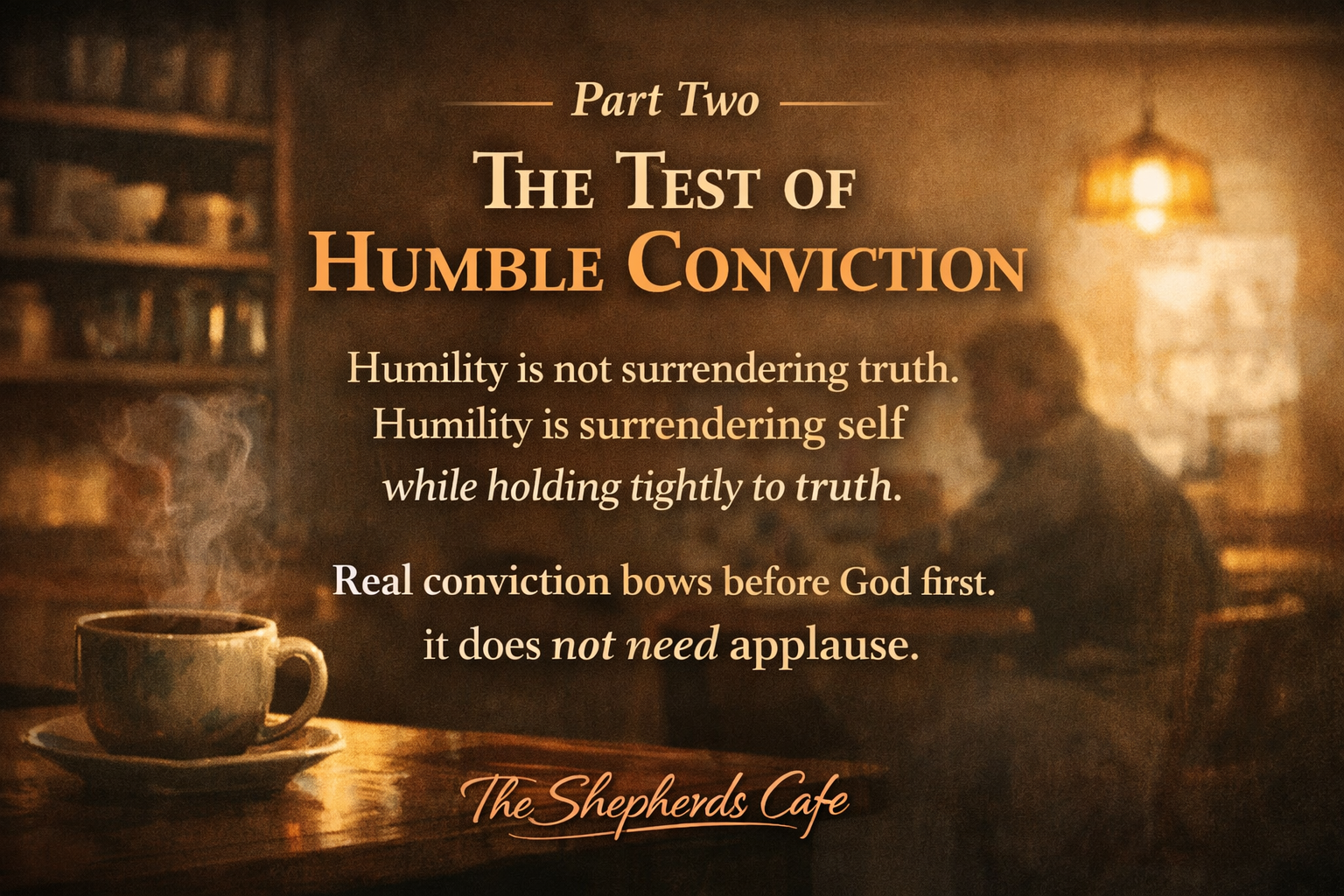
Jeremiah gave a faint nod. “Yes, but Christ was never weak, and still He was meek. Some people think humility is compromise. It is not. Humility is surrendering self while holding tightly to truth.”
Barbara asked softly, “So how do you know the difference?”
Jeremiah answered without hurry.
“One of the clearest tests is this: can I be corrected by Scripture? Can I be shown by the word of God that I am wrong without becoming defensive, cold, or offended? Can a faithful brother or sister reason with me from the Bible, and I honestly listen?”
He leaned back slightly.
“If I cannot, then what I call conviction may not be conviction at all. It may be vanity with a Bible verse in its hand.”
Barbara gave a sad little smile. “That reaches deep.”
Jeremiah nodded. “It does. Because most people do not mind truth examining others. They just do not like truth examining them.”
He looked toward the darkening window.
“Philippians 2 says, ‘Do nothing from selfishness or empty conceit, but with humility of mind regard one another as more important than yourselves.’ Then Paul points us to Christ. That is the measure. Not just whether I can state what is right, but whether I carry truth in the spirit of Christ.”
He rested both hands around the mug.
“I have watched pride make people unreachable. Every disagreement feels personal. Every question feels threatening. Every correction feels insulting. That kind of spirit can damage marriages, strain families, and fracture congregations. Pride can take a person who once loved truth and slowly turn him into someone who mainly loves being known as the defender of truth.”
For a moment, the three of them sat in silence.
Then Jeremiah spoke again, more quietly.
“The older I get, the less interested I am in sounding impressive and the more interested I am in being useful. I want conviction without conceit. I want firmness without vanity. I want to say, ‘This is what the Bible teaches,’ and still be humble enough to say, ‘If I have missed something, show me.’”
Barbara’s expression softened. “That takes strength.”
“It does,” Jeremiah said. “But it is the kind of strength the kingdom values. Real conviction bows before God first. It does not need applause. It does not need to dominate the room. It just needs to remain faithful.”
He looked at Elijah, then Barbara.
“And if I cannot be corrected by the word of God, by plain reason, or by faithful brethren, then what I call conviction may not be conviction at all.”
Barbara lifted her tea slightly. “That is a lesson worth hearing twice.”
Elijah nodded. “And worth living every day.”
The quiet hum of The Shepherds Cafe continued around them, but at that table, the silence that followed felt like mercy.