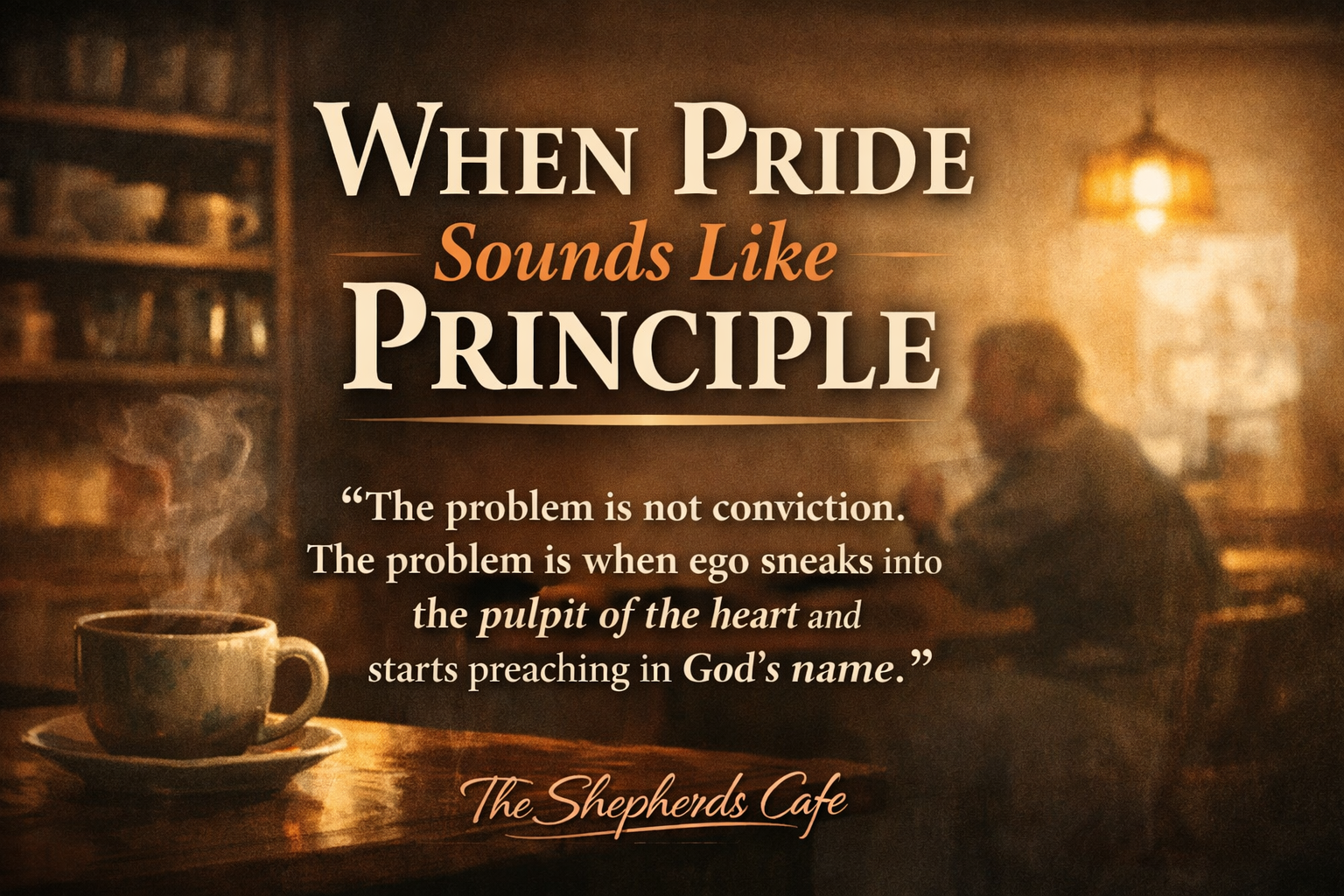
The late afternoon light fell soft through the front windows of The Shepherds Cafe, casting long golden lines across the floor and the edge of the little round table in the corner. The espresso machine hissed now and then, cups clinked gently behind the counter, and the quiet hum of conversation stayed low enough for serious thoughts to breathe.
Jeremiah sat with both hands around his coffee mug, though it had already cooled some. Elijah sat across from him with his glasses low on his nose, and Barbara had her tea in front of her, watching Jeremiah with that patient look she had when she knew something weighty was about to be said.
Jeremiah stared down into the cup a moment before he finally spoke.
“You know,” he said, “I have lived long enough to see a dangerous thing in people, and I have seen it in the church too. I have watched pride dress itself up as conviction.”
He looked up slowly.
“And I’ll tell you something even plainer than that. Some of the proudest people I ever met were absolutely convinced they were the most faithful.”
Barbara said nothing. Elijah leaned back, listening.
Jeremiah continued.
“There is such a thing as godly conviction. I believe that with all my heart. A man ought to stand where the word of God stands. He ought not bend every time the culture shifts, every time somebody gets offended, or every time truth becomes unpopular. If God said it, then that settles it. But that is exactly why this matter is so dangerous. Pride loves to borrow the language of faithfulness.”
He tapped the table lightly.
“A proud man does not usually say, ‘I am arrogant.’ He says, ‘I’m just standing for what’s right.’ A stubborn woman does not say, ‘I refuse to be corrected.’ She says, ‘I have convictions.’ A harsh brother does not say, ‘I enjoy cutting people down.’ He says, ‘Somebody has to speak the truth.’”
Jeremiah paused and let the words settle.
“The problem is not conviction. The problem is when ego sneaks into the pulpit of the heart and starts preaching in God’s name.”
He took a small sip from the mug and set it down again.
“Scripture never tells us to abandon truth for the sake of peace. But it also never gives us permission to wear truth like a weapon of self-exaltation. James said the wisdom from above is ‘first pure, then peaceable, gentle, reasonable, full of mercy and good fruits, unwavering, without hypocrisy.’ A lot of what people call boldness would not survive that verse.”
Elijah gave a quiet nod.
Jeremiah went on.
“I have seen brethren get red in the face over matters of opinion and call it zeal. I have seen people defend their traditions, their preferences, their methods, and even their tone as though all of it came down from Sinai. And if anybody questioned them, they treated correction like persecution. That is not always conviction. Sometimes that is just pride that has learned religious vocabulary.”
He folded his hands.
“The truth is, real conviction is anchored in God’s word. Pride is anchored in self. Conviction says, ‘Show me what the Scripture teaches.’ Pride says, ‘I already know I’m right.’ Conviction can be firm and still humble. Pride has to win. Conviction wants God honored. Pride wants self vindicated.”
Barbara finally spoke, softly. “That is a hard difference for some people to see in themselves.”
Jeremiah gave a faint smile. “Yes, ma’am. That is because pride is a master of disguise. It can kneel in prayer and still love applause. It can quote verses and still refuse rebuke. It can talk about truth while quietly feeding on superiority.”
He looked out the window for a moment, watching a car roll slowly past the café.
“I think about the Pharisee in Luke 18. He stood and prayed, but his prayer was full of himself. He thanked God, but only as a way of praising his own goodness. Meanwhile, that tax collector would not even lift up his eyes to heaven. He cried, ‘God, be merciful to me, the sinner!’ And Jesus said that man went home justified. That account ought to shake every serious Bible student, every teacher, every elder, every preacher, every Christian who thinks knowledge alone proves humility.”
Jeremiah’s voice lowered.
“Because it is possible to be doctrinally informed and spiritually swollen.”
Part 2: The Test of Humble Conviction
The room was quiet around them now. Even the sounds behind the counter seemed farther away.
“I have had to learn that the hard way,” he said. “I can remember times in my life when I was more interested in being seen as right than in helping somebody see what was right. I could defend a point, answer an objection, and press an argument, but deep down there were moments when I was not trying to win a soul. I was trying to win the exchange.”
He exhaled through his nose.
“That is ugly when you finally see it clearly. Because you realize you can be technically correct and still spiritually wrong in the way you carry yourself.”
He turned his mug slowly.
“Paul said, ‘Knowledge makes arrogant, but love edifies.’ That does not mean knowledge is bad. It means knowledge without humility becomes dangerous. Some people grow in information but never grow in gentleness. They grow in argument but never in patience. They become skilled at correction but weak in mercy.”
Elijah spoke then. “And they usually think strength means sharpness.”
“That’s right,” Jeremiah said. “But Christ was not weak because He was meek. Some people think humility is compromise. It is not. Humility is strength under God’s control. Pride is weakness pretending to be strength.”
He leaned forward a little.
“Here is one of the clearest tests I know. Ask yourself: Can I be corrected by Scripture? Can I be corrected by sound reasoning from the word of God? Can a faithful brother or sister come to me and show me I am wrong without me immediately getting defensive, cold, or dismissive? If the answer is no, then what I call conviction may really be vanity with a Bible verse in its hand.”
Barbara looked down at her tea and smiled sadly. “That line will preach.”
Jeremiah gave a small shrug. “It preaches to me first.”
He continued.
“Philippians 2 says, ‘Do nothing from selfishness or empty conceit, but with humility of mind regard one another as more important than yourselves.’ Then it points us to Christ. That is the standard. Not just whether I hold the right doctrine, though I must. Not just whether I oppose error, though I should. But whether I carry truth in a way that reflects the mind of Christ.”
He let that stand for a moment.
“You can tell when pride is involved, because the person becomes nearly unreachable. They do not listen well. They do not examine themselves honestly. They do not leave room for the possibility that they have mixed flesh with faithfulness. Everything becomes personal. Every disagreement becomes an attack. Every correction becomes an insult.”
He shook his head once.
“That spirit can wreck homes. It can fracture congregations. It can poison friendships. It can take a person who once loved truth and turn him into somebody who merely loves being the defender of truth.”
The café door opened and closed as someone left, and for a moment all three of them watched the fading light outside.
Then Jeremiah said, very quietly, “The older I get, the more I want conviction without conceit. I want firmness without vanity. I want to stand where God stands, but I do not want my ego tied up in every word I speak. I want to be strong enough to say, ‘This is what the Bible teaches,’ and humble enough to say, ‘If I have missed it, show me.’”
He looked at Elijah, then Barbara.
“Because in the end, pride does not become holy just because it learned to quote Scripture. And conviction is not proven by volume, harshness, or refusal to bend. Real conviction bows first before God.”
Jeremiah sat back and wrapped his hands around the mug again.
“And if I cannot be corrected by the word of God, by plain reason, or by faithful brethren, then what I call conviction may not be conviction at all.”
No one spoke for a few seconds.
Then Barbara lifted her tea and said softly, “That is a lesson worth hearing twice.”
Elijah nodded. “And worth living every day.”
The low murmur of The Shepherds Cafe carried on around them, but at that little corner table, the silence felt like mercy.