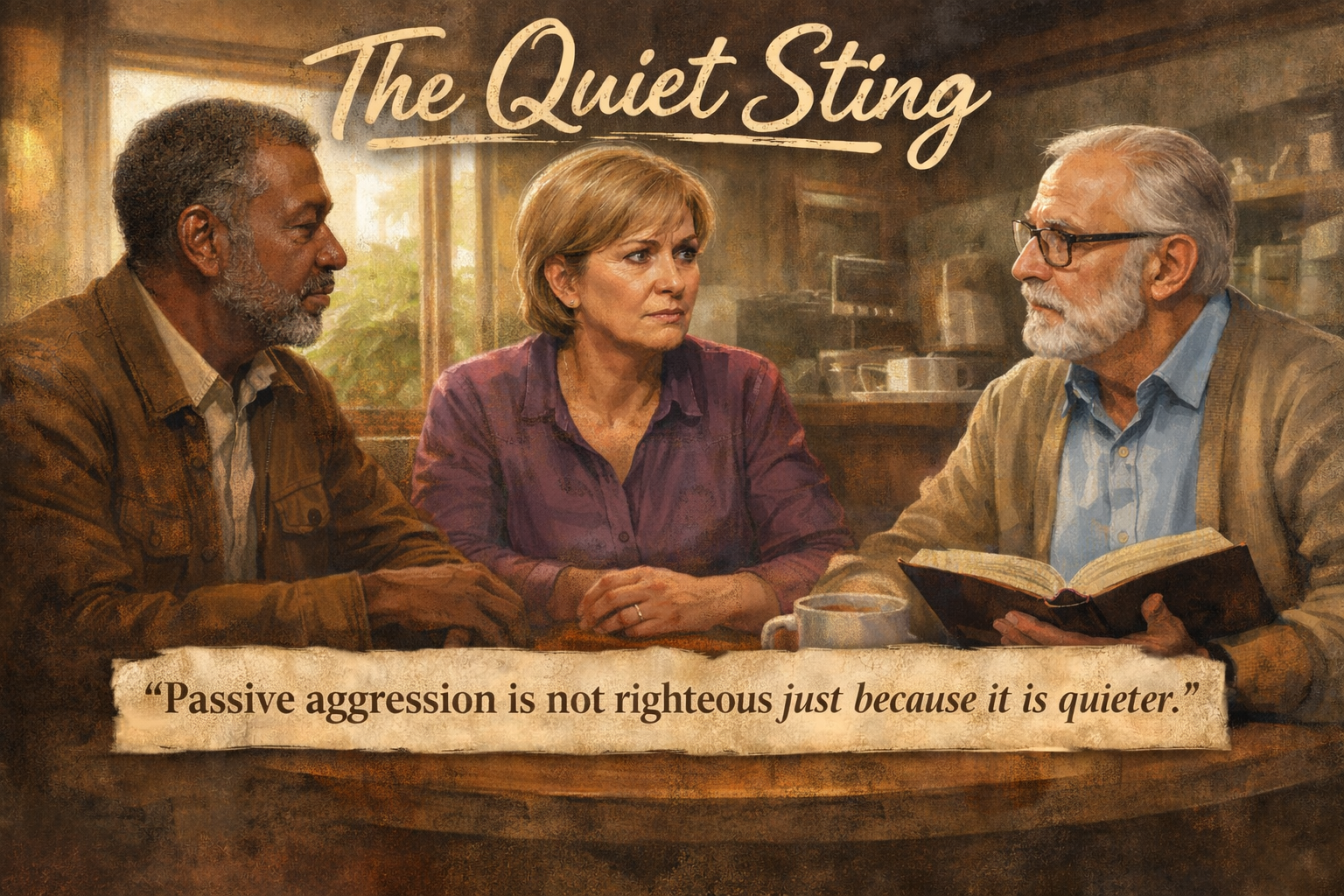
The lunch crowd had thinned at The Shepherds Cafe, leaving behind the soft clink of cups and the low hum of a refrigerator behind the counter. Sunlight pushed through the front windows and landed across Jeremiah’s folded hands. Elijah sat with his glasses low on his nose, reading something from a small Bible. Barbara stirred her tea slowly, though from the look on her face, her mind was nowhere near the cup.
“I’ll tell you something I cannot stand,” Barbara said at last.
Jeremiah looked up. “Only one thing?”
She gave him a quick smirk. “Passive-aggressive behavior. That little sideways way people punish each other while pretending they are innocent.”
Elijah closed his Bible partway. “That is a real problem. It is a polished form of fleshly behavior. It hides behind tone, delay, silence, sarcasm, and fake sweetness.”
Barbara nodded. “Exactly. People act wounded, but instead of speaking truthfully, they start sending signals. They make little comments. They withhold kindness. They become cold. They want the other person to feel the blow without ever being able to quote the words.”
Jeremiah leaned back in his chair. “It is hostility dressed up in church clothes.”
That landed hard enough for all three of them to sit with it.
Elijah finally said, “Scripture does not leave much room for that kind of conduct. Paul said, ‘Therefore, laying aside falsehood, speak truth each one of you with his neighbor, for we are members of one another’” (Ephesians 4:25, NASB). Passive aggression is the opposite of that. It is not honest. It is not direct. It is not clean.”
Barbara sighed. “And yet people justify it because they did not technically yell.”
“That is part of the deceit,” Elijah said. “A person can whisper sin just as easily as shout it.”
Jeremiah smiled faintly. “That ought to be printed on a wall somewhere.”
Barbara set her spoon down. “I think some Christians believe that because direct conflict feels uncomfortable, indirect conflict must be more righteous. But it is not righteous just because it is quieter.”
“No,” Elijah said. “It often reveals fear of man, pride, bitterness, or a desire to control the emotional temperature of the room without taking responsibility for it. It is a way of saying, ‘I want you to suffer, but I do not want to be accountable for causing it.’”
Jeremiah opened his Bible and turned a few pages. “Listen to this: ‘Let all bitterness and wrath and anger and clamor and slander be put away from you, along with all malice’” (Ephesians 4:31, NASB). He tapped the page. “Passive aggression belongs in that family. It may not sound like clamor, but it certainly carries bitterness, malice, and often a quiet form of slander.”
Barbara looked out the window. “It shows up in marriages, families, and congregations all the time. Somebody is offended, but instead of going to the person, they become icy. They stop helping. They answer with sharp little comments. They make sure everybody feels the tension.”
Jeremiah nodded. “And then when they are confronted, they say, ‘I didn’t mean anything by it.’”
Elijah gave a dry laugh. “That sentence has covered a multitude of sins.”
Barbara laughed too, then grew serious again. “What makes this especially dangerous in the church is that it destroys trust. You never know where you stand with somebody. You start reading the room instead of rejoicing in the truth.”
“Right,” Elijah said. “Jesus taught open, honest dealing with sin. ‘If your brother sins, go and show him his fault in private’” (Matthew 18:15, NASB). That is plain speech. That is courage. That is love with a backbone. Passive aggression refuses that path because it wants emotional leverage without biblical accountability.”
Jeremiah rubbed his beard. “It also tempts others to sin. One person starts dropping little barbs, another person responds in the flesh, and before long the whole situation is burning.”
Barbara said, “So what does the better way look like?”
Elijah answered immediately. “First, tell the truth plainly. Not harshly. Plainly. Second, deal with people directly, not through moods, delays, and signals. Third, keep your heart clean. If I speak with a polite voice but my goal is to sting you, I am still wrong.”
Jeremiah added, “And remember Romans 12:18: ‘If possible, so far as it depends on you, be at peace with all men’ (NASB). Peace is not pretending. Peace is not pouting. Peace is not making somebody guess why you are angry. Peace takes honest work.”
Barbara smiled. “That is what people forget. Biblical peace is work. Fleshly tension is easy.”
A young couple at the next table stood to leave. One of them looked irritated, the other looked confused, and neither said much. The door opened, then shut again.
Jeremiah watched them go. “There goes another silent sermon.”
Elijah reopened his Bible. “Passive aggression is unscriptural because it is not truth in love. It is frustration disguised as restraint. It gives the appearance of control while feeding the works of the flesh.”
Barbara lifted her cup. “Then here is the lesson. Say what is true. Say it kindly. Say it directly. But stop trying to punish people with side doors.”
Jeremiah raised his coffee mug. “Amen to that.”
Elijah looked at both of them and said, “The Christian way is better. Not easier. Better.”
And for a moment, at their little table in The Shepherds Cafe, the room felt especially quiet in the right kind of way.