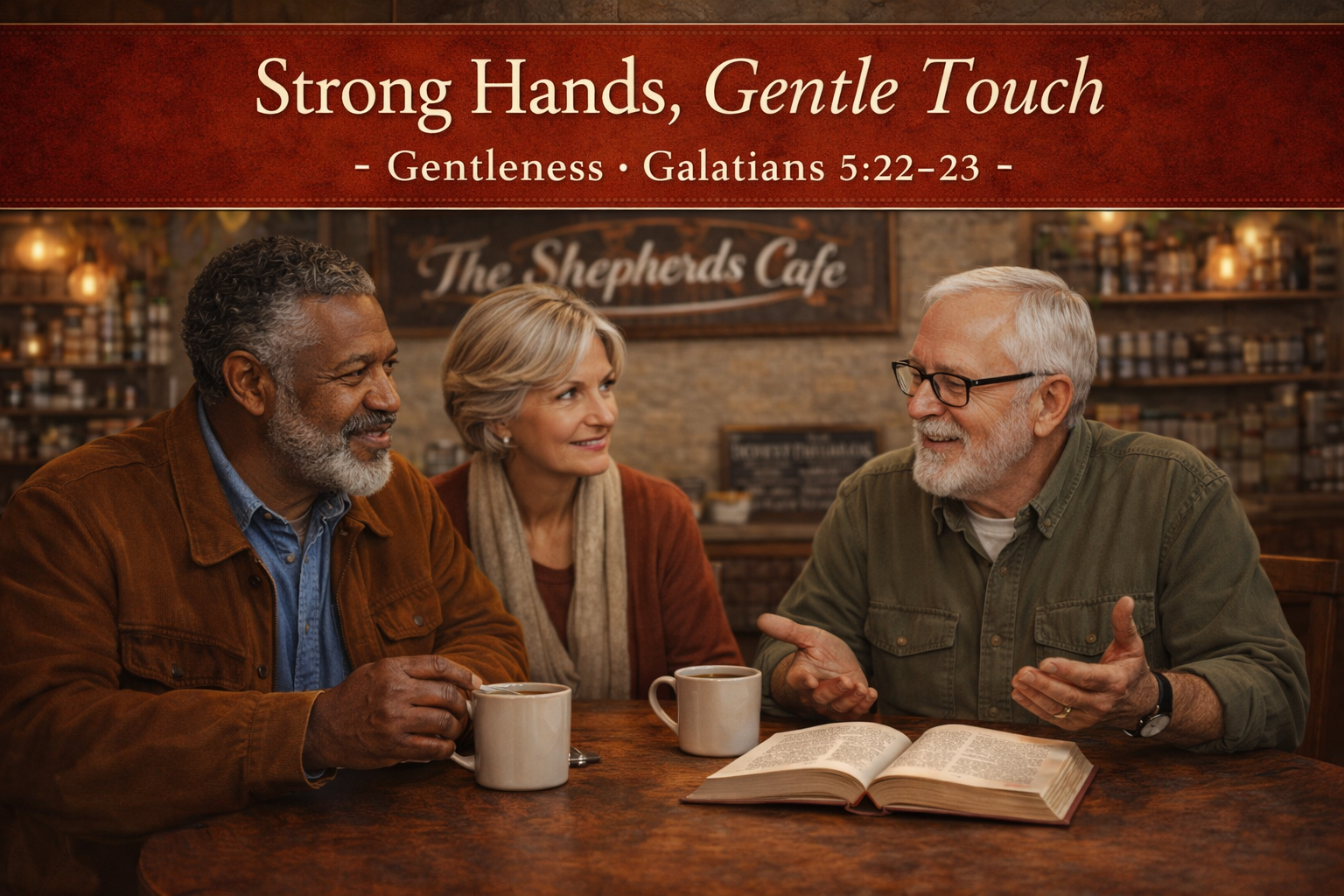
The lunch rush at The Shepherds Cafe had the usual rhythm—milk steaming, cups clinking, a few quiet laughs near the pastry case—but the back corner where Elijah liked to sit felt like its own room. The light there was softer, filtered through hanging plants and the tall window that looked out on a slow street.
Jeremiah arrived first, already smiling, already settled. Barbara came next with her scarf tucked neatly at her collar, carrying a small notebook that looked as though it had been read more than written in.
Elijah came last, a little more quiet than usual.
He didn’t look upset in a loud way. He looked like a man who had been weighing something and found it heavier than expected.
Jeremiah noticed immediately. “You’re thinking hard enough to bend the table,” he said.
Elijah set his cup down. “I’m thinking about what the Spirit is supposed to produce in me… and what I’ve been producing lately.”
Barbara didn’t interrupt. She simply waited. That was one of her strengths: she left room for honesty to arrive without feeling rushed.
Jeremiah opened his Bible to Galatians and read the list again—love, joy, peace, patience, kindness, goodness, faithfulness, gentleness, self-control—like a man reading a diagnosis and a cure in the same breath.
Barbara tapped the page lightly. “Last time we talked about patience.”
Elijah nodded. “Today I don’t want to talk about patience.”
Jeremiah raised an eyebrow. “Then what?”
Elijah’s jaw tightened, and he said it plainly. “Gentleness.”
Barbara’s face softened in the way it did when a hard truth was spoken without excuses. “That one tends to hit men like a hammer,” she said quietly.
Elijah gave a short, humorless laugh. “It hits me like a hammer.”
Jeremiah leaned in, elbows on the table. “Tell us what happened.”
Elijah stared into his coffee, then looked up as if deciding not to hide. “I corrected someone this week. Not about doctrine—about… attitude. And I was right. That’s the problem. I was right and I used it like a club.”
Barbara didn’t flinch. She simply asked, “How did it land?”
Elijah swallowed. “Like I wanted it to land. That’s what bothers me. It landed with force. It shut him down. It made the room quiet. I got the ‘win.’”
Jeremiah’s tone was calm but direct. “Truth can be spoken in a way that honors God, or in a way that honors self.”
Elijah nodded once, almost sharply. “Exactly. And mine honored self.”
Barbara folded her hands. “Gentleness isn’t weakness. It’s strength trained to serve.”
Elijah looked at her. “Say that again.”
“Gentleness,” she repeated, “is strength trained to serve.”
Jeremiah added, “It’s power under control. It’s the opposite of needing to dominate.”
Elijah exhaled slowly, as if letting go of something he’d been holding. “I grew up thinking gentleness was… soft. Like a personality trait. Like something you either have or you don’t.”
Jeremiah shook his head. “In Scripture it’s not temperament. It’s obedience. Gentleness is what strength looks like when it’s yielded to God.”
Barbara leaned forward just a little. “And it’s one of the clearest signs someone is being led by the Spirit. Because the flesh loves force. The flesh loves winning. The flesh loves making sure everybody knows who’s in charge.”
Elijah gave a grim smile. “The flesh loves to be right loudly.”
Jeremiah’s eyes held Elijah’s. “Jesus had every right to crush people with truth. He didn’t. That should tell us something.”
A silence settled, not awkward—more like reverent.
Then Elijah spoke again, and his voice had a different edge now. Not sharpness—resolve.
“I’ve been thinking about the difference between boldness and harshness,” he said. “I’ve justified harshness by calling it boldness.”
Barbara nodded. “A lot of people do.”
Jeremiah said, “Boldness is telling the truth even when it costs you. Harshness is telling the truth in a way that costs the other person more than it should.”
Elijah stared at the open Bible between them. “So what does gentleness actually do?”
Barbara answered first. “Gentleness keeps correction from becoming humiliation.”
Jeremiah followed. “Gentleness keeps leadership from turning into intimidation.”
Barbara continued, “Gentleness keeps conviction from becoming cruelty.”
Elijah looked down again, but this time he wasn’t hiding from it. He was examining it.
“I think I’ve been afraid,” he admitted, “that if I’m gentle, people won’t take the truth seriously.”
Jeremiah didn’t miss a beat. “If the truth depends on your sharpness to be respected, it’s not the truth they’re respecting. It’s your edge.”
That sentence landed hard. Elijah’s eyes flicked up, and for a moment he didn’t speak.
Barbara watched him carefully. “Elijah,” she said, “gentleness doesn’t make truth weaker. It makes truth cleaner. Less mixed with ego.”
Elijah sat back, as if the chair suddenly had more weight. “That’s what I want. Clean truth.”
Jeremiah nodded. “Then you’ll have to crucify the part of you that enjoys the impact.”
Elijah’s mouth tightened. “That part of me is alive and well.”
Barbara’s tone stayed kind but firm. “Then this is where the fruit of the Spirit becomes real. Not in a lesson. Not in a slogan. In a moment where you could cut someone… and you choose to heal instead.”
Elijah looked at the table and spoke slowly, like a man making a decision out loud.
“I want to be the kind of man who can correct without crushing,” he said. “Lead without intimidating. Be firm without being mean.”
Jeremiah smiled slightly. “That’s gentleness.”
Elijah nodded. “Then here’s my reflection—my confession and my plan.”
He drew a breath.
“From now on, if I need to confront something, I’m going to ask myself two questions before I open my mouth:
Am I trying to help this person repent—or am I trying to make them feel small? Would I say it this way if Christ were sitting right here at this table?”
Barbara’s eyes glistened. “Those are honest questions.”
Jeremiah said, “And they’ll save you from yourself.”
Elijah looked out the window for a long second. The street was still moving, people still passing, life still life. But inside him something had shifted.
“Gentleness,” he said quietly, “might be the hardest fruit for me. Because it requires me to win less.”
Jeremiah’s voice was warm. “Or to win differently.”
Barbara lifted her cup slightly. “To win a brother instead of an argument.”
Elijah lifted his cup too, and his smile returned—smaller, truer.
“Alright,” he said. “No more clubs. If I’m going to carry the truth, I’m going to carry it like Jesus did—strong hands, gentle touch.”
And there, in the ordinary back corner of The Shepherds Cafe, the fruit of the Spirit was not a list on a page. It was a choice being planted—one that, with time and obedience, could grow into something others could finally taste.