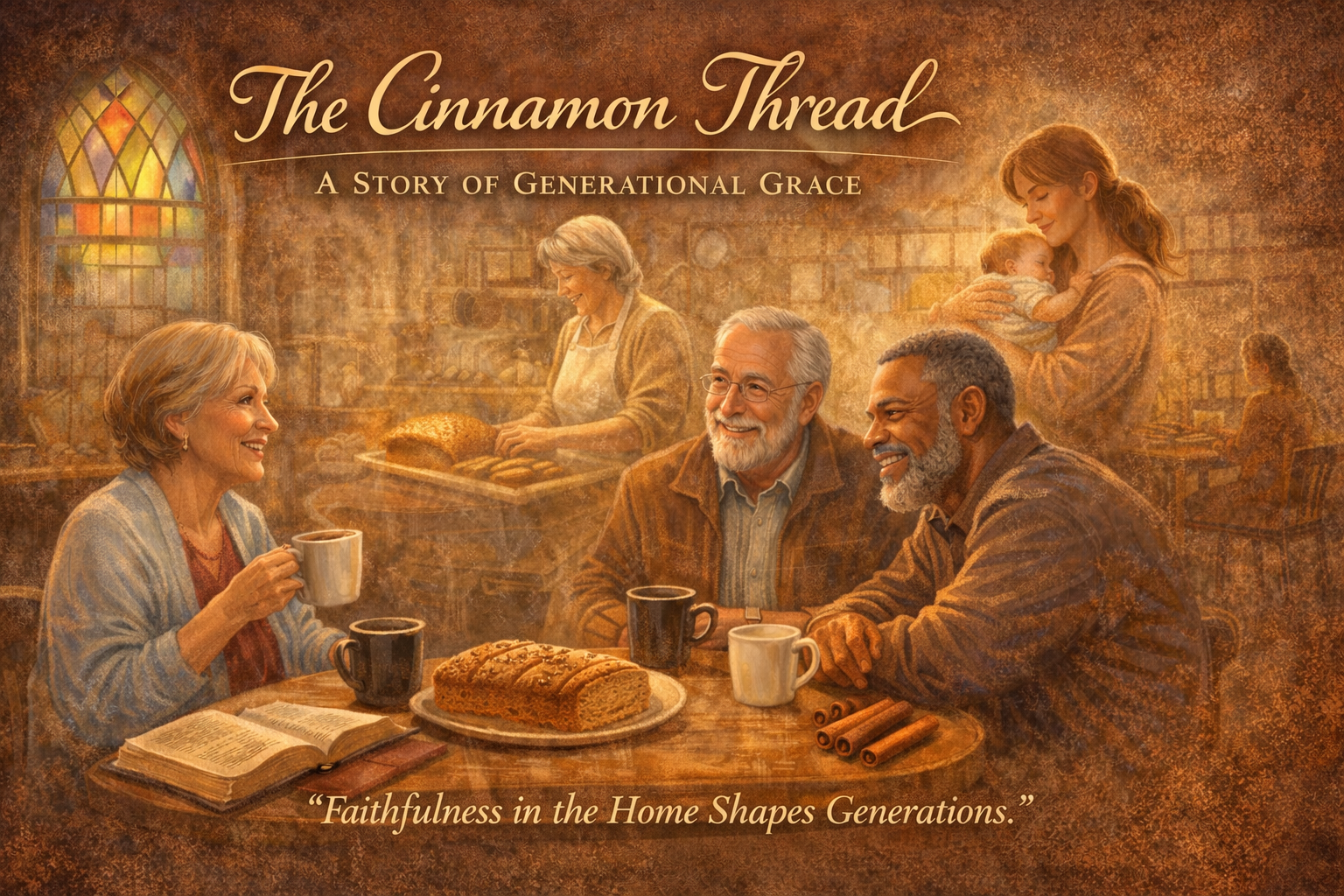
Late afternoon settled softly over The Shepherds Cafe, and the stained-glass windows did what they always did when the sun hit them just right: they threw calm, colorful shapes across the hardwood floor like God was quietly reminding the room that light can be gentle and still be strong.
Steam rose from cinnamon-laced coffee. Mugs clinked. A low line of jazz drifted under conversations that sounded ordinary—until you listened closely.
Elijah sat nearest the window, glasses low on his nose, short white beard catching the warm light. He was mid-joke, hands moving like punctuation.
“I’m telling you,” he said, eyes bright, “kids today can’t fold a fitted sheet… but give them ten minutes and they’ll reprogram the Wi-Fi like it owes them money.”
Jeremiah’s laughter came first—deep, steady, the kind that made the table feel like a safe place. He adjusted his knit cap with a smile and leaned back, shoulders relaxed.
Barbara laughed too, but it didn’t last. Her smile softened into something older than humor. She cradled her cup with both hands and stared into the swirling cinnamon like it was a doorway.
Elijah’s grin faded. He noticed the glassiness at the edge of her eyes and the way her shoulders held a quiet ache.
“Barbara,” he said, gentle now, “you look like you just ran into a sweet memory.”
Barbara nodded, barely. “It’s the cinnamon.” She breathed in slowly and let it out like a prayer. “It smells exactly like my Grandma Rose’s kitchen. Every Saturday she baked cinnamon bread, and while it rose, she told stories—about her mama… and her mama’s mama. That smell feels like a thread pulling me backward through generations.”
Jeremiah straightened a little, the elder’s care in his face. “That’s not just nostalgia,” he said quietly. “That’s testimony.”
Barbara smiled at him, grateful. “Grandma Rose didn’t call it testimony. She called it ‘keeping the faith in the house.’”
Elijah folded his hands, letting the moment take the lead. “Tell us about her.”
Barbara’s eyes warmed. “She was the kind of woman who woke early—not because she had to, but because she wanted to. I’d come into the kitchen half-asleep and she’d be there with her Bible open and flour on her hands, whispering a prayer like it belonged in the recipe.”
She chuckled softly. “She used to say, ‘Child, if you begin your day with the Lord, your hands will do holy work—even if you’re just folding laundry.’ And she meant it. She wasn’t perfect. But she was present. Consistent. Steady.”
Jeremiah nodded slowly, listening like a man who understood that spiritual strength often looks like ordinary faithfulness.
Barbara continued, “She wasn’t just a homemaker. She was a home-shaper. She set the tone—love and discipline, warmth and order, hospitality and truth. She taught us the Scriptures the way she taught us to bake: patiently, step by step, over and over until it got into your hands.”
Elijah leaned forward, voice thoughtful. “You’re saying motherhood is… more than raising kids. It’s forming souls.”
Barbara’s eyes met his. “Exactly. It’s discipleship in a kitchen. It’s theology in a living room. From the beginning, God entrusted families with the responsibility of shaping hearts. When God said to fill the earth, that wasn’t just about numbers—it was about households where faith could be taught.”
She tapped her finger lightly on the table, like she was underlining Scripture without needing to quote it at length. “And later, God tells His people to keep His words on their hearts and teach them diligently to their children—talking about them in ordinary life. That’s Grandma Rose. That’s a godly mother.”
Jeremiah’s voice came low and steady. “Paul noticed that pattern too. He told Timothy his sincere faith showed up first in his grandmother and his mother. That’s not a small compliment. That’s a spiritual lineage.”
Elijah’s eyebrows lifted. “So when a mother is faithful, she’s building something that outlives her.”
“Yes,” Barbara said. “And we treat it like it’s small because it happens quietly. But God values the work no one applauds—midnight feedings, quiet corrections, whispered prayers over a child’s bedroom door.”
As if on cue, Barbara’s gaze drifted past Jeremiah’s shoulder. Across the cafe, a young mother rocked gently with a baby strapped against her chest, one hand patting the child’s back while the other tried to manage a cup and a bag.
Barbara watched her with a tenderness that didn’t need words. “That,” she said softly, “is kingdom work happening right now.”
Jeremiah followed her gaze. “A mother is often the first theologian a child meets,” he said. “She teaches love, discipline, mercy, and forgiveness long before a child can name those things. And every act done in faith matters to God.”
Elijah nodded, his humor returning—but carefully, respectfully, like a man stepping back onto the path after kneeling at an altar. “I’m just saying,” he murmured, “if cinnamon can wake up that much gratitude, we might need to serve it at every Bible study.”
Barbara laughed—real laughter this time. Not shallow, but healing.
Then her voice softened again. “Motherhood isn’t easy. It’s sacrificial. It sanctifies you whether you’re ready or not. But when God is at the center, that work echoes beyond a single lifetime. I see it in my daughters. I see it in my grandbabies. It’s like Grandma Rose planted something in me that keeps growing even when she’s gone.”
Jeremiah’s eyes shone as he spoke, almost like he was leading worship with a single sentence. “There’s a proverb that says a faithful woman is blessed by her children.”
Barbara’s smile turned modest. “That was Grandma Rose,” she said. Then, after a pause, “And I’m trying to pass it on.”
They sat in a rare stillness, the kind that doesn’t feel awkward—only holy.
When they stood to leave, Elijah held the cafe door for Barbara with the old-school courtesy he never outgrew. Jeremiah waited a step behind her, hands folded, the elder’s calm still on him.
Barbara pulled her scarf tighter as the cool air met her face. The scent of cinnamon clung faintly to her sweater like a memory that refused to let go.
Elijah glanced at her. “Thank you for sharing her with us,” he said.
Jeremiah nodded. “If you can still smell her faith in cinnamon bread, then her influence didn’t end. It multiplied.”
Barbara’s eyes shone again—this time with gratitude more than grief. “Then I’ll keep baking,” she whispered. “And I’ll keep telling the stories.”
If you had the gift of a godly mother or grandmother, honor her. If you are a mother, don’t believe the lie that your work is small. Faithfulness in the home shapes generations.
And if your relationship with your mother has been painful, remember this: God’s compassion is not limited by what you lacked. Jesus pictured God’s care as the sheltering tenderness of a mother gathering her children. He sees, He heals, and He supplies what broken places cannot.
Let your gratitude rise like warm cinnamon in a quiet cafe—and thank God for the women who shape generations with gentleness, grit, and grace.