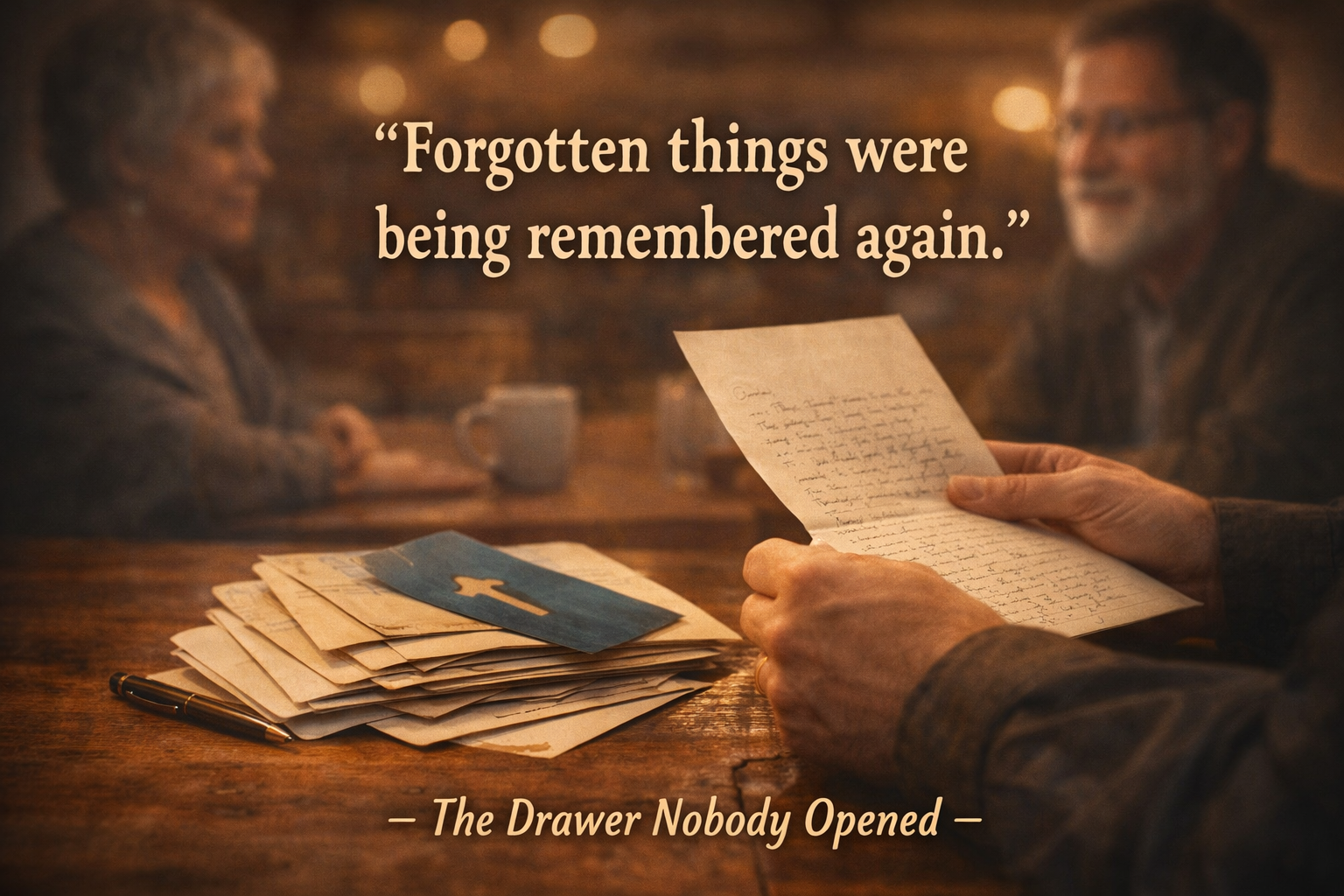
Rain pressed softly against the front windows of The Shepherds Cafe, turning the streetlights outside into long gold streaks on the glass. Inside, the room felt smaller in the best way—lamplight, warm mugs, and the low hum of quiet conversation. Elijah sat at the end of the table with a folder beside him. Jeremiah had his hands wrapped around a cup of coffee, and Barbara was watching Elijah with the kind of expression that meant she had already noticed something was on his mind.
“You have that look,” Barbara said.
Elijah glanced up. “What look?”
“The one that says you’ve been thinking about something for two days and are just now deciding whether to say it.”
Jeremiah smiled. “She is accurate more often than not.”
Elijah rested a hand on the folder. “I was cleaning out a drawer at home.”
Barbara nodded slowly. “And?”
“And I found letters. Old notes. Cards. A few things people wrote to me years ago.”
Jeremiah leaned back. “That can be a dangerous kind of archaeology.”
Barbara laughed. “What kind of letters?”
Elijah opened the folder and pulled out a folded sheet of paper, worn at the creases. “Encouraging ones. Notes from brethren. A letter from a man I studied the Bible with years ago. A card someone sent after a hard season in my life.” He looked down at it for a moment. “I had forgotten I even kept them.”
Barbara’s expression softened. “That can humble a person.”
“It did,” Elijah said. “It also convicted me.”
Jeremiah raised an eyebrow. “How so?”
Elijah laid the paper on the table. “Because I realized I have received a lot of encouragement in my life. And I have probably given less of it than I should have.”
The table fell quiet for a moment.
Barbara looked down into her tea. “That lands.”
Jeremiah nodded. “We tend to think encouraging people is a small thing. Scripture does not treat it like a small thing.”
Elijah opened his Bible and turned a few pages. “That is exactly where my mind went. ‘Therefore encourage one another and build up one another, just as you also are doing’” (1 Thessalonians 5:11, NASB). He looked at both of them. “That is not a suggestion for unusually sentimental Christians. That is a command for the church.”
Barbara said, “I think some of us imagine encouragement has to be grand. A speech. A long letter. Something polished.”
Jeremiah shook his head. “Usually it is simpler than that. Timely words. Honest gratitude. Telling someone you see their labor. Reminding a weary person that faithfulness matters.”
Elijah smiled faintly. “One of those notes I found was only three sentences long.”
Barbara asked, “Do you remember what it said?”
Elijah nodded. “It said, ‘I know you are tired. I see your work. Do not quit. The Lord knows what is done for Him.’”
Jeremiah let out a slow breath. “That is strong medicine.”
Barbara folded her hands on the table. “Amazing how a few right words can stay alive for years.”
Elijah looked out toward the rain-swept window. “That is what struck me. I do not remember half the ordinary things from that period of life. But I remember that letter.”
Jeremiah said, “Because discouragement is heavy, and encouragement helps a man stand up under the weight.”
Barbara nodded. “Hebrews says to encourage one another day after day, so none of us is hardened by the deceitfulness of sin” (Hebrews 3:13, NASB). “That means encouragement is not just emotional support. It is spiritual protection.”
Elijah pointed gently at her. “Exactly.”
Jeremiah smiled. “Some people think faithfulness is only correction, warning, rebuke, and hard conversations. Those things matter. But if that is all we give, we are not giving the whole counsel of God in how we treat one another.”
Barbara gave a small grin. “Leave it to you to make encouragement sound like a neglected doctrine.”
Jeremiah lifted his cup. “Because it is.”
That made Elijah laugh.
Barbara looked around the café for a moment—the young man wiping tables near the counter, the woman reading alone by the window, the older couple sharing a slice of pie in the corner. “You know what is sad? A lot of people are carrying burdens nobody can see. And they come to worship, sit in a pew, shake a few hands, then go home without anyone saying one meaningful thing to them.”
Elijah closed his Bible gently. “And then we wonder why people grow cold.”
Jeremiah added, “Encouragement is one way love becomes audible.”
Barbara reached for her notebook. “That is worth writing down.”
Elijah looked at the old paper one more time before slipping it back into the folder. “I think I have been too willing to assume people know they are appreciated.”
Jeremiah said, “Assumptions are lazy. Love speaks.”
Barbara smiled. “That should be on a wall somewhere.”
Elijah nodded. “Or in a text message tonight.”
Barbara looked at him. “You planning to do something about this?”
He gave a steady smile. “Yes. I think I am going to write three notes this week. No special occasion. No grand reason. Just honest encouragement.”
Jeremiah said, “That is how these things start. One person remembers what helped him, then passes it on.”
Barbara closed her notebook. “I’ll do the same.”
Jeremiah looked down into his coffee and smiled. “Then maybe I should stop pretending I was not just convicted too.”
Outside, the rain kept falling. Inside, the little table at The Shepherds Cafe felt like a place where forgotten things were being remembered again—not just old letters in a drawer, but the simple duty of strengthening one another before the heart grows tired.
And before they left that evening, each of them had written down at least one name.