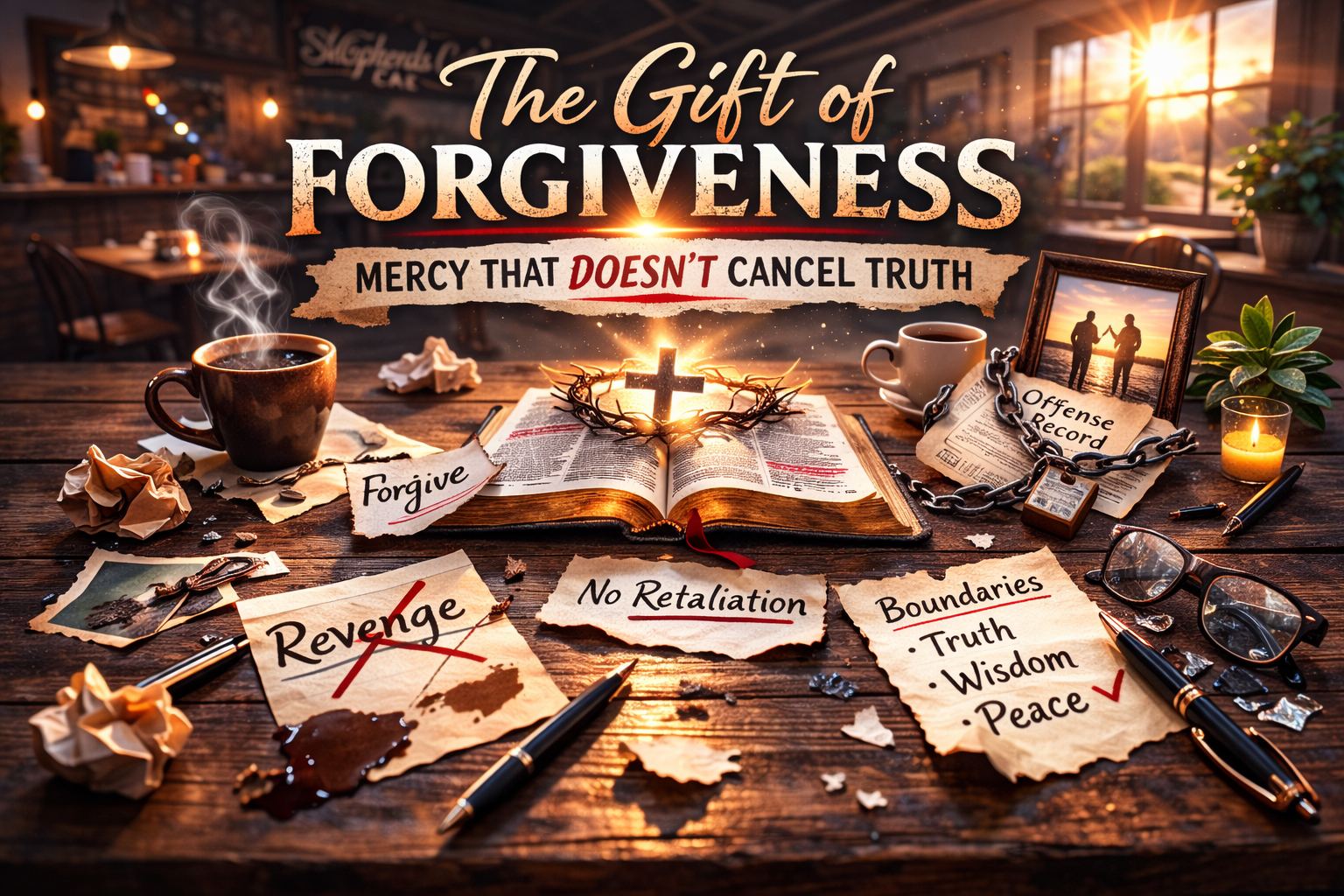
The afternoon light at The Shepherds Cafe made the dust in the air look like gold—quiet, gentle, almost forgiving. The café wasn’t full, but it was steady: a few regulars, a couple of tired parents, and two men at the far end who weren’t talking loudly but were clearly talking about something heavy.
Barbara noticed that kind of conversation. She didn’t pry. She just kept coffee moving and made sure nobody felt alone.
Elijah sat beneath the café’s wooden sign with his glasses low, phone in hand. Jeremiah slid into the booth across from him, Bible already open like a tool that belonged on the table.
Elijah tapped the screen and turned it toward Jeremiah. “I pulled two pieces—same topic, two angles.”
Jeremiah glanced down.
One was BibleTalk.tv: “The Gift of Forgiveness.”
The other was La Vista: “What Is ‘Forgiveness?’”
Barbara set two mugs down and said, “If there’s one topic people misunderstand the most, it’s forgiveness.”
Jeremiah nodded. “Because we confuse forgiveness with pretending.”
Elijah read a line from the BibleTalk devotional and summarized it in his own words: forgiveness is not a small accessory in the Christian life—it’s a priceless gift, purchased by Christ, meant to be received with gratitude and handled with reverence.
Jeremiah’s eyes stayed steady. “And the La Vista piece presses the other side: forgiveness is tied to God’s terms. You don’t get to redefine it into something softer than God intended.”
A woman near the window—late forties, tired eyes, hands wrapped around a cup like it was the only warm thing in her day—finally spoke. “I’ve tried to forgive,” she said. “But when I think of what happened, it feels like forgiveness would let them off the hook.”
Barbara didn’t flinch. She walked over slowly and spoke with quiet firmness. “Forgiveness doesn’t cancel truth,” she said. “And it doesn’t cancel consequences. It cancels your right to revenge.”
Jeremiah nodded once. “That’s the critical distinction. Forgiveness is not saying, ‘It didn’t matter.’ Forgiveness is saying, ‘I won’t become evil trying to punish evil.’”
Elijah leaned forward. “BibleTalk frames forgiveness as a gift from God that frees us from the guilt of sin—because Christ bore our sins in His body on the cross. It’s costly grace, not cheap sentiment.”
Jeremiah added, “And La Vista stresses something people skip: when Jesus teaches prayer, He ties our request for God’s forgiveness to how we forgive others. It’s serious business, not a therapeutic slogan.”
The woman swallowed. “So what am I supposed to do—just act like everything is fine?”
Jeremiah shook his head. “No. Forgiveness is not the same as instant trust. Trust is rebuilt. Forgiveness is granted.”
Barbara’s voice softened, but she didn’t water it down. “Some wounds require boundaries. A boundary is not bitterness. It’s wisdom.”
Elijah tapped the table lightly. “The La Vista article uses Peter’s question—‘How many times?’—to show that forgiveness isn’t meant to be rare. It’s meant to be practiced.”
Jeremiah glanced toward the back of the café where the two men had been talking. Their shoulders were tight, like they were holding years in their spine.
“That’s the other problem,” Jeremiah said. “Some people keep a mental file cabinet of offenses. They forgive in words but keep records in the heart.”
Barbara nodded. “And that’s how you live tired.”
Elijah’s phone chimed softly with a notification he ignored. “Here’s what both articles push us toward,” he said. “Forgiveness isn’t only about the person who hurt you. It’s also about refusing to let the hurt become your identity.”
Jeremiah opened his Bible and spoke plainly. “God forgives in a way that’s real and holy. Forgiveness is not God shrugging at sin. It’s God paying for sin. That’s why forgiveness is both mercy and justice meeting at the cross.”
Barbara’s eyes narrowed with compassion. “And that’s why mothers and fathers—families—need this. Unforgiveness poisons homes. Forgiveness doesn’t erase accountability, but it can stop the infection from spreading.”
The woman at the window nodded slowly, like she wasn’t ready to feel good yet, but she was ready to be honest.
“So how do you start?” she asked.
Jeremiah didn’t give a slogan. He gave a path.
“Start by naming what happened truthfully—no minimizing. Then decide: ‘I will not retaliate.’ Then pray for God’s help because you can’t do it on willpower alone. And if reconciliation is possible, pursue it biblically. If it isn’t safe or it isn’t appropriate, maintain wise boundaries without feeding hatred.”
Elijah added, “And receive God’s forgiveness properly too. BibleTalk’s point is that forgiveness is a gift—something you accept, not something you keep punishing yourself over.”
Barbara gave a small nod, like she’d seen this cycle too many times. “Some folks can’t forgive others because they haven’t accepted God’s forgiveness for themselves. They live like they’re still on trial.”
Jeremiah’s voice was calm. “But in Christ, forgiveness is real. And when it’s real, it changes how you treat people who don’t deserve mercy—because you remember you didn’t deserve it either.”
The café didn’t erupt into applause. It never did. The Shepherds Cafe wasn’t built for performance. It was built for truth.
And that afternoon, forgiveness didn’t feel like a soft word. It felt like a strong one—strong enough to hold grief, strong enough to hold justice, strong enough to keep a soul from turning into stone.