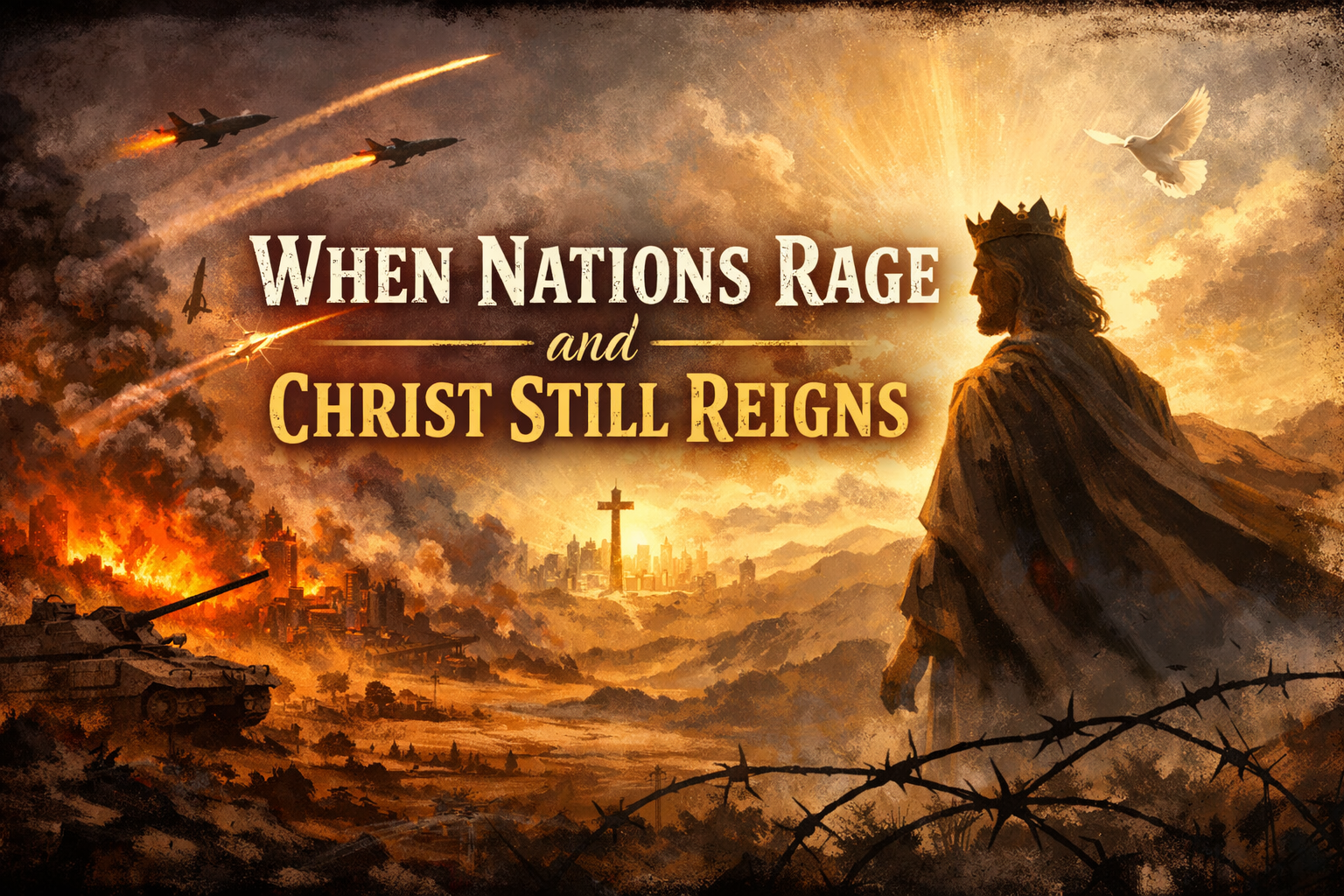
One recent event dominating the news is the rapidly widening war involving Iran, Israel, and the United States. Reports on March 5–6, 2026 describe continued airstrikes, missile attacks, regional retaliation, casualties across multiple countries, disruption to energy infrastructure, and growing concern that the conflict could expand even further. Reuters and AP both describe the situation as a broader regional crisis rather than an isolated exchange.
Here is a story-shaped reflection on that moment, followed by a biblical view:
The coffee shop television was on, but nobody in the room was really drinking in peace. The headlines kept rolling across the bottom of the screen—missiles, retaliation, warnings, casualties, governments vowing strength, families fleeing, leaders promising that the next strike would bring order. An older man at the back table finally muttered, “Every side says it is defending itself, and every side keeps burying somebody.” No one argued with him, because that was the one sentence in the room that felt undeniably true. The world was watching power answer power, and yet the result was not peace. It was smoke, fear, funerals, and another generation learning how to live under the shadow of war. That is where many people are today as this Middle East conflict intensifies.
A young Christian in the room asked the question many believers ask when the news turns dark: “What are we supposed to think when nations rage like this?” The first answer is that Christians must resist the temptation to become bloodthirsty spectators. War coverage can slowly train people to treat human lives like scorecards. Scripture will not allow that. Every person under those headlines bears the image of God, whether citizen, soldier, hostage, parent, child, ally, or enemy. That means the first biblical response is not excitement, but grief. “Blessed are the peacemakers” is still in the Bible. “Love your enemies” is still in the Bible. “Weep with those who weep” is still in the Bible. The Christian response begins with moral seriousness, not partisan adrenaline. Matthew 5:9, 44 and Romans 12:15 speak directly to that posture.
The second answer is that the Bible is realistic about a fallen world. Scripture does not pretend nations will always behave justly. It recognizes rulers, wars, rumors of wars, violent men, proud kingdoms, and human ambition. Jesus said, “You will be hearing of wars and rumors of wars,” not to create panic, but to keep disciples from being spiritually shocked by the ugliness of history. In other words, the existence of war does not disprove God’s word; it confirms the Bible’s plain diagnosis of fallen humanity. Matthew 24:6 does not command panic or date-setting. It commands steadiness.
The third answer is that Christians must be very careful before calling any modern war “God’s side” in a simplistic way. Governments make claims. Armies justify campaigns. media outlets frame conflicts. But the people of God do not hand out divine endorsement cheaply. The Bible does affirm that governing authorities have responsibilities related to justice and restraint of evil in Romans 13:1–4. At the same time, the same Bible condemns arrogance, cruelty, deceit, vengeance, and the shedding of innocent blood. So a biblical view is not blind pacifism, but neither is it blind nationalism. It is morally alert, slow to celebrate violence, and honest enough to say that human governments often mix legitimate concerns with sinful ambition.
The fourth answer is that believers should reject the fantasy that military strength alone can heal the human heart. A missile can destroy a launch site. It cannot produce repentance. A regime can fall. Hatred can remain. Borders can shift. Sin still lives in the soul. Jeremiah 17:9 reminds us that the human heart is deceitful. James 4:1 asks a brutal but accurate question: “What is the source of quarrels and conflicts among you?” His answer reaches deeper than geopolitics. He points to sinful desires at war within people. That does not erase real-world complexities, but it does explain why violence keeps reproducing itself. The Bible pushes deeper than strategy into sin itself.
The fifth answer is that Christians should pray specifically, not vaguely. Pray for civilians in danger. Pray for restraint from leaders. Pray for truth in reporting. Pray for justice without cruelty. Pray for the spread of the gospel in fearful places. Pray for believers living in the middle of the crisis. Pray that those who make decisions would be restrained from pride, rage, and deception. First Timothy 2:1–2 instructs Christians to pray for kings and all who are in authority. That command matters most when authority is handling matters of life and death.
The sixth answer is that believers must not treat every headline as a prophecy chart to decode on the spot. It is understandable that war in the Middle East makes many people think immediately of the end times. But a sound biblical approach is sober and restrained. Jesus warned against fear-driven confusion, and Scripture repeatedly calls for readiness through holiness, faithfulness, and endurance rather than speculation. The right response to alarming news is not obsession. It is obedient living. Whether Christ returns soon or later, the command is the same: stay awake spiritually, remain faithful, and keep doing the will of God.
So what is the biblical view of recent events like this? It is this: war reveals the depth of human fallenness; every life involved bears God’s image; justice matters, but vengeance is dangerous in human hands; peace is a godly pursuit, not a weak one; prayer is a real duty, not a symbolic gesture; and the hope of the Christian is not in any nation’s ability to dominate the earth, but in the reign of Jesus Christ, the Prince of Peace. Isaiah 9:6 still matters because every other ruler eventually proves limited, flawed, or deadly.
And that brings the room back to silence. The television still talks. Analysts still speculate. Leaders still posture. But above the noise stands a harder truth: the world does not merely need stronger governments. It needs redemption. The nations do not simply need better weapons policies. They need righteousness. Until the King returns, Christians must be people of truth, prayer, compassion, and moral clarity. We do not mock suffering. We do not worship power. We do not surrender to fear. We look at the smoke of this world and say what the Bible has said all along: man cannot save himself, but God has provided a kingdom that cannot be shaken.