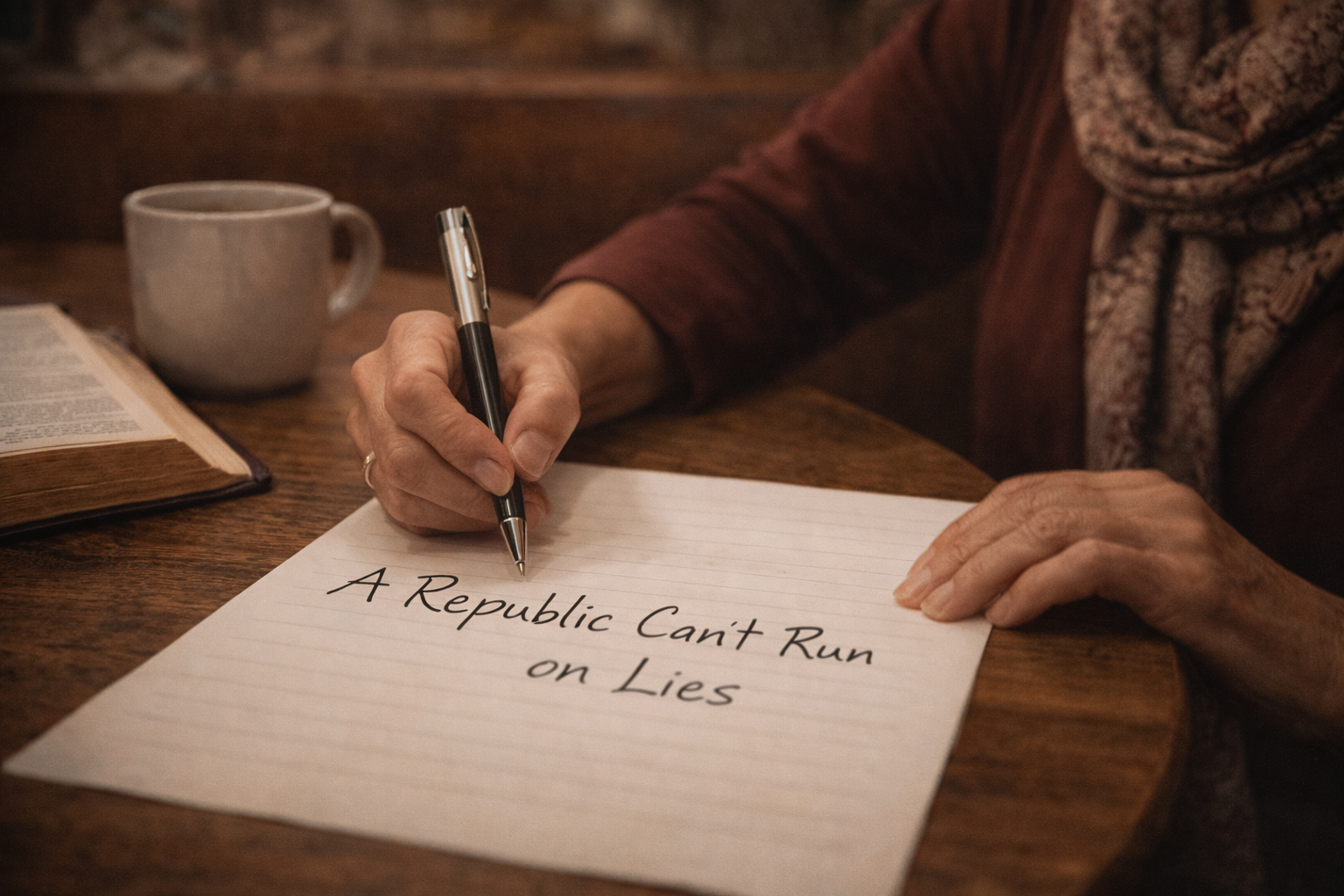
The bell above the door of The Shepherds Cafe chimed, and Elijah stepped in carrying two coffees and a stack of notes he hadn’t meant to bring. He’d told himself he was coming for a quiet hour. But he’d learned something about quiet hours: they vanish the moment someone sits down and speaks honestly.
Barbara was already in her usual booth—scarf in place, Bible open, phone facedown like it was something that might bite.
Elijah slid a mug toward her. “You look like you’ve been holding your breath.”
Barbara didn’t smile. “I’ve been watching America.”
Elijah sat, steady. “Then you have been holding your breath.”
Barbara tapped the edge of her Bible. “Road rage. Abuse. People unraveling in public. Families turning into war zones over politics. And the news—spin, fear, propaganda, emotional manipulation. It feels like we’re living inside a pressure cooker.”
Elijah waited a beat. “You’re describing a mental health burden and a truth crisis feeding each other.”
Barbara nodded once. “I’ve been calling it Truthistaria—like hysteria, but built on the hatred of plain facts.”
Elijah’s eyes narrowed slightly—not at her, but at the accuracy of the symptom. “There’s a researched term for a piece of what you’re describing. RAND calls it Truth Decay—the diminishing role of facts and analysis in public life.”
Barbara’s voice went quieter. “Truth Decay. That’s the clean name for the ugly thing.”
Elijah stared into his coffee like he could see the last decade floating on the surface. “Another word that fits the wider collapse is moral anomie—when shared standards weaken and people stop feeling accountable to anything but impulse and tribe.”
Barbara leaned forward. “So I’m not imagining the mental strain?”
“No,” Elijah said. “The data backs it up.”
He opened a page and read it like a man reading a medical chart. “A CDC report comparing 2019 to 2022 found anxiety symptoms rose from about 15.6% to 18.2%, and depression symptoms from 18.5% to 21.4%. That’s millions more people living in distress.”
Barbara’s jaw tightened.
“And NIMH estimates 23.1% of U.S. adults—more than one in five—had ‘any mental illness’ in 2022.”
Barbara exhaled, slow. “That’s not a fad. That’s a national condition.”
Elijah nodded. “And during parts of 2020–2021, the CDC reported adults with symptoms of anxiety or depressive disorder rising into the upper 30s to low 40s percent range in their surveys—an extraordinary level of widespread strain.”
Barbara looked down at her Bible as if she needed something solid. “Has America ever looked like this before?”
Elijah chose his words carefully. “America has had seasons of fracture—Civil War era propaganda and hatred, later cycles of unrest, periods of moral panic. But the difference now is the speed and saturation. The combination of constant media stimulation, social reward for outrage, and shrinking trust in institutions creates an atmosphere where people don’t just disagree—they doubt reality itself.”
Barbara’s eyes hardened. “And when reality becomes optional, people become dangerous.”
Before Elijah could answer, Jeremiah slid into the booth beside Barbara, quiet as a shadow but present like an anchor. “That’s the part many don’t want to say,” he murmured. “When truth is treated like a tool, the next thing that collapses is restraint.”
Barbara didn’t turn. “Give me real-life examples. Widely known. Not theories.”
Elijah nodded. “Two cases keep coming to mind because they show what happens when mental instability meets a society already on edge.”
He held up one finger. “Lewiston, Maine. Reporting after the mass shooting described warning signs and known concerns about the suspect’s mental deterioration—voices, erratic behavior, threats—and the failures to intervene in time.”
Barbara’s face tightened.
“And another,” Elijah continued, “is what happened in Charlotte on the light rail. Iryna Zarutska, a young woman who fled war-torn Ukraine seeking safety, was fatally stabbed on a commuter train. The suspect, Decarlos Brown Jr., has been described in major reporting as having a history of severe mental illness, including schizophrenia, and the case drew national attention precisely because she escaped one kind of terror only to meet another.”
Jeremiah’s voice turned heavy. “A woman outruns a battlefield and dies on a train car. That’s the kind of headline that should humble everybody—politicians, commentators, and citizens.”
Barbara’s eyes glistened but stayed controlled. “So the mental health crisis is real. But what about the dishonesty? The illogical arguments. The rage. The propaganda designed to provoke violence. The shamelessness.”
Jeremiah answered first, because Scripture lived close to his tongue. “The Bible doesn’t treat truth like a preference. It treats truth like a boundary line. People can know and still refuse. Romans 1 says some ‘suppress the truth.’ That isn’t confusion—it’s rebellion.” (Romans 1:18–25)
Elijah nodded. “And Scripture is equally direct about rage. ‘The anger of man does not achieve the righteousness of God’ (James 1:19–20). ‘Let all bitterness and wrath and anger… be put away from you’ (Ephesians 4:31–32). The Bible doesn’t endorse a permanent state of outrage.”
Barbara pressed her palms together. “What about the intellectual dishonesty—people denying obvious reality even when evidence is undeniable?”
Jeremiah’s reply was blunt. “Proverbs says, ‘A fool is right in his own eyes’ (Proverbs 12:15). Isaiah warns about moral inversion—calling evil good and good evil (Isaiah 5:20). Second Thessalonians describes a refusal to ‘receive the love of the truth’ (2 Thessalonians 2:10–12). That’s not an IQ issue. It’s a heart issue.”
Barbara looked from one man to the other. “So what do Christians do when they’re dealing with someone who truly has mental health issues?”
Elijah answered with the steadiness of an elder who has seen both suffering and manipulation.
“First, compassion without naïveté: ‘Weep with those who weep’ (Romans 12:15). Don’t mock pain. Don’t shame weakness.”
“Second, gentle restoration when sin is involved: ‘Restore… in a spirit of gentleness’ (Galatians 6:1). Gentle does not mean permissive; it means controlled.”
“Third, burden-bearing with wisdom: ‘Bear one another’s burdens’ (Galatians 6:2), and help them pursue appropriate care—medical evaluation when symptoms are severe, counseling when trauma is present, and practical supports that stabilize life.”
Jeremiah added, calm and firm, “And if there is danger—threats, violence, abuse—you protect life. You do not spiritualize danger away. Romans 13 exists for a reason: God uses lawful authority to restrain chaos.” (Romans 13:1–7)
Barbara nodded. “Now tell me what anchors a republic when truth collapses.”
Elijah didn’t guess. He quoted men who said it plainly.
“John Adams wrote: ‘Our Constitution was made only for a moral and religious People. It is wholly inadequate to the government of any other.’”
Jeremiah followed immediately. “Washington warned in his Farewell Address: ‘Religion and morality are indispensable supports’ of political prosperity.”
Elijah finished the triangle. “And Madison warned about crowds: ‘Passion never fails to wrest the sceptre from reason… Had every Athenian citizen been a Socrates, every Athenian assembly would still have been a mob.’”
Barbara sat back, as if those sentences carried the weight of a beam. “So even they knew—without virtue, you don’t keep liberty. You keep only the appearance of it.”
Jeremiah nodded. “And when truth decays, people stop self-governing. When self-government collapses, someone else governs them—usually with force.”
Barbara’s voice hardened into resolve. “Then what do we do to stop the madness? Not post about it—stop it.”
Elijah’s answer was practical, not theatrical.
“Stop feeding the machine. Limit outrage intake. Choose fewer sources. Verify before you repeat. Refuse to share claims you cannot substantiate.”
Jeremiah added, “Rebuild moral formation locally. Your home. Your friendships. Your congregation. Truth is restored the same way it’s lost—through daily habits, words, and accountability.”
Barbara’s eyes sharpened. “And in the church?”
Elijah didn’t hesitate. “Practice clean Christian conduct: Matthew 18 instead of whisper campaigns. Ephesians 4 speech instead of verbal arson. Romans 12 peace as far as it depends on you.”
Jeremiah nodded. “And pray for leaders, because chaos punishes the vulnerable first.” (1 Timothy 2:1–2)
Barbara picked up her phone, looked at it for one second, then set it down again—farther away than before.
“I don’t want Truthistaria renting space in my mind,” she said.
Elijah’s voice softened, but it didn’t soften the truth. “Then don’t let the world disciple you. Let Scripture disciple you.”
Jeremiah looked up at the café TV—muted now, still flickering—and said quietly, “If enough people stop rewarding lies and rage, the lies and rage get weaker.”
The café remained warm. The nation remained loud.
But in that booth, reality felt solid again—not because the world had healed, but because three believers decided to live under something sturdier than panic: truth, restraint, mercy, and obedience to Christ.