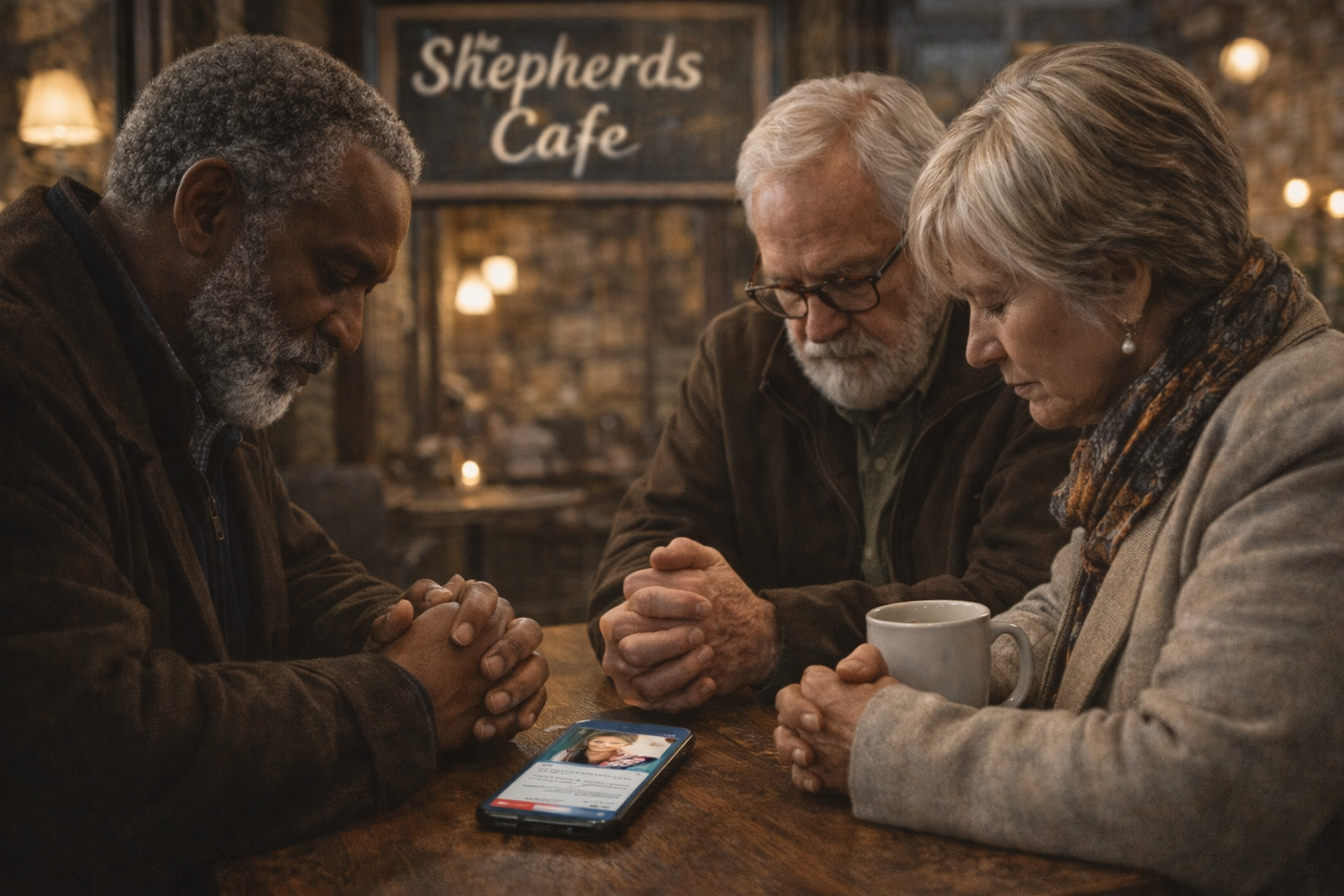
The winter light outside The Shepherds Cafe had that washed-out look it gets when the air is cold and the headlines are colder. Inside, the warmth didn’t feel like comfort so much as contrast—coffee, low conversation, and the quiet clink of cups against saucers.
Elijah was already seated near the window, glasses low on his nose, scrolling carefully on his phone as if he didn’t want to misread anything. Jeremiah sat across from him, shoulders squared, calm but not relaxed. Barbara arrived last, set her bag down, and didn’t sit immediately. She stood a second, watching their faces.
“Bad news?” she asked.
Elijah looked up. “Hard news.”
Jeremiah nodded once. “The kind that makes you check your own house twice before you go to sleep.”
Barbara sat down slowly. “Tell me.”
Elijah turned the phone so both could see. “Oklahoma. A missing 12-year-old boy—Ryan Davis. Authorities said he was last seen January 2 in Chickasha, and the state bureau called the disappearance suspicious.”
Barbara’s hand went to her mouth for a moment, then lowered. “Twelve.”
Jeremiah’s voice stayed steady, but there was weight behind it. “At twelve, a child should be thinking about school, friends, and what they’re going to be when they grow up. Not how to survive adults.”
Elijah kept reading. “An endangered missing advisory was issued. And then—his mother and stepfather were arrested on allegations that include child abuse, child sexual abuse, and conspiracy.”
Barbara’s eyes narrowed. “So while the public is searching, the investigators are seeing something darker.”
Jeremiah’s jaw tightened. “And we have to say ‘alleged,’ because it’s an investigation and courts exist. But we’re not blind either. The pattern is familiar.”
Elijah nodded. “The officials said there was ‘apparent harm’ done to him while living with them.”
Barbara stared at the table as if the grain in the wood could absorb what she was feeling. “How do you even process that?”
Jeremiah’s eyes stayed on the window, but he wasn’t looking at the street. “You don’t process it quickly. You carry it. And you decide what kind of people you’re going to be in a world where children can disappear and nobody notices for too long.”
Elijah scrolled again, then looked up. “There’s an update. He was found safe days later—in Caddo County, near Cement—and checked out medically.”
Barbara exhaled like her lungs had been holding air for strangers. “Thank God.”
Jeremiah didn’t soften. “Yes—thank God. But ‘found safe’ doesn’t erase what he’s been through.”
Elijah nodded slowly. “Charges were filed and publicly reported—multiple counts against the adults.”
Barbara’s voice was quiet, direct. “People will read this and treat it like a true-crime episode. They’ll argue online. They’ll pick sides. They’ll forget there’s a real child with a real body and a real soul.”
Jeremiah leaned forward slightly. “And some Christians will do something worse. They’ll read it, shake their heads, and act like it has nothing to do with us.”
Elijah’s eyes met his. “But it does.”
Barbara looked between them. “Say what you mean.”
Jeremiah didn’t hesitate. “This is why God hates violence and deceit. This is why Scripture commands protection for the vulnerable. This is why the church has to be alert—not paranoid, but awake. Families don’t just need advice. They need righteousness. They need accountability. They need truth.”
Elijah set the phone down. “People want a solution that fits in a comment section. But when children are harmed, the response has to be bigger than outrage.”
Barbara’s expression hardened with purpose. “So what does a faithful response look like?”
Jeremiah answered like a man making a checklist for his own conscience.
“First,” he said, “we refuse to treat this as entertainment. No jokes. No casual sharing. No graphic curiosity.”
Barbara nodded once.
“Second,” Jeremiah continued, “we tell the truth without slander. We don’t invent details. We don’t speculate. We respect due process while still admitting evil is real.”
Elijah nodded. “That’s hard for people.”
“It’s necessary,” Jeremiah replied.
“Third,” Jeremiah said, “we check our own circles. Children need safe adults, and safe adults need standards. In families. In the church. Everywhere. Scripture isn’t silent about this.”
Barbara’s eyes lifted. “Give me Scripture.”
Jeremiah didn’t raise his voice. He didn’t need to.
“Jesus warned about harming little ones—strongly,” he said. “He said it would be better for someone to face severe consequences than to cause a child to stumble.” (Matthew 18:6)
Barbara swallowed.
“And James defines pure religion in part as caring for the vulnerable,” Jeremiah continued. “Not performing. Not posing. Caring.” (James 1:27)
Elijah added, quiet and firm, “And Paul’s words about exposing deeds of darkness—those aren’t abstract either.” (Ephesians 5:11)
Barbara sat back, eyes glossy but controlled. “So the church can’t just be a place where people show up. It has to be a place where people are safe.”
Jeremiah nodded. “Exactly. And that means fathers and mothers have to be vigilant. It means the congregation has to be wise. It means we don’t ignore warning signs because it’s uncomfortable.”
Elijah looked down at the table, then up again. “There’s another reason this story matters. It’s a reminder that God sees what people try to hide.”
Barbara’s voice came out in a whisper. “And He hears what children can’t say.”
Jeremiah’s eyes closed for a brief second. When he opened them, they were steady again.
“We can talk about systems and laws,” he said, “and those matter. But at the end of the day, a child needs protection, healing, and a future. That’s why God designed the home the way He did—and why Satan targets it.”
Barbara placed her hands flat on the table. “Then we end this the right way.”
Elijah nodded. “Not with commentary.”
Jeremiah’s voice softened. “With prayer.”
They bowed their heads right there, in the middle of the café noise, because some moments don’t require a stage—only sincerity.
Jeremiah prayed first, slow and heartfelt.
“Father in heaven, thank You for mercy—thank You that Ryan was found alive. We ask You now for what only You can do: protect him, heal him, strengthen him, and surround him with people who will do right by him. Bring truth into the light. Give wisdom to investigators and restraint to every voice that wants to turn this into spectacle. Expose what is evil. Guard the innocent. Comfort the hurting.”
Barbara’s voice joined in, trembling but firm.
“Lord, forgive us where we’ve been sleepy. Forgive us where we’ve assumed children are always safe. Make Your people a refuge—quiet, steady, and vigilant. Raise up men and women who will protect, report, intervene, and care. Help us to love what You love, and hate what harms the vulnerable.”
Elijah finished, voice low.
“Father, we ask for restoration where it can be found, justice where it must be done, and peace for a boy whose world has been shaken. Teach us to be the kind of church that notices. The kind that acts. The kind that prays—and then obeys. In Jesus’ name, amen.”
When they lifted their heads, the café looked the same—cups, chairs, warm lights—but something in their table was different.
They weren’t just informed.
They were accountable.
And they meant it.