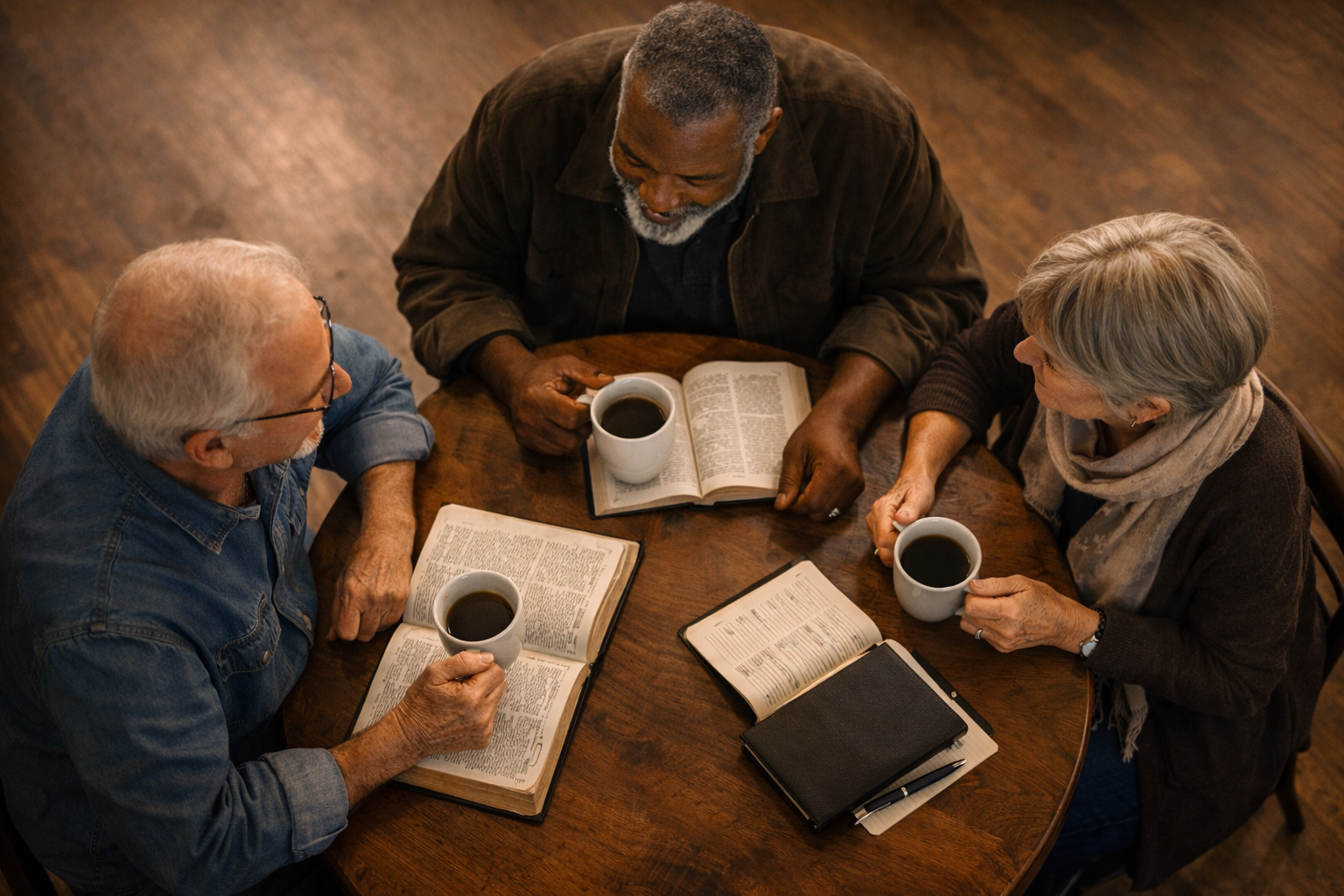
The lunch rush at The Shepherds Cafe had thinned down to that quiet, late-afternoon lull when cups clink a little louder and people talk a little softer. Sunlight leaned across the front windows in long, warm rectangles. Elijah sat with his glasses pushed up on his nose, a Bible opened beside his coffee. Jeremiah, with his salt-and-pepper beard and steady eyes, watched the door out of habit more than curiosity. Barbara stirred her tea slowly, listening the way she always did—like she was weighing every word before it landed.
A young couple had just left the counter, and as they passed the table they smiled.
“Good to see you, brother,” the man said to Jeremiah.
“And you too, sister,” the woman added to Barbara, cheerful and natural as breathing.
They walked out, the bell over the door giving one clean ring—and then Barbara let her spoon rest.
“I want to ask something,” she said. “Because I love how that sounds. I love what it means. But I also know people can turn a good thing into something shallow without even trying.”
Jeremiah nodded. “Go on.”
Barbara’s gaze moved between the two men. “In the Bible, what does it really mean to call someone brother or sister? Is it just church language? Is it supposed to be a title? And is there anything like it in the Old Testament?”
Elijah leaned back, eyes narrowing a bit—not in suspicion, but in careful thought. “That’s not a small question. The words are simple, but the weight of them is heavy.”
Jeremiah opened his Bible. “Let’s start where Scripture starts—with what the words are before we decide what people made them.”
The word before the habit
“In the most basic sense,” Jeremiah said, tapping the page, “brother and sister are family words. Literal first. Cain and Abel, Jacob and Esau—blood family. But Scripture also uses family language beyond biology when a shared covenant or shared identity is involved.”
Barbara nodded. “So it can stretch.”
“It stretches,” Elijah said, “but it doesn’t become vague. It stretches with purpose.”
He flipped a few pages and glanced up. “In Israel, there’s a strong thread where fellow Israelites are called brothers—not because they all share the same father, but because they share a covenant peoplehood. Think of Moses’ language: ‘You shall not harden your heart… to your poor brother’ (Deuteronomy 15). That’s not biology. That’s covenant responsibility.”
Barbara lifted her eyebrows. “So the Old Testament equivalent is Israel calling Israel ‘brother’?”
“Exactly,” Jeremiah said. “And it shows up in the prophets too—when the covenant is violated, it’s not just ‘laws broken.’ It’s family betrayed.”
Elijah added, “Even outside Israel, there’s a broader human sense sometimes—neighbor language, shared humanity—but the sharpest Old Testament use is ‘brother’ as covenant kin.”
Barbara set her tea down. “So the Old Testament already has the idea of spiritual kinship.”
“Yes,” Jeremiah said, “but the New Testament takes that idea and anchors it in something even deeper.”
The early church wasn’t pretending
Elijah leaned forward. “When Jesus comes, He doesn’t just teach people to be nicer. He creates a new family.”
Jeremiah spoke like he was building a foundation stone by stone. “Jesus says the one who does God’s will is His brother and sister and mother (Matthew 12:50). That’s not a cute metaphor. That’s a boundary line. He’s describing an identity formed by obedience to God.”
Barbara’s voice softened. “So the family is defined by submission to God, not last names.”
“And then the apostles live that out,” Elijah said. “In the book of Acts and the letters, believers are constantly addressed as brothers—and the idea includes sisters as well, even when the masculine plural is used. The point is: they belonged to one another.”
Jeremiah lifted his cup, then set it down again without drinking. “In the early church, this wasn’t a greeting card sentiment. It had teeth. If you were my brother, I couldn’t treat you like a stranger. I couldn’t ignore your needs. I couldn’t slander you. I couldn’t casually divide from you for petty reasons. Brotherhood meant obligation.”
Barbara smiled, but there was a seriousness behind it. “So when people called each other brother and sister, it wasn’t a ‘churchy vibe.’ It was a pledge.”
Elijah nodded. “A pledge—and a reminder. It says, ‘We don’t belong to the world anymore the way we used to. We belong to Christ, and therefore to each other.’”
Is it a title—or is it a relationship?
Barbara looked down at her hands. “But what about today? People say ‘Brother So-and-So’ like it’s a label. Is that okay? Or is it improper?”
Jeremiah didn’t rush. “It depends what you mean by title.”
Elijah spoke plainly. “If ‘brother’ and ‘sister’ are used as honest descriptions—like ‘This person is my family in Christ’—that’s biblical in spirit. The New Testament writers use ‘brothers’ constantly as an address to the saints. That’s not wrong.”
Barbara pressed gently. “But if it becomes… a status marker?”
“That’s where it goes sideways,” Jeremiah said. “The moment ‘Brother’ becomes a substitute for holiness, or a badge people wear while refusing the obligations of family, we’ve hollowed the word out.”
Elijah added, “Or worse—when people use it as a way to sound spiritual while staying distant. ‘Brother’ in name, but not in conduct. That’s a contradiction.”
Barbara’s eyes narrowed thoughtfully. “So it’s not improper to say it. It’s improper to reduce it.”
“Right,” Jeremiah said. “It can become a mere form of address—like ‘sir’—and if it does, we’ve lost what made it powerful.”
Elijah flipped his Bible again. “The New Testament repeatedly warns against empty religion—words without obedience. The term ‘brother’ is one of those words that can be spoken while the heart refuses the reality.”
Barbara leaned in. “So what does the Bible actually demand from this word?”
Jeremiah answered with calm certainty. “It demands that we treat each other as family. It demands integrity—especially in how we speak, how we forgive, how we serve, and how we correct.”
Why the church should be careful with “titles”
Barbara watched a server wipe down a nearby table. “Some churches use titles heavily—‘Reverend,’ ‘Father,’ ‘Pastor,’ all that. We don’t. But we do say ‘brother’ and ‘sister.’ Is there a danger we treat it like those?”
Elijah’s voice was firm, respectful, and direct. “There is always a danger when language becomes ceremony. But ‘brother’ and ‘sister’ are different in nature. Those other titles often claim rank or office. ‘Brother’ and ‘sister’ claim shared standing at the foot of the cross.”
Jeremiah nodded. “They level the room. They don’t elevate one Christian above another.”
Barbara said, “But some people still use ‘Brother’ as a kind of rank.”
Elijah didn’t sugar-coat it. “Then they’re using a family word like a trophy. That’s not the Bible’s intent.”
Jeremiah added, “In Scripture, if anything, leaders are told to be servants. The family language is meant to deepen humility, not inflate ego.”
What it meant when it first hit their mouths
For a moment, the café seemed quieter, like the building itself was listening.
Barbara said softly, “I’m trying to picture the first time a believer used that word for someone they weren’t related to.”
Jeremiah’s eyes drifted upward, as if he could see the scene. “A Jewish believer calling a Gentile believer ‘brother.’ That’s revolutionary. That word crossed lines the world guarded fiercely.”
Elijah’s finger rested on the page. “And it cost them something. When they took ‘brother’ and ‘sister’ seriously, they shared meals, carried burdens, endured persecution together, and sometimes buried each other. In that environment, the word wasn’t cheap.”
Barbara swallowed. “So when we say it today, we’re either honoring that reality—or we’re playing with a sacred thing.”
“That’s exactly it,” Elijah said.
A practical test: can you say it and live it?
Jeremiah looked at Barbara. “Here’s a test that’s simple and uncomfortable: if I call someone ‘brother,’ am I willing to act like it when it costs me time, patience, money, forgiveness, or pride?”
Barbara nodded slowly. “And if I’m not… then I’m using the word as camouflage.”
Elijah pointed gently. “And another test: do we only use the words for people we like? Because Scripture doesn’t define family by chemistry. It defines it by covenant in Christ.”
Barbara sighed. “So the term is not a social preference. It’s a spiritual reality.”
Jeremiah smiled. “Now you’re talking like the New Testament.”
The closing thought Barbara wouldn’t let go of
They sat for a moment, the kind of pause that isn’t empty—it’s full.
Barbara finally said, “I think I understand. The Bible doesn’t give us ‘brother’ and ‘sister’ as cute church décor. It gives them as a name for what God made us—a family bought by Christ, obligated to love, and meant to be recognizable by our care for one another.”
Elijah nodded once, satisfied. “If we treat ‘brother’ and ‘sister’ as mere titles, we risk making them cheap. But if we treat them as what they are—family identity in Christ—then those words become one of the most powerful confessions a Christian can make.”
Jeremiah lifted his cup at last. “And they become a reminder every time we say them: ‘I am not alone. And I do not get to live like I am.’”
Barbara smiled, picked up her tea, and looked out the window as someone walked past the café with a bag of groceries.
“Then we’d better say it carefully,” she said, “and live it loudly.”
And for a moment, in that quiet corner of The Shepherds Cafe, the word brother sounded less like a habit—and more like a vow.