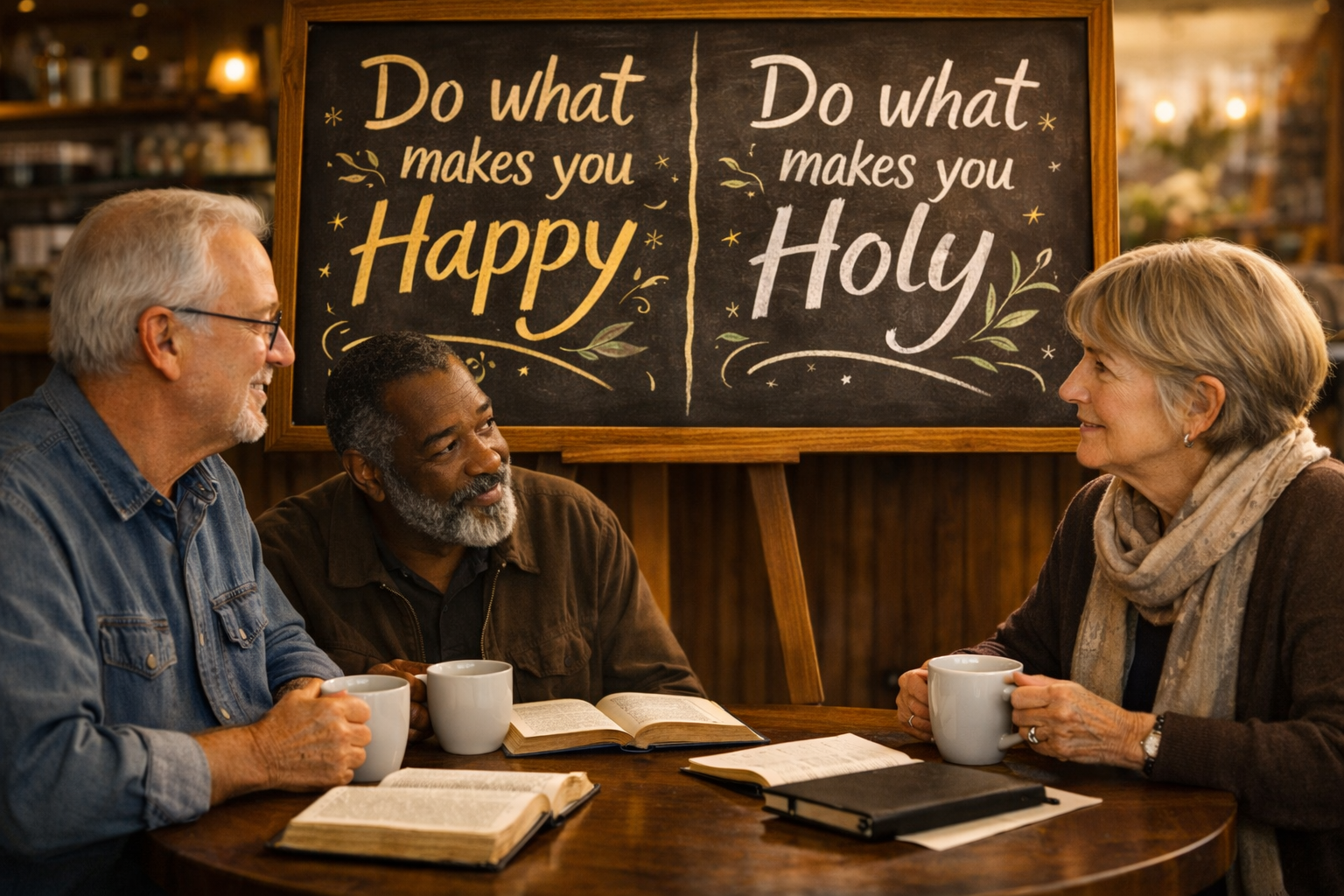
The sign on the counter at The Shepherds Cafe was meant to be cute, the kind of thing people photograph and post without thinking too hard.
It read:
DO WHAT MAKES YOU HAPPY.
Barbara saw it while she was waiting on her tea. She didn’t frown. She didn’t scoff. She just looked at it a long time, like she was measuring the phrase against something older and heavier than modern slogans.
When she returned to the table, Elijah noticed immediately.
“That sign got you,” he said.
Barbara sat down, set her cup beside her Bible, and nodded once. “It did. Not because happiness is wrong. But because it’s incomplete. And because I can hear another phrase in my head that the world never prints on a chalkboard.”
Jeremiah’s salt-and-pepper beard moved with the smallest smile. “Let me guess. ‘Do what makes you holy.’”
Barbara pointed at him like he’d read her mail. “Yes. That. Exactly. And I want to talk about it because people act like holiness is a punishment word.”
Elijah pushed his glasses up and opened his Bible. “Holiness isn’t a punishment word. It’s a belonging word.”
Jeremiah leaned in. “Start with the meaning. If we don’t define it biblically, we’ll drift into feelings and slogans.”
What “holy” actually means
Barbara exhaled slowly. “So what does it mean?”
Jeremiah tapped the open pages. “At its core, holy means set apart—distinct, devoted, belonging to God. Not ‘weird for the sake of weird.’ Not ‘better than everyone else.’ It’s the idea of being claimed.”
Elijah added, “In Scripture, God is holy because He is utterly distinct—morally pure, unmatched, uncorrupted, separate from sin. When God calls something holy—a day, a place, a people—He’s saying, ‘This is mine. Treat it accordingly.’”
Barbara looked down at her hands. “So holiness is not just behavior.”
Jeremiah nodded. “Behavior matters, but holiness begins with ownership—God’s claim on you.”
Elijah said it plainly. “That’s why holiness is personal. You can’t fake it with aesthetics. You can’t buy it with respectability. You either belong to God or you don’t.”
Barbara’s eyes lifted. “That’s direct.”
“It needs to be,” Elijah replied. “Because people will settle for a clean image and never pursue a clean heart.”
Why holiness is good
Barbara wrapped her fingers around her cup. “Okay. If holiness means set apart and belonging to God, why is it good? People hear ‘holy’ and think ‘joyless.’”
Jeremiah didn’t hesitate. “Because holiness protects what love builds.”
Elijah nodded. “Holiness is good for the same reason purity is good, truth is good, faithfulness is good. Sin doesn’t just break rules—it breaks people.”
Barbara frowned slightly. “But people want immediate pleasure.”
“And immediate pleasure isn’t the same as lasting good,” Elijah said. “Holiness is not God trying to keep you from joy. It’s God keeping joy from being poisoned.”
Jeremiah leaned back, hands folded. “Think about it: God’s commands aren’t random. They’re not arbitrary hoops. They’re the architecture of life lived in fellowship with Him. Holiness is the shape of a life that can actually hold up under pressure.”
Barbara’s voice softened. “So holiness isn’t the enemy of happiness.”
“It’s the foundation for a kind of happiness that doesn’t collapse,” Jeremiah said.
Why God expects holiness
Barbara looked from one man to the other. “Why does God expect holiness from His subjects?”
Elijah’s answer came like a straight line. “Because God isn’t recruiting admirers. He’s forming a people.”
Jeremiah added, “Because His nature sets the standard. A holy God doesn’t call people into fellowship so they can remain committed to sin. He calls them out of darkness into light. Holiness is simply living in agreement with who He is.”
Barbara’s gaze tightened. “But the world hears that as controlling.”
Elijah didn’t blink. “The world calls any authority ‘controlling’ if it interrupts their appetites. But Scripture teaches that submission to God is not slavery—it’s liberation from sin’s mastery.”
Jeremiah’s voice stayed calm. “And there’s another reason. God expects holiness because His people represent Him. When God’s people live like the nations, the world learns to misread God.”
Barbara nodded slowly. “So holiness is witness.”
“Yes,” Elijah said. “Holiness is the visible proof that God’s rule is real.”
“Do what makes you holy” vs “Do what makes you happy”
Barbara looked back toward the counter sign. “So then what’s wrong with ‘Do what makes you happy’?”
Jeremiah answered carefully. “Nothing—if happiness is defined by God’s truth and restrained by God’s will. But the slogan doesn’t mean that. In practice it usually means: ‘Do what feels good right now. You are your own authority.’”
Elijah leaned in. “That phrase assumes your desires are trustworthy. Scripture says they’re not always. The heart can be sincere and still be wrong. A person can be genuinely happy on the road to ruin.”
Barbara’s mouth tightened. “So the slogan is dangerous because it makes feelings king.”
“Exactly,” Jeremiah said. “Happiness is a result, not a ruler.”
Elijah continued. “When people say ‘Do what makes you happy,’ they often mean: choose comfort over conviction, preference over obedience, appetite over wisdom. But ‘Do what makes you holy’ means: choose what aligns you with God—whether it feels easy or not.”
Barbara looked down at her Bible. “So holiness sometimes requires doing what doesn’t feel happy in the moment.”
Jeremiah nodded. “Yes. Repentance rarely feels happy at first. Forgiveness can feel like loss before it feels like freedom. Self-control can feel like deprivation before it feels like strength.”
Elijah added, “But holiness isn’t misery. Holiness is training your joy to live in the right place.”
Barbara sat back. “So one phrase says, ‘Follow yourself.’ The other says, ‘Follow God.’”
“And there’s the whole fight,” Elijah said.
A test the café can’t ignore
Barbara stared at the table for a moment. “Can I say something blunt?”
Jeremiah smiled. “Please do.”
Barbara looked at them with quiet seriousness. “If I chase happiness as my highest goal, I will eventually justify sin. I will rename sin. I will call it ‘self-care’ or ‘my truth’ or ‘what I deserve.’”
Elijah nodded once. “That’s exactly what people do.”
Barbara continued. “But if I pursue holiness, I might lose some short-term comforts—and gain something deeper: a clean conscience, a steady mind, a faithful life, and fellowship with God.”
Jeremiah’s eyes softened. “And you gain a happiness that doesn’t have to lie to survive.”
Elijah glanced at the sign again. “The world’s slogan sells impulse. God’s call builds endurance.”
Barbara took a sip of tea. “So what would a better sign say?”
Jeremiah thought for a second. “Maybe: Do what pleases God—happiness will learn to follow.”
Elijah gave a small smile. “Or: Do what makes you holy—then you’ll finally learn what happiness was supposed to be.”
Barbara looked back toward the counter one last time. The chalkboard slogan hadn’t changed, but something had shifted anyway—right there at the table.
She nodded slowly. “Holiness isn’t God ruining our fun.”
Jeremiah raised his cup slightly. “It’s God rescuing our joy from becoming our god.”
Elijah’s voice was calm and unflinching. “And that’s why God expects holiness: because He loves His people too much to let them be ruled by whatever makes them feel good today.”
Barbara set her cup down and opened her Bible.
“Then,” she said, “I want to live like someone who belongs to Him.”
And in the ordinary warmth of The Shepherds Cafe, the word holy stopped sounding like a museum word—and started sounding like a home address.