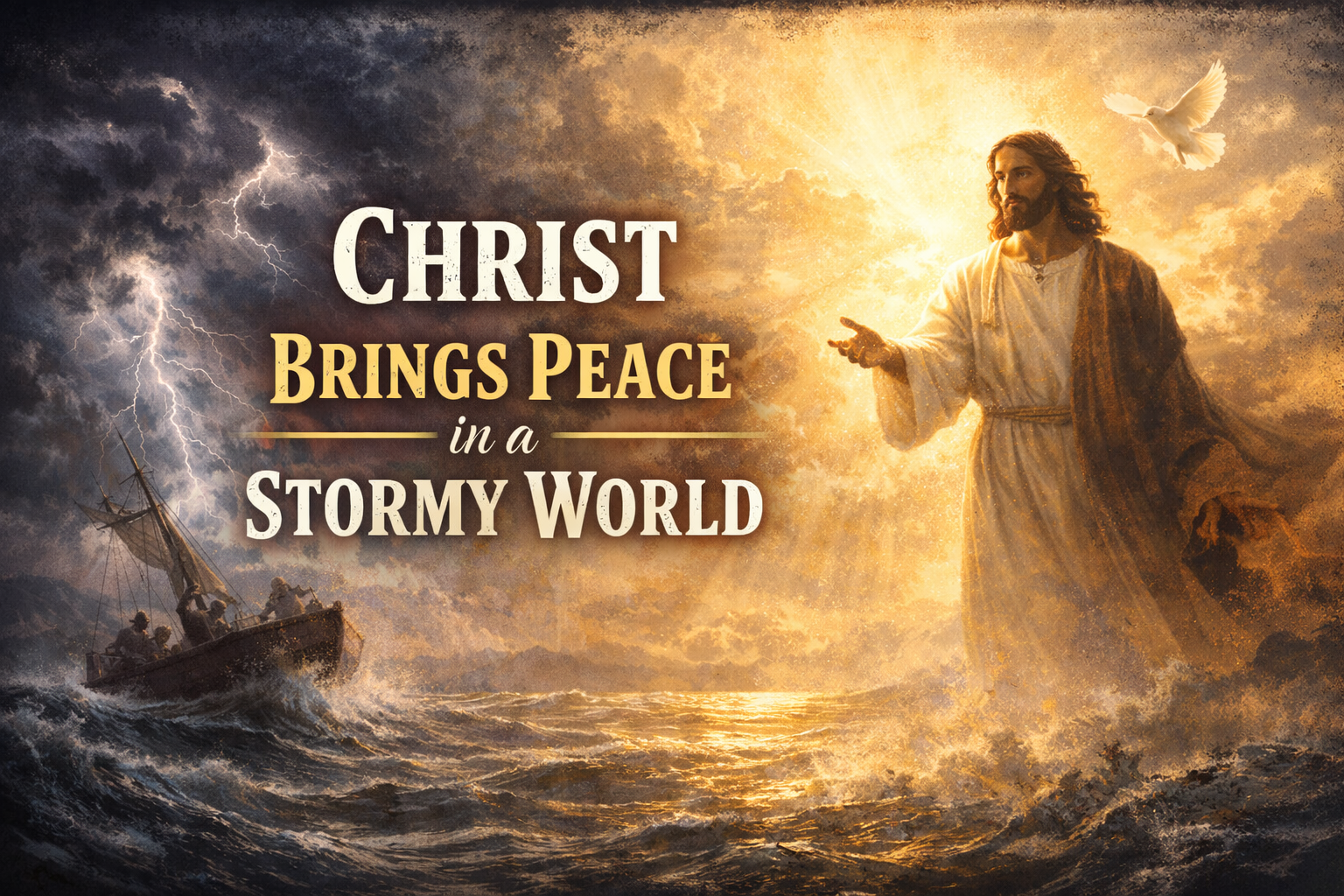
The rain had started before sunrise and never really let up. By late afternoon, the windows of The Shepherds Cafe were streaked with water, the sky was dark as old slate, and the whole street outside looked tired. Cars moved slower. People moved slower. Even the usual clatter of cups and conversation seemed softened by the weather, as if the storm had pressed its hand over the whole town and told it to hush.
Barbara stood near the counter drying a cup that was already dry. Elijah noticed that and smiled to himself, but he did not say anything. Jeremiah sat near the window, watching the runoff gather at the curb and swirl around leaves and bits of gravel. The television in the corner was on low volume, showing one hard story after another. War overseas. Political division at home. Economic worries. Another shooting. Another scandal. Another family shattered. Another reason for people to go to bed anxious and wake up more anxious than they were the day before.
Finally Barbara shook her head and said, “It feels like the world has forgotten how to be still.”
Jeremiah looked over from the window. “The world has never been very good at stillness.”
“That’s true,” Elijah said, stepping forward with a warm mug in his hand. “But we’ve got more ways now to hear the storm. People used to hear thunder outside. Now they hear thunder from every direction all day long.”
Barbara gave a tired laugh. “That may be the truest thing said in here today.”
At the far end of the room sat a young man named Caleb, shoulders hunched, staring into a coffee cup like it might explain his life to him. He had come in several times that month, always polite, always quiet, and always looking like he had not slept well. Elijah had learned not to rush people when grief or pressure was sitting on them. Some folks opened up quickly. Others needed room. That afternoon, maybe because of the weather, maybe because the room felt safe, Caleb finally spoke.
“I don’t know how people are supposed to have peace anymore.”
The room did not freeze, but it did focus.
He continued, “Everywhere you turn, there’s something else to worry about. Money. Family. Health. Work. The country. The church. The future. And every time I think maybe I’ll get my footing, something else shifts under me. People keep saying, ‘Just trust God.’ I know that’s true. I’m not arguing with it. I just…” He stopped and rubbed his forehead. “I just don’t know what that looks like when your mind feels like a storm.”
Jeremiah leaned back and folded his hands over his cup. “That,” he said gently, “is a better question than most people ask.”
Barbara sat down across from Caleb. “A lot of people think peace means the storm leaves. But that isn’t always how Christ works.”
Caleb looked up. “Then what does He do?”
Elijah pulled out a chair and joined them. He did not speak immediately. He glanced once at the rain on the windows, then said, “Sometimes He calms the storm. Sometimes He calms you in the middle of it. And a lot of us have to learn that second one before we appreciate the first.”
Caleb frowned slightly, thinking.
Jeremiah nodded. “Mark 4 says Jesus was in the boat while the storm was raging. The disciples were panicking because experienced men knew enough to recognize real danger. This wasn’t pretend trouble. It wasn’t small. The waves were filling the boat. And where was Jesus? Asleep. Not because He didn’t care. Because He was never threatened by what terrified them.”
Barbara added, “And when they woke Him, they asked, ‘Teacher, do You not care that we are perishing?’ That’s the question people still ask, just with different wording. ‘Lord, do You not care that my family is hurting? Do You not care that I’m afraid? Do You not care that I don’t know what comes next?’”
Caleb looked down again. “I’ve asked that.”
“Most faithful people have,” Elijah said. “The mistake is not in bringing the question. The mistake is assuming the storm means Christ is absent.”
Outside, lightning flashed somewhere beyond the buildings, followed a few moments later by a low roll of thunder. No one in the cafe moved much. The weather had become part of the lesson.
“Elijah,” Barbara said, “tell him what you told me when I was losing sleep over everything last year.”
He gave her a knowing look. “Which part? You had enough worries for a whole prayer meeting.”
She smiled. “The part about peace not being natural.”
Elijah nodded. “All right. Caleb, this is the hard truth. Peace in Christ is not the same thing as a calm personality. Some people are naturally easygoing. That is not the peace of Christ. Biblical peace is deeper than temperament. It is not denial. It is not pretending everything is fine. It is not the power of positive thinking. It is confidence rooted in the character, authority, and promises of Jesus Christ.”
He paused and continued. “In John 16:33 Jesus said, ‘In the world you have tribulation, but take courage; I have overcome the world.’ Notice what He did not say. He did not say, ‘In the world you might have minor inconvenience.’ He said tribulation. Pressure. Trouble. Distress. So Christian peace is not built on the fantasy that trouble will not come. It is built on the certainty that trouble does not have the final word because Christ has already overcome the world.”
Caleb listened closely now.
Jeremiah pointed toward the muted television. “That screen will never run out of storms. Nations rage. markets shake. families fracture. bodies fail. friends disappoint. Churches go through strain. Your own thoughts can become a battlefield. If your peace depends on a quiet world, you will never have peace. This world is too broken to support that kind of hope.”
Barbara’s voice softened. “But Christ can support it.”
That line sat in the air for a moment.
She went on. “Paul wrote in Philippians 4 to be anxious for nothing, but in everything by prayer and supplication with thanksgiving let your requests be made known to God. Then he says the peace of God, which surpasses all comprehension, will guard your hearts and your minds in Christ Jesus. I love that language. Guard your hearts and minds. That means peace is not just a feeling drifting through the room. It stands watch. It protects. It holds the line when fear tries to invade.”
Caleb asked, “But what do you do when the fear keeps coming back?”
“All the time?” Jeremiah said.
Caleb gave a tired smile. “Yes. All the time.”
“You keep going back to Christ all the time,” Jeremiah replied. “That’s the part people sometimes leave out. They speak of peace like one prayer should settle every fear forever. But peace is often a repeated returning. You remember. You cast your cares on Him. You pray again. You open Scripture again. You refuse to hand your thoughts over to panic. You obey again. You trust again. This is not weakness. This is discipleship.”
Elijah added, “And sometimes the most spiritual thing you can do is stop feeding the storm inside you. Some people spend hours every day marinating in outrage, fear, speculation, and noise, then wonder why they have no peace. Brother, you cannot pour chaos into your mind morning to night and expect your soul to feel steady.”
Barbara pointed toward the corner television. “That box can inform you, but it is a terrible shepherd.”
Caleb laughed, and even Jeremiah smiled at that.
“It’s true,” Barbara said. “A lot of people are being discipled by headlines, social media arguments, and worst-case scenarios. Then they try to squeeze a little Jesus in somewhere around the edges and wonder why they still feel spiritually breathless. Christ does not offer peace as an accessory. He offers peace as the fruit of abiding in Him.”
The rain kept striking the glass in steady sheets.
Elijah looked out the window and said, “Isaiah called Him the Prince of Peace. That means peace is not merely something Jesus gives at a distance. It is bound up in who He is. He reconciles us to God through His blood. Romans 5 says, ‘having been justified by faith, we have peace with God through our Lord Jesus Christ.’ That is the deepest peace of all. Before Christ calms your emotions, He settles your standing before God. Before He eases your troubled mind, He removes your guilt through His sacrifice. The greatest storm any man faces is not politics or suffering or uncertainty. It is the matter of sin before a holy God. And Christ dealt with that at the cross.”
Caleb’s expression changed. Not fully relieved, but anchored.
Jeremiah saw it. “That’s where Christian peace begins. Not with improved circumstances. With reconciliation. If I know I belong to Christ, that my sins have been washed away, that I have been brought near to God, then even when the world shakes, the foundation under me has not moved.”
Barbara folded her hands on the table. “That does not mean Christians never feel grief. Jesus Himself said, ‘Let not your heart be troubled,’ and He said it to disciples who were about to walk through confusion, loss, and fear. Peace is not numbness. It is not the absence of tears. It is the presence of trust.”
Caleb asked quietly, “So how do I practice that this week?”
Elijah appreciated the question. It was practical. Honest. Necessary.
“First,” he said, “start with the Lord before you start with the world. Open your Bible before you open the news. Let the first loud voice in your day be God’s voice, not everybody else’s. Second, pray specifically instead of panicking generally. Name the fears before God. Put them into words. Third, limit what feeds your anxiety. Not because you are hiding from reality, but because you are trying to keep reality in its place under Christ. Fourth, remember what is actually fixed. God is still holy. Christ is still reigning. The gospel is still true. The tomb is still empty. The church still has a mission. Fifth, stay close to faithful brethren. Storms feel worse in isolation.”
Jeremiah added, “And sixth, do the next right thing. Sometimes peace grows while you obey. Write the note. Make the call. Go to worship. Serve somebody. Confess what needs confessing. Repent where needed. Much anxiety grows in the soil of avoidance.”
Barbara smiled. “That one will preach.”
“It ought to,” Jeremiah said.
Caleb looked at the rain again, but this time not with the same heaviness. “I think I’ve been waiting for my life to feel settled before I trust God peacefully.”
Elijah nodded. “A lot of people do that. But Christ teaches us something better. We do not wait for the sea to become glass before we believe He is Lord. We believe He is Lord while the waves are still hitting the boat.”
The thunder moved farther off. The rain softened from pounding to steady. A few people began stirring again, conversation returning to the room little by little.
Barbara stood to refill cups. “There’s another part people miss,” she said over her shoulder. “Christ not only brings peace to us. He teaches us to carry peace into a restless world. A peaceful Christian becomes a witness. Not passive. Not spineless. Peaceful. There is a difference. You can speak truth without panic. You can confront sin without hatred. You can endure hardship without collapsing. You can mourn without despairing. You can face tomorrow without pretending to control it.”
Jeremiah looked at Caleb with a fatherly seriousness. “That kind of peace gets noticed. Everybody understands panic. Very few understand settled trust. When a man goes through loss and still honors Christ, people notice. When a woman faces uncertainty and still speaks with hope, people notice. When a church stays steady in a foolish age, people notice. Peace is not just comfort. It is testimony.”
Caleb sat with that for a while, then finally said, “So the goal is not to become a man with no storms. It is to become a man who knows who is in the boat.”
Elijah smiled. “Now you’re talking right.”
The room warmed with small laughter.
Outside, the clouds had not broken fully, but the edge of the sky had lightened. Not bright. Not clear. But lighter. Enough to notice.
And maybe that was fitting. Christ does not always remove every dark cloud in one moment. Sometimes He gives something better than immediate escape. Sometimes He gives presence. Sometimes He gives strength to endure. Sometimes He gives brothers and sisters to help hold the line. Sometimes He says to the raging sea, “Peace, be still,” and sometimes He says it first to the frightened heart.
Either way, the peace is real because He is real.
In a stormy world, Christ brings peace because He is greater than the storm outside us and deeper than the storm within us. He reconciles sinners to God. He rules over chaos. He steadies troubled hearts. He teaches anxious souls to pray. He reminds frightened disciples that the boat was never abandoned. The wind may still howl. The headlines may still shake. The future may still be hidden. But for the one who belongs to Jesus, peace is not a fragile wish. It is a living promise anchored in the Son of God.
By the time Caleb stood to leave, the rain had softened to a mist. He pulled on his coat, thanked them quietly, and stepped toward the door.
Jeremiah called after him, “Remember this, son: peace is not found in figuring everything out.”
Caleb turned.
“It is found,” Jeremiah said, “in belonging to the One who never loses control.”
Caleb nodded once, then stepped out into the damp evening.
The street was still wet. The clouds were still there. The world was still troubled.
But he walked out steadier than he came in.
And that, sometimes, is how Christ calms a storm.