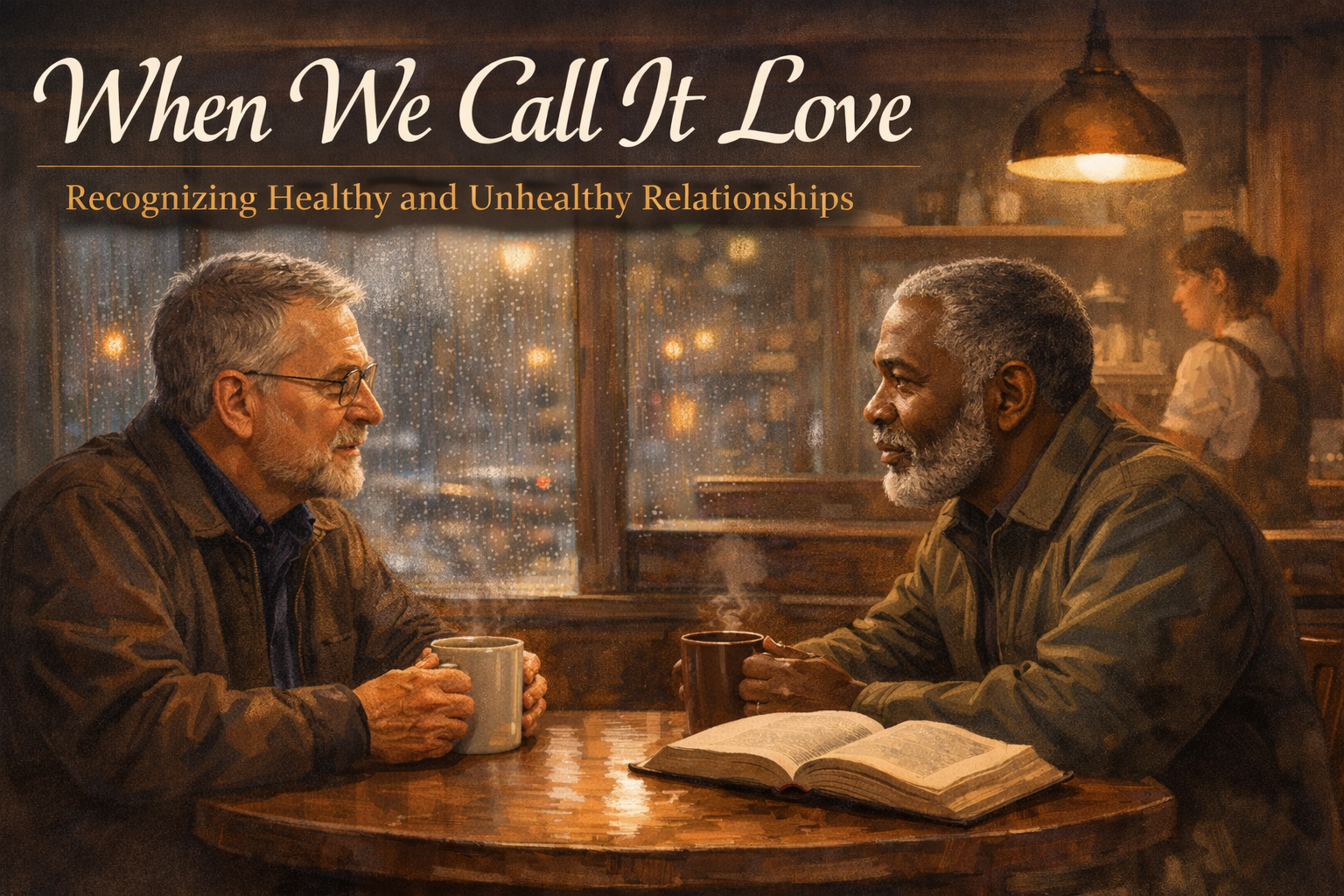
The rain had started just before supper time, steady and gray, tapping against the windows of The Shepherds Cafe like a hand that refused to quit knocking. Inside, the room was warm with coffee, old wood, and the low murmur of people who had nowhere urgent to be for a while.
Elijah was already seated when Jeremiah came in. He had a Bible open beside his cup, though he was not reading it now. He was watching the front door with the look of a man who had something heavy on his mind.
Jeremiah hung his coat, sat down across from him, and said, “You saw them too, didn’t you?”
Elijah nodded once. “I did.”
Neither man needed to explain. An hour earlier, just outside the building, they had both watched a young Christian defend a relationship that was plainly draining the life out of him. The young man had called it love. He had called it loyalty. He had called it patience. But what Elijah and Jeremiah had seen looked more like confusion, exhaustion, and spiritual compromise dressed up in noble words.
After a moment Jeremiah said, “That’s exactly why people need definitions.”
Elijah wrapped both hands around his mug. “Yes. Because once people stop defining things biblically, they start naming things by how they feel.”
Jeremiah leaned forward. “And once that happens, almost anything can be baptized with a good-sounding label. Control becomes concern. Enabling becomes kindness. Flattery becomes encouragement. Fear becomes loyalty. Silence becomes peace.”
Elijah gave a grim half-smile. “And rebuke becomes judgmentalism.”
“That too.”
Barbara came by with the coffee pot. She topped off both cups and looked from one man to the other. “You two look like you’re trying to repair the whole human condition again.”
“Just one corner of it,” Elijah said.
Barbara nodded toward the window. “Well, while you’re at it, fix the way people call every strong feeling love.” Then she moved on.
Jeremiah watched her go. “She got there faster than we did.”
“She usually does.”
The rain pressed harder against the glass. Elijah glanced down at his Bible and then back up. “The trouble is, people often ask whether a relationship feels meaningful before they ask whether it is righteous.”
Jeremiah answered quickly. “That’s my concern too, though I’d put the emphasis a little differently. I think a healthy relationship is one that helps both people live truthfully before God.”
Elijah tilted his head. “That’s good. I’d say a healthy relationship is one where love is governed by God’s righteousness rather than selfish desire.”
Jeremiah smiled faintly. “Different emphasis.”
“Same direction.”
They sat with that for a second.
Jeremiah said, “It matters because if we define relationships badly, we will stay in harmful ones too long, excuse sinful patterns, and call the damage normal. People can lose years that way.”
Elijah nodded. “And not just years. They lose peace. They lose clarity. Sometimes they lose courage. Sometimes they lose their appetite for worship and prayer, and then they can’t figure out why joy feels so far away.”
Jeremiah rested one arm on the table. “That is something people miss. A broken relationship does not just hurt the emotions. It clouds the soul.”
Elijah opened his Bible a little wider. “Scripture is clearer about this than people act like it is. Leviticus 19 ties love of neighbor to honesty, justice, fairness, and refusing vengeance. That means biblical love is not vague affection. It has moral content.”
“And Proverbs won’t let us soften it,” Jeremiah added. “‘A friend loves at all times.’ ‘Faithful are the wounds of a friend.’ That means a healthy relationship is not one where nobody says anything hard. It is one where truth can be spoken for someone’s good.”
Elijah nodded. “Right. Healthy relationships tell the truth. Unhealthy relationships hide, distort, or manipulate. Healthy relationships seek holiness. Unhealthy ones normalize sin. Healthy relationships restore. Unhealthy ones use, drain, or corrupt.”
Jeremiah pointed at him. “That’s memorable. Keep that.”
Elijah smiled. “You may borrow it.”
They both knew the Old Testament gave them examples enough to fill the evening. David and Jonathan showed covenant loyalty. Ruth and Naomi showed steadfast devotion in hardship. But Cain and Abel showed how envy poisons blood. Saul and David showed what insecurity does when a man refuses to master it. Amnon and Tamar showed how selfish desire can wear the mask of love while acting like violence.
Jeremiah said, “That’s one of the clearest biblical warnings, isn’t it? Not everything called love is love.”
“No,” Elijah said. “Sometimes what people call love is appetite. Sometimes it is fear of being alone. Sometimes it is vanity. Sometimes it is control.”
“And in the New Testament,” Jeremiah said, “Christ closes every loophole. ‘Love one another as I have loved you.’ Paul says love is patient, kind, not arrogant, not self-seeking, rejoicing in the truth. Romans 12 says love must be genuine. Ephesians says speak truth, forgive, put away corrupt speech. That’s not a suggestion box. That’s a definition by description.”
Elijah looked toward the counter, where Barbara was wiping a table. “A lot of believers know those passages individually but do not bring them together into one actual standard.”
Jeremiah nodded. “That’s why you can have Christians who are doctrinally careful in public and relationally careless in private.”
Elijah gave a slow exhale. “And we ought to be honest about how we fall short. Pride is a big one. Pride makes it hard to apologize. Hard to listen. Hard to admit fault. Hard to receive correction. Pride can wreck a marriage, a friendship, or a congregation without ever raising its voice.”
Jeremiah added, “Fear does damage too. Fear of conflict. Fear of rejection. Fear of being exposed. So instead of honest conversation, people retreat into politeness, distance, and half-truths. They call it keeping the peace, but it really is just avoiding the work.”
Elijah nodded. “Then there is selfishness. Church members stop reaching out. Friends wait for the other person to call. Husbands and wives start speaking in sarcasm instead of tenderness. Brethren confuse attending the same building with actually bearing one another’s burdens. Some people only keep around those who affirm them, never those who challenge them.”
Jeremiah’s face tightened. “And resentment is another slow killer. Not the dramatic kind. The quiet kind. The kind that remembers every slight, interprets everything negatively, and then starves the relationship without ever saying why.”
Elijah said, “That’s why defining healthy relationships matters so much. If you define peace as the absence of conflict, you will tolerate dishonesty. If you define love as unconditional approval, you will resist repentance. If you define loyalty as never confronting sin, you will confuse faithfulness with cowardice.”
Jeremiah sat back. “That should go on the wall somewhere.”
Elijah almost laughed. “It should probably go in the mirror first.”
For a moment both men were silent. The rain had softened again, but the room felt heavier now in a useful way, as if truth had settled into the chairs with them.
Jeremiah reached into his coat pocket and unfolded a paper. Elijah looked at it and frowned. “You brought statistics to a coffee table?”
“I brought reinforcement.”
“That is even worse.”
Jeremiah ignored him. “Listen. Pew has reported that people who are active in religious congregations tend to be happier and more civically engaged than those who are unaffiliated or inactive. That does not prove every church relationship is healthy, but it does show that embodied spiritual community is connected with stronger well-being. In the United States, Pew found a noticeable happiness gap between the actively religious and others. ”
Elijah nodded. “Which fits the design of God. We are not saved by social connection, but we were not made for isolation either.”
Jeremiah tapped the page. “And Gallup reported that daily loneliness affected one in five U.S. adults, with loneliness tied to lower well-being. That matters because when people live cut off from trustworthy, strengthening relationships, their emotional and spiritual stamina often weakens. ”
Elijah’s expression grew sober. “That explains a lot of what we’re seeing. People are relationally underfed.”
Jeremiah continued, “Barna reported this year that while over 90 percent of pastors say their marriages are strong, two in five feel lonely, and only about one in three have a trusted confidant outside their church. That says something important: even people surrounded by ministry can still be relationally thin. ”
Elijah folded his hands. “That is a warning to all of us. Bible knowledge alone does not guarantee relational health. Activity does not equal connection. Being around people is not the same as being known, strengthened, and sharpened.”
Barbara passed by again and heard the last line. She stopped just long enough to say, “A lot of people want relationships that keep them company. Fewer want relationships that make them better.”
Jeremiah looked up. “There she goes again.”
Elijah smiled. “Straight to the point.”
Barbara shrugged. “That’s because cold coffee and unclear thinking both get worse if you leave them sitting too long.” She moved on.
Jeremiah laughed softly, then turned serious again. “So here’s the real loss. When relationships are unhealthy, joy thins out. Not all at once. Sometimes slowly. You laugh less freely. Trust less easily. Pray less openly. Hope less steadily. You carry more suspicion. More fatigue. More inward noise.”
Elijah nodded. “Because joy grows best where truth and love can breathe. Fulfillment is not just getting what you want from people. It is knowing, serving, trusting, forgiving, being forgiven, and walking in the light with others who want the same.”
“And unhealthy relationships do the opposite,” Jeremiah said. “They make a person guarded, anxious, performative, resentful, or numb. Even when the relationship is intense, the soul can still be starving.”
Elijah looked toward the rain-streaked glass. “That’s one of the devil’s cleverest lies. He persuades people that anything strong must be real, and anything real must be good. But strong is not the same as holy.”
Jeremiah answered, “And familiar is not the same as healthy.”
They let that rest between them.
Then Elijah said, “So let’s state it plainly.”
Jeremiah nodded.
Elijah began. “A healthy relationship is one that reflects God’s character through truth, love, faithfulness, honor, self-control, and a sincere desire for the other person’s good.”
Jeremiah added, “And it does that under God’s authority, not under the rule of appetite, fear, pride, or convenience.”
Elijah continued, “It helps rather than harms someone’s walk before the Lord.”
Jeremiah said, “And an unhealthy relationship is one marked by recurring patterns of deceit, manipulation, selfishness, impurity, bitterness, control, or neglect that pull people away from righteousness.”
Elijah nodded. “No matter how close it feels.”
“No matter how long it has lasted,” Jeremiah added.
“No matter how passionately it is defended.”
They both fell quiet after that, not because there was nothing left to say, but because the matter had reached its center.
At last Jeremiah stood and gathered his coat. “So we agree.”
Elijah rose too. “We do.”
Jeremiah extended his hand. “A biblical relationship is healthy when it reflects God’s character and helps people walk in His ways.”
Elijah took it firmly. “And any relationship that makes it easier to sin and harder to serve God is not healthy, no matter how much people call it love.”
Outside, the rain had nearly stopped. Inside, the warmth remained. And for a moment, in the steady light of The Shepherds Cafe, the truth seemed plain enough to carry home: not every bond is good because it is strong, and not every painful truth is harsh because it is hard. Some of the healthiest relationships in the world are the ones that love us enough to keep calling us toward God.