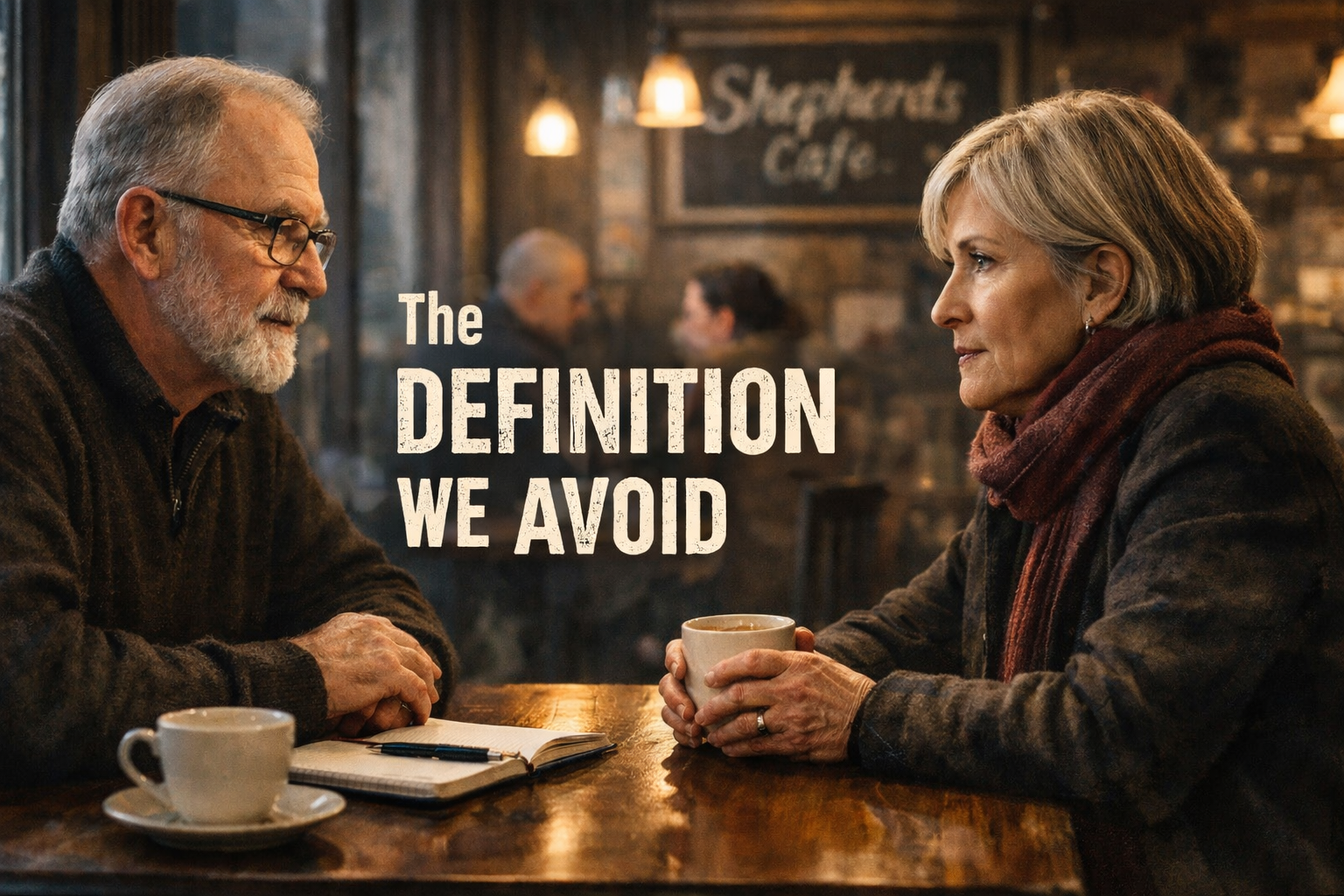
Elijah didn’t reach for a Bible, but Barbara could tell he had already opened it in his mind. There was a shift at the table—less opinion, more submission. His notebook stayed closed, like he’d decided his words weren’t the point anymore.
“Here’s the problem,” Elijah said quietly. “Most people want sacrifice to be inspirational, not instructional.”
Barbara didn’t argue. She nodded once, eyes steady. “Because instruction means accountability.”
“And accountability means we have to admit we’ve been using the word wrong,” Elijah replied.
Barbara’s fingers tightened around her mug. The heat should have been comforting, but the conversation wasn’t meant to comfort first. It was meant to correct.
Elijah leaned forward slightly. “We’ve told ourselves sacrifice is what you do when you’ve got extra. Extra time. Extra money. Extra emotional bandwidth. But Scripture describes sacrifice as what you do when you don’t have extra—and you choose love anyway.”
Barbara’s gaze dropped to the table, then lifted again. “So we don’t get to define it by convenience.”
“No,” Elijah said. “We define it by Christ.”
Barbara exhaled. “Then let’s stop circling the idea and say it plainly. What did Jesus call sacrificial love?”
Elijah didn’t hesitate. “He didn’t call it a feeling. He called it laying down your life.”
He quoted it carefully, like he wanted each word to stand on its own weight. “Greater love has no one than this, that one lay down his life for his friends” (John 15:13, NASB).
Barbara’s eyes narrowed—not in skepticism, but in recognition. “That’s not a compliment to love. That’s a definition of love.”
“And John refuses to let it stay dramatic and distant,” Elijah said. “He brings it straight into your living room.”
Barbara nodded. She already knew where he was going.
Elijah continued: “We know love by this, that He laid down His life for us; and we ought to lay down our lives for the brethren” (1 John 3:16, NASB). He paused. “Not ‘we ought to have good intentions.’ We ought to lay down our lives.”
Barbara stared at the steam rising from her cup. “That makes people nervous.”
“It should,” Elijah said. “Because it means sacrifice is not an accessory. It’s Christianity.”
Barbara turned her head slightly, as if weighing the statement. “But people will hear that and jump straight to extremes. They’ll say, ‘So I have to destroy myself to prove I’m loving.’”
Elijah shook his head once. “No. Scripture never calls you to be reckless. But it does call you to be real.”
Barbara’s voice sharpened. “So we need guardrails. What does sacrifice not mean?”
Elijah answered as if he’d seen the damage firsthand. “It does not mean calling sin ‘fine’ to keep peace. It does not mean lying to protect someone’s image. It does not mean ignoring patterns of abuse. Love does not cooperate with evil.”
Barbara’s eyes held his. “Say that again in a sentence.”
Elijah didn’t blink. “Sacrificial love never requires you to betray truth.”
That line sat between them like a plumb line.
Barbara nodded slowly. “So when I withhold enabling, I might actually be sacrificing—because I’m giving up the comfort of being liked.”
“Yes,” Elijah said. “And when the brother took a second job, he sacrificed—because he gave up rest and margin.”
Barbara leaned forward. “Different costs. Same heart.”
“Same direction,” Elijah corrected. “Toward God’s definition, not ours.”
Barbara’s expression tightened with something like conviction. “So how do you know you’ve been touched by sacrificial love?”
Elijah’s answer came slower this time, more personal. “Because it rewires you. When someone pays a real cost for your good, you stop believing love is just words. And you start noticing how often you’ve offered words instead of yourself.”
Barbara’s voice softened. “It humbles you.”
“And it exposes you,” Elijah said. “Not to shame you—just to show you the gap between what you claim and what you practice.”
Barbara stared out the window for a moment. Cars moved slowly through the wet street, headlights smeared in the glass.
“I think that’s why people avoid sacrifice,” she said. “Not because it’s impossible. Because it’s revealing.”
Elijah nodded. “Yes. Sacrifice is a mirror.”
Barbara looked back at him. “Then how do you know you’re making sacrifices out of love and not out of guilt or pride?”
Elijah lifted one finger slightly, like he was marking the first test. “Ask what you demand in return.”
Barbara nodded.
“If your sacrifice needs repayment—praise, control, gratitude—then you’re not loving,” Elijah said. “You’re trading.”
Barbara’s jaw set. “So love can receive thanks, but it doesn’t require it.”
“Correct,” Elijah said. “Second test: is your sacrifice producing the fruit of the Spirit in you—patience, kindness, self-control—or is it producing bitterness and superiority?”
Barbara gave a small, sober laugh. “That one cuts.”
“It’s supposed to,” Elijah replied.
Barbara tapped the table lightly, as if emphasizing the point. “And I’d add this: is the sacrifice actually helping the person toward righteousness, or just helping them stay comfortable in sin?”
Elijah nodded. “That’s Romans 12 kind of love. Love that refuses to bless what God calls evil.”
Barbara’s eyes sharpened again. “So the question isn’t just ‘Did I give something up?’ The question is ‘Did I give it up in a way that honors Christ and helps someone toward God?’”
“Yes,” Elijah said. “Otherwise, you might call it sacrifice while it’s actually fear—fear of conflict, fear of rejection, fear of losing control.”
Barbara sat back. The café noise continued around them, but their corner felt set apart—quietly serious.
“So,” Barbara said, “do we know the meaning of sacrifice?”
Elijah answered plainly. “We know the word. We’ve dulled the meaning.”
“And our lack of understanding,” Barbara said slowly, “inhibits our appreciation for Jesus Christ.”
Elijah’s eyes stayed fixed on hers. “Because if sacrifice to us means ‘minor inconvenience,’ then the cross becomes a story instead of a rescue.”
Barbara swallowed. “And if we treat it like a story, we’ll never be changed by it.”
Elijah nodded once, firm. “Exactly.”
Barbara’s voice lowered. “Is there a way to get reacquainted with the true definition of sacrifice?”
Elijah didn’t hesitate. “Yes. And it’s not complicated.”
Barbara waited.
Elijah spoke like a man laying out a path, not a slogan.
“First, spend time in the Gospels with one question: What did it cost Him? Watch Jesus choose inconvenience on purpose. Watch Him give up reputation, comfort, safety, and finally life itself.”
Barbara nodded.
“Second,” Elijah continued, “read the cross not as a symbol, but as a payment. When Scripture says He ‘gave Himself,’ don’t rush past that. Sit with it until your excuses feel thin.”
Barbara’s eyes stayed steady, but her face softened—like her defenses were lowering.
“Third,” Elijah said, “practice small, hidden obedience. Sacrifice that doesn’t get noticed. Forgive without announcing it. Serve without posting it. Give without needing credit. Because hidden sacrifice trains the heart to love for God, not for applause.”
Barbara exhaled slowly. “So you’re saying reacquaintance isn’t emotional. It’s behavioral.”
Elijah nodded. “Yes. You don’t rediscover sacrifice by admiring it. You rediscover it by obeying.”
Barbara held the mug with both hands now, as if grounding herself.
“And the more we obey,” she said, “the more we understand what we’ve been saved by.”
Elijah’s voice softened, but not by much. “That’s the truth. The cross becomes more precious as your definition of love becomes more honest.”
Barbara stared at the closed notebook in front of Elijah, then at the wet street outside.
“Then Part 2 ends where it should,” she said. “Not with an inspiring quote.”
Elijah nodded. “With a corrected definition.”
Barbara lifted her eyes. “Sacrifice is love that pays a real cost for someone’s true good—without betraying truth—and measured by Christ, not by comfort.”
Elijah’s expression was calm, but satisfied. “That’ll do.”
Barbara looked out the window one more time and spoke as if to herself, but loud enough for Elijah to hear.
“And if we’re reacquainted with sacrifice,” she said, “we won’t just appreciate Jesus more.”
Elijah waited.
“We’ll finally understand why we needed Him.”