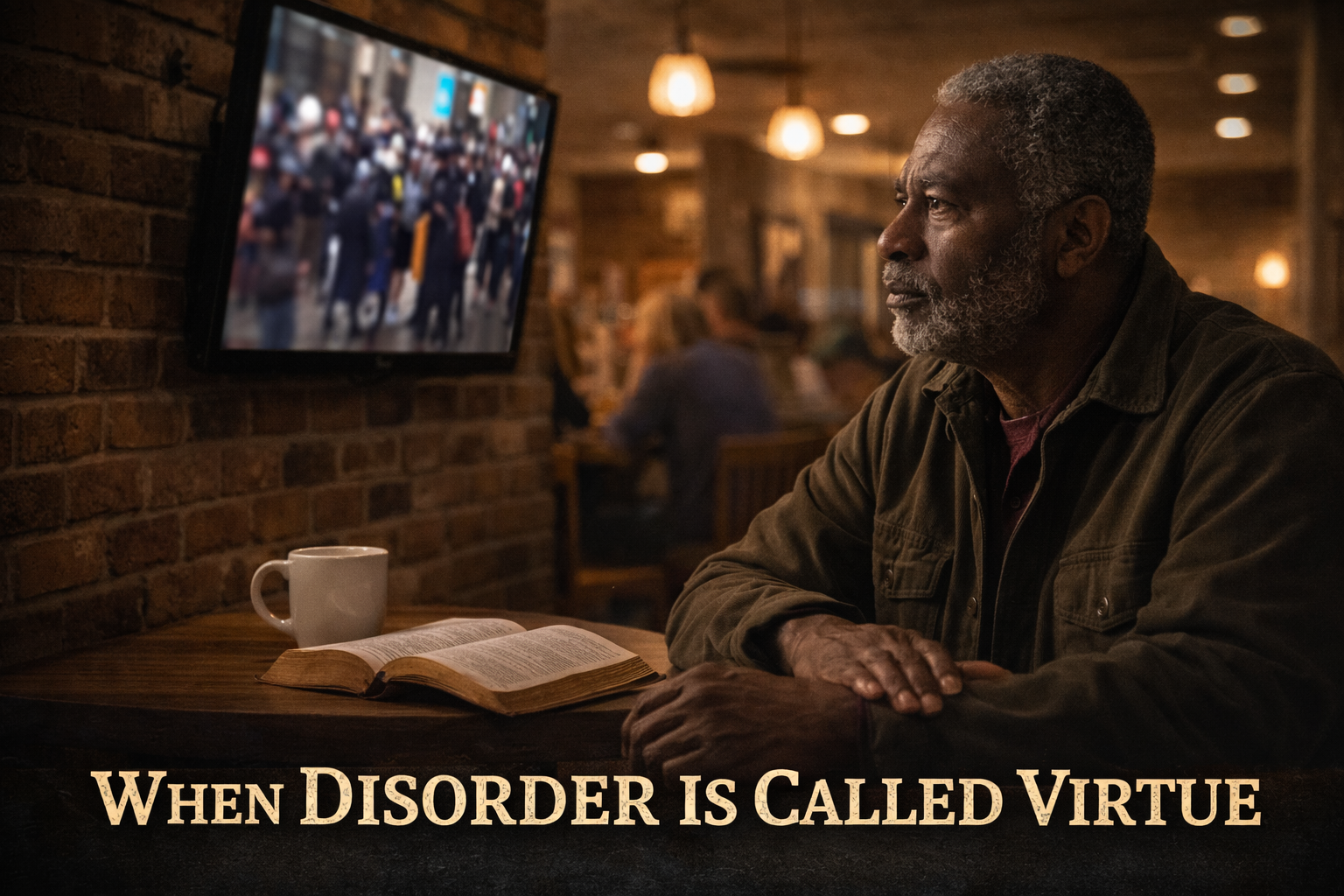
Jeremiah didn’t choose the seat under the television by accident.
At The Shepherds Cafe, the screen hung high on the brick wall like a watchman—always on, always ready to pull the outside world into the room. The café itself was calm: warm pendant lights, the steady hiss of espresso, the low murmur of small talk. But the broadcast overhead showed Minnesota with a different spirit—crowds pressing forward, voices raised, police lines hardening, and a kind of public behavior that didn’t look like disciplined civic action so much as contempt on display.
Jeremiah watched it with the same feeling he got when he saw a bridge cable fray. Not panic. Not entertainment. A sober frustration—because once a society starts treating restraint as weakness, it doesn’t take long before the weak get hurt first.
He let the footage roll, and he let Scripture start speaking in his mind the way it always did when the world got loud.
“Let every person be subject to the governing authorities…” (Romans 13:1–7). That passage always came first, because it was always the one people tried to dodge. Not because Jeremiah believed government was pure—he didn’t—but because the Bible treated order as a mercy. Romans 13 didn’t say rulers are always righteous. It said God uses governing structures to restrain chaos, and that Christians don’t get to treat law as optional just because they’re angry.
Then came Peter: “Submit yourselves for the Lord’s sake to every human institution…” (1 Peter 2:13–17). Jeremiah could almost hear the tone—“for the Lord’s sake”—as if God was saying, Your public conduct is part of your witness. The world would love to disciple Christians into being just another angry tribe. Scripture wouldn’t allow it.
And then Titus: “Be subject… be obedient… be ready for every good deed… show consideration for all men.” (Titus 3:1–2). Jeremiah’s jaw tightened. The broadcast made “good deeds” look naïve, and “consideration” look like surrender. But the Bible wasn’t ashamed of self-control. The Bible insisted on it.
On the screen, the crowd surged again—bodies packed close, faces hard, voices aimed like weapons. Jeremiah didn’t deny the possibility of real grievance. He didn’t deny injustice exists. But he watched the way contempt was being celebrated, and his mind went to Proverbs: “My son, fear the Lord and the king; do not associate with those who are given to change.” (Proverbs 24:21–22). The old wisdom wasn’t praising oppression. It was warning that reckless agitation—people who love upheaval for its own sake—brings ruin quickly.
Jeremiah didn’t need a conspiracy to see what was right in front of him: too many people were being trained to despise law, despise authority, and despise restraint.
But he also refused to pretend the chaos was always “organic.” He’d seen enough public record to know what many Christians are too polite to say out loud: professional organizing exists. Not as a rumor—just as a reality of modern political life. There are paid roles, structured groups, planned tactics, and coordinated campaigns.
That didn’t automatically make a protest wicked. Organization can be used for safety, lawful advocacy, and real reform.
But it also raised a question Jeremiah couldn’t shake while the footage played:
Why is it organized? What is it organized for?
Because history had taught a hard lesson: sometimes the objective isn’t the stated grievance. Sometimes the objective is to keep conflict hot—to sustain pressure, manufacture confrontation, control the narrative, recruit the young and angry, and normalize a posture of defiance until the public starts believing a nation is ungovernable.
And the moment a people start believing they are ungovernable, they become easy to break.
Jeremiah’s eyes narrowed at the screen again, and another passage surfaced—one that always showed up when societies started swapping truth for theater: “Woe to those who call evil good and good evil.” (Isaiah 5:20). That wasn’t just about private sin. That was about moral inversion—when public language becomes a tool to rename lawlessness as virtue and restraint as oppression.
He watched the anchor talk about “tensions” like tension was weather. Jeremiah’s thoughts answered back:
No. This is hearts.
And Jeremiah knew what Scripture said about hearts. Jesus taught that words and actions don’t spill from nowhere; they reveal what’s inside (Matthew 12:34–35). When a crowd delights in humiliation, when people protect lawbreakers as long as the lawbreakers serve the narrative, when officials and commentators spin instead of speak plainly—that isn’t just “politics.” That’s a spiritual condition.
And Jeremiah also knew the Bible didn’t give Christians permission to become cruel in response.
He felt his own irritation rising, and James stepped in like a hand on the shoulder: “Everyone must be quick to hear, slow to speak, slow to anger; for the anger of man does not achieve the righteousness of God.” (James 1:19–20). Jeremiah hated how necessary that verse was. It didn’t flatter him. It corrected him.
Because it’s possible to hate lawlessness and still sin in the way you hate it.
It’s possible to see real danger and still become a man whose soul is shaped by rage instead of Christ.
So Jeremiah forced his thoughts into a disciplined line—four rails Scripture always required him to keep on.
First, truth must matter. “Speak truth each one of you with his neighbor.” (Ephesians 4:25). Jeremiah had watched too many people treat “narrative” like righteousness. The Bible called that what it is: falsehood. And Jesus didn’t leave wiggle room—He said truth isn’t a tool, it’s a Person and a path (John 14:6), and that the truth sets people free (John 8:31–32).
Second, law and order are not enemies of goodness. Proverbs said, “Righteousness exalts a nation.” (Proverbs 14:34). A nation doesn’t become righteous by pretending sin isn’t sin. It becomes righteous when justice and restraint are honored—when people can disagree without tearing the street apart.
Third, the family must be protected. Jeremiah knew this wasn’t a separate topic. A society that scorns authority in public will raise children who scorn authority at home. And a home without discipline doesn’t produce freedom; it produces instability. The Bible never treated parents as optional or boundaries as cruelty (Proverbs 1:8–9; Proverbs 22:6; Hebrews 12:11). When the culture trains contempt, the home must train honor.
Fourth, Christians must respond like disciples, not like a mob. “Blessed are the peacemakers.” (Matthew 5:9). Not peace-fakers. Peacemakers—people who tell the truth, restrain their tongues, and refuse to spread fire. “Let no unwholesome word proceed… but only such a word as is good for building up.” (Ephesians 4:29). Jeremiah knew that verse was for the dinner table and the comment section.
He watched the footage again and felt the “bigger picture” settle, not as a dramatic prophecy but as a pattern Scripture had warned about from the beginning:
When a people lose reverence for truth, they lose the ability to govern themselves.
When they lose self-government, they demand someone else govern them.
And when that happens, liberty becomes a candle in the wind.
Jeremiah’s mind went to another command that felt almost scandalously simple in an age of outrage: pray. Paul told Christians to pray for leaders “so that we may lead a tranquil and quiet life in all godliness and dignity.” (1 Timothy 2:1–2). Jeremiah didn’t pray because he trusted politicians. He prayed because he trusted God—and because he knew chaos devours the vulnerable first.
Then one last passage surfaced, because Jeremiah knew someone would eventually ask the question Christians always ask when law and order gets complicated: What if the law commands what God forbids?
Acts answered that without turning Christians into rebels by default: “We must obey God rather than men.” (Acts 5:29). Jeremiah held that verse carefully. It wasn’t a license for lawlessness. It was a sober line: Christians submit to law as a rule, and only refuse when obedience to man requires disobedience to God—accepting the consequences with humility, not violence.
Jeremiah finally looked away from the television and down at his coffee, hands wrapped around the cup like he was anchoring himself.
He refused two temptations at once.
He refused naivety—the lie that disorder is harmless and organization is always innocent.
And he refused paranoia—the lie that every person in a crowd is a puppet and every conflict is one mastermind’s script.
But he did ask the honest question that mature believers have to ask when the street becomes theater:
Why would anyone want a society to lose its grip on restraint?
Because if you can make people hate order, you can make them beg for control.
If you can make them doubt truth, you can sell them narratives.
If you can make them despise authority, you can replace authority with force.
Jeremiah let the thought sit, then quietly prayed—without performance, without drama.
For justice without chaos.
For restraint without apathy.
For truthful speech in leaders and citizens.
For protection of families and children.
For the church to keep its head when the world wants to lose its mind.
Then he lifted his eyes back to the screen, not because he trusted what he was seeing, but because he refused to stop being sober.
And under his breath—more warning to himself than commentary on anyone else—Jeremiah said:
“Any spirit that trains a people to love disorder will not end in freedom. It ends in chains.”