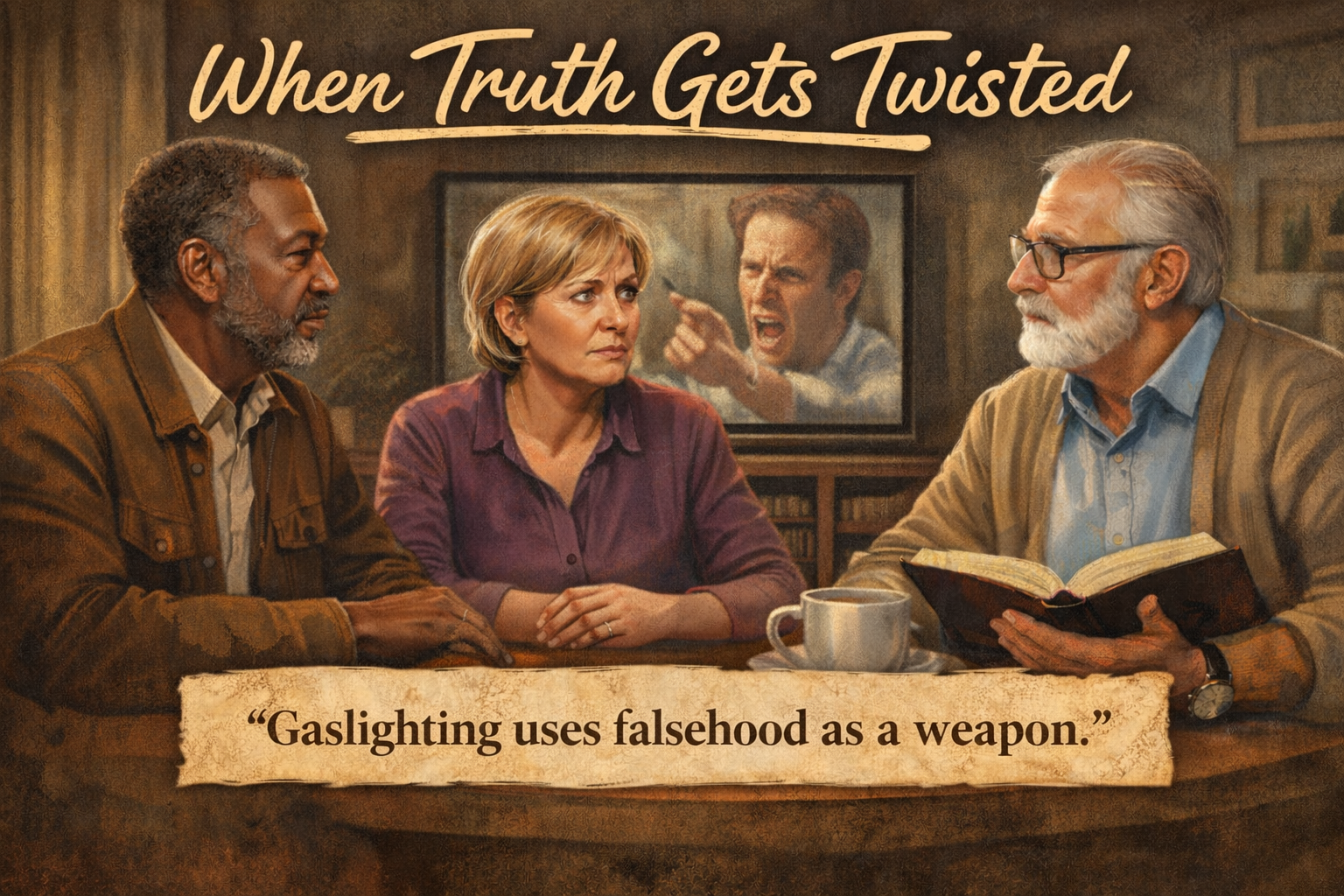
Late afternoon light spilled through the windows of The Shepherds Cafe. Elijah sat with his Bible open beside his coffee. Barbara held her tea with both hands. Jeremiah leaned back in his chair, quietly watching the room.
Barbara broke the silence. “I keep hearing the word gaslighting.”
Jeremiah nodded. “A modern word for an old sin.”
Elijah looked up. “That is exactly right.”
Barbara said, “People misuse the word sometimes. Every disagreement is not gaslighting. But some behavior fits it. Somebody says or does something hurtful, then later denies it, rewrites it, or makes the other person feel unstable for bringing it up.”
Jeremiah folded his hands. “That kind of thing does real damage.”
Elijah turned a page in his Bible. “The word may be modern, but Scripture has long addressed this kind of manipulation. At its heart, gaslighting is deception used for control. It is an effort to make another person doubt what is true so the manipulator can escape accountability or keep power.”
Barbara nodded. “So it is more than lying.”
“Yes,” Elijah said. “It is lying with pressure attached. The goal is not only to avoid blame, but to make the other person question his own judgment.”
Jeremiah added, “A person says something cruel, then later says, ‘I never said that.’ Or he mistreats someone and responds, ‘You’re imagining things. You’re too sensitive. You always overreact.’ After a while the victim starts doubting his own memory.”
Barbara looked down at her tea. “That is what makes it so dangerous. It attacks a person’s grip on reality.”
Elijah nodded. “And the Bible is a book of truth. Ephesians 4:25 says, ‘Therefore, laying aside falsehood, speak truth each one of you with his neighbor, for we are members of one another’ (NASB). Gaslighting violates that directly. It uses falsehood as a weapon.”
Jeremiah read softly, “‘A lying tongue hates those it crushes, and a flattering mouth works ruin’” (Proverbs 26:28, NASB). He looked up. “Manipulative speech ruins people. It may sound polished. It may even come with a smile. But it still crushes.”
Barbara said, “That is part of the problem. It is not always loud. Sometimes it sounds calm, reasonable, even kind on the surface.”
Elijah gave a sober half-smile. “Sin often borrows good manners when it wants to stay hidden.”
Jeremiah chuckled. “That is the truth.”
Barbara leaned forward. “What are the signs?”
Elijah answered, “First, a pattern of denying plain facts. Second, repeated blame-shifting. Third, making the other person seem mentally or emotionally unreliable instead of honestly dealing with the issue. And fourth, a desire for control underneath it all.”
“And usually no repentance,” Jeremiah added. “Just more spinning.”
Barbara sighed. “That sounds exhausting.”
“It is,” Elijah said. “Truth brings clarity, but manipulation creates fog. And when someone lives in that fog long enough, peace and confidence start to erode.”
Jeremiah turned to James 3:16. “‘For where jealousy and selfish ambition exist, there is disorder and every evil thing’ (NASB). Gaslighting creates disorder on purpose. It scrambles the room so one person can stay in charge.”
Barbara looked across the table. “So what does the Bible call us to do instead?”
Elijah answered quickly. “Speak truth. Accept responsibility. Repent when wrong. Refuse to use words as smoke screens. Never try to dominate another person by making him doubt what is real.”
Jeremiah nodded. “God’s people are to be trustworthy. If we are wrong, we admit it. If we are hurt, we speak honestly. We do not twist reality to protect pride.”
Barbara lifted her mug. “Then maybe the lesson is this: if truth has to be bent for me to win, I have already lost.”
Jeremiah smiled. “That is worth remembering.”
Elijah closed his Bible gently. “The Lord calls us to walk in light, not in mental traps for other people.”
And in the quiet warmth of The Shepherds Cafe, that truth stayed on the table longer than the coffee did.