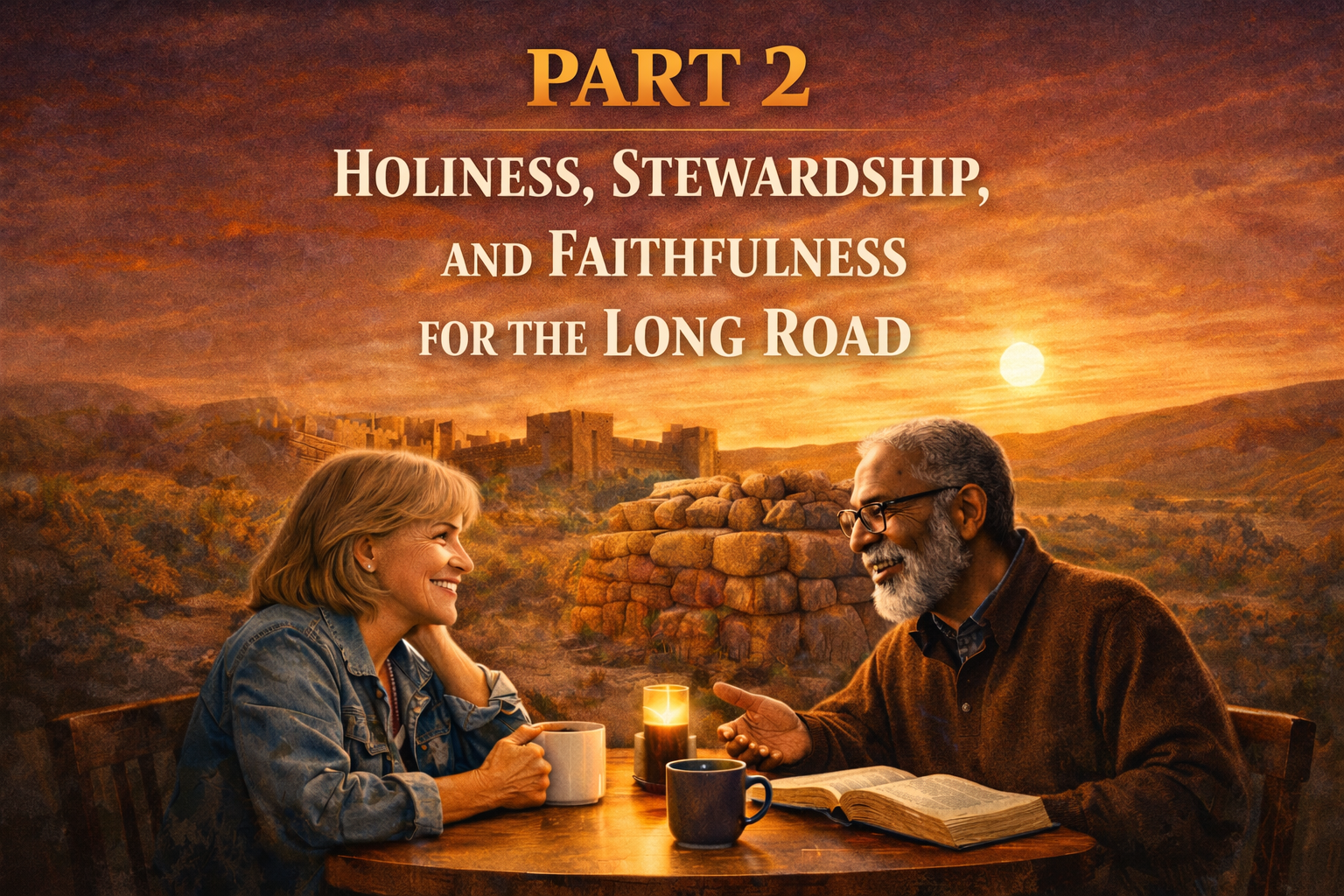
The light had shifted by the time Barbara and Jeremiah resumed their conversation. What had begun as a bright afternoon in The Shepherds Cafe had softened into the warm amber of early evening. The café windows caught the last glow of the sun, and the long shadows across the wooden floor gave the room a calmer, quieter mood. A few people still lingered over coffee, but most had gone. The clink of a cup at the counter and the low murmur of distant voices only seemed to make Barbara and Jeremiah’s table feel more set apart.
Barbara lifted her mug, then set it down again without taking a drink. She had that look Jeremiah had come to recognize over the years, the look that meant she was still turning something over in her mind.
“In Part One,” she said, “we talked about Moses and Joshua as men God used to bring Israel out, prepare them, and call them forward. But that is not where the real struggle ends, is it?”
Jeremiah gave a slight smile. “No. In many ways, that is where another struggle begins.”
Barbara nodded. “That is what I keep thinking. Getting out of Egypt was one thing. Crossing the Jordan was another. But then came the harder question: how do you live faithfully after God has brought you through?”
Jeremiah rested one hand on the open Bible before him. “Now you are right in the middle of the lesson. Because the Christian life is not just about dramatic beginnings. It is about long obedience after the beginning.”
Barbara looked at the pages, then back at him. “And that is where a lot of people falter.”
“Yes,” he said plainly. “Some people want salvation as an event, but not discipleship as a way of life. They want deliverance without discipline. Promise without perseverance. But Moses and Joshua together show that God’s people are called not only to start well, but to continue well.”
Barbara leaned back in her chair. “Then where does Part Two begin?”
“With holiness,” Jeremiah said.
Barbara gave a small nod, as though she had expected that answer. “Achan.”
“Achan,” Jeremiah repeated. “That account has never been popular, but it is necessary. Israel had just seen God bring down Jericho. It was a stunning victory. The people had every reason to be encouraged. Then they went against Ai, and instead of triumph they suffered defeat. The reason was not weak strategy. It was hidden sin.”
Barbara folded her hands. “Which means that a people can have visible victories and still have corruption beneath the surface.”
Jeremiah looked at her with approval. “Exactly. And Christians need that lesson badly. We live in a time when people want to reduce sin to a mistake, a weakness, an issue, an imperfection, almost anything but rebellion against God. But Scripture does not let us talk that way for long.”
Barbara sighed quietly. “No, it does not.”
“The sin in Achan’s tent,” Jeremiah continued, “was not private in the way he imagined. It affected the whole people. That should sober every Christian. Hidden sin always spreads its damage farther than we think. It weakens conscience. It disrupts peace. It affects families. It injures congregations. It dulls the heart.”
Barbara glanced down at the table, tracing the grain in the wood with her eyes. “People often say, ‘It is only hurting me.’ But that is rarely true.”
“It is almost never true,” Jeremiah said. “The lesson here is plain: God’s people cannot live carelessly and still expect His favor to rest on them as though holiness does not matter.”
Barbara looked up again. “That sounds severe to modern ears.”
Jeremiah gave a calm, steady shrug. “Truth often does. But severity is not the point. Purity is. God was not being arbitrary with Israel. He was teaching them that covenant life in His presence is not casual. Christians should know that too. Grace is not permission to make peace with sin.”
Barbara was quiet for a moment, then said, “Then one of the major lessons from Joshua is that the people of God must deal honestly with sin if they want to live faithfully.”
“Yes,” Jeremiah said. “And not only honestly, but decisively. That does not mean harshness without mercy. It means clarity without excuses.”
Barbara gave a thoughtful nod. “So holiness comes first. What comes next?”
“Stewardship,” Jeremiah said.
She smiled faintly. “That is not the word most people jump to when they think about Joshua.”
“No,” he said, “but they should. Once the great moments of conquest begin to settle, Joshua spends much of his effort doing something less dramatic and more enduring. He oversees the dividing of the land.”
Barbara looked at him with interest. “And most people read those chapters quickly.”
“Far too quickly,” Jeremiah replied. “But think about what is happening. The land is being assigned. Boundaries are being established. Families and tribes are being given their inheritance. Cities are set apart. The Levites receive their portions among the people. This is not filler material. It is the shaping of a nation’s life.”
Barbara smiled. “So conquest gets the attention, but order is what makes life sustainable.”
Jeremiah’s eyes brightened. “That is exactly it. A dramatic victory can make a nation rejoice for a day. But ordered faithfulness is what lets it endure.”
Barbara leaned forward slightly. “And the Christian parallel is obvious, isn’t it? A person may have a powerful conversion experience, but after that comes the daily matter of how he lives, gives, serves, prays, governs his home, and uses what God has entrusted to him.”
Jeremiah pointed lightly toward her. “You have it. Christians often love the language of breakthrough, but they are less excited by the language of stewardship. Yet stewardship is where much of true faithfulness is proven. Not in a moment of spiritual excitement, but in the repeated, ordinary decisions that shape a life.”
Barbara wrapped both hands around her cup. “That is sobering. Because routine is where a lot of us reveal what we really are.”
“Yes,” Jeremiah said. “Anyone can talk boldly in a special moment. The harder question is this: how do you live on an ordinary Tuesday? Are you trustworthy? Are you prayerful? Are you generous? Are you disciplined? Are you faithful when nobody is applauding?”
Barbara laughed softly. “You have a way of making the question uncomfortably direct.”
Jeremiah smiled. “It is a gift.”
Barbara smiled back, then her expression settled into thoughtfulness again. “So Joshua teaches not only battle, but structure.”
“Very much so,” he said. “And Christians need structure more than many realize. We live in a culture that often resists discipline because it sounds restrictive. But without structure, good intentions remain unformed. The Christian who wants to grow must make room for spiritual habits. The congregation that wants to remain sound must be intentional. The family that wants to honor God must not drift.”
Barbara nodded slowly. “That seems to fit with the whole land division theme. God did not merely give Israel inspiration. He gave them responsibilities.”
Jeremiah rested his hand near the edge of the Bible. “Exactly. Blessing is never an excuse for carelessness. It creates responsibility.”
Barbara repeated that quietly. “Blessing creates responsibility.”
He nodded. “And that leads to another lesson: remembrance.”
Barbara’s expression changed at once. “The memorial stones.”
“The memorial stones,” Jeremiah said. “Joshua understood that a people who fail to remember will soon fail to remain faithful. That is why the stones mattered. They gave Israel something visible to point to when the next generation asked, ‘What do these mean?’”
Barbara smiled. “That question matters in every age.”
“It does,” Jeremiah said. “Because faith is always one generation from forgetting if it is not deliberately remembered and taught.”
Barbara glanced around the café, then back at him. “Christians do not set up piles of stones in the same way, but we do have our own memorials.”
Jeremiah nodded. “We do. Scripture is one. Worship is another. Prayer. Hymns. Testimony. The Lord’s Supper especially. Each of these keeps the mighty acts of God before us. They remind us that we belong to a story larger than ourselves.”
Barbara’s face softened. “And if we neglect them, we grow forgetful.”
“Yes,” Jeremiah said. “And forgetfulness is dangerous. A forgetful Christian becomes vulnerable to pride, compromise, and spiritual drift. That is why Israel was repeatedly warned not to forget the Lord when they lived in houses they did not build and ate from vineyards they did not plant.”
Barbara let out a quiet breath. “It is easy to think hardship is the main threat to faith.”
“Sometimes it is,” Jeremiah said. “But comfort can be just as dangerous. Hardship can tempt us to despair. Prosperity can tempt us to forget.”
Barbara nodded. “There are people who pray fervently when everything is collapsing and then grow casual once life feels stable.”
Jeremiah gave a solemn nod. “That has always been one of the dangers of blessing. People begin by thanking God for what He gave, then slowly start speaking as though they produced it by their own hand.”
Barbara looked down again. “So remembrance guards gratitude.”
“And gratitude guards humility,” Jeremiah said. “And humility helps preserve faithfulness.”
For a few moments they were silent. The candle on the table flickered gently between them. Outside, the evening had deepened. The colors in the sky were darker now, though the western horizon still held a faint gold.
Barbara finally spoke again. “There is another part of this that I do not want to miss. Moses prepared Joshua. Joshua then had to lead the people. The work did not stop with one generation.”
Jeremiah’s expression warmed. “That is one of the strongest lessons in the whole story.”
“And one of the most neglected,” Barbara said.
He smiled. “You are right again.”
Barbara shrugged modestly. “It happens from time to time.”
Jeremiah chuckled, then said, “Moses did not cling selfishly to leadership. He strengthened Joshua in the sight of the people. That matters. Joshua did not invent the covenant. He received a work already underway and carried it forward. That also matters.”
Barbara’s eyes were fixed on him now. “So Christians should be thinking beyond themselves. Older believers should be preparing younger believers. Leaders should be helping future leaders. Parents should be shaping children. Teachers should be training those who can teach after them.”
“Yes,” Jeremiah said. “Truth does not preserve itself through neglect. It must be taught, modeled, repeated, defended, and loved.”
Barbara’s tone grew more serious. “And when that stops, a generation can grow up around the things of God without really knowing Him.”
Jeremiah’s voice lowered. “That is the tragedy of Judges. The people were still in the land, but faithfulness began to unravel. Outward location is not the same as inward loyalty.”
Barbara sat with that for a moment. “That may be one of the sharpest warnings of all. A person can be surrounded by religious language and still drift far from the Lord.”
“Yes,” Jeremiah said. “Which is why Joshua’s closing call matters so much.”
Barbara smiled faintly. “Choose you this day whom ye will serve.”
He smiled back. “A fitting summary.”
“But it is more than a summary,” Barbara said. “It is a confrontation.”
Jeremiah nodded. “Exactly. After all the victories, all the inheritance, all the evidence of God’s faithfulness, Joshua still presses the issue home: whom will you serve? That question never becomes outdated. Every generation must answer it. Every household must answer it. Every Christian, in one sense, answers it repeatedly.”
Barbara’s voice softened. “Because loyalty is not merely declared once. It is lived.”
“That is right,” Jeremiah said. “A person may say the right words in a strong moment, but real loyalty shows itself over time. In choices. In habits. In sacrifices. In perseverance. In repentance. In worship. In whether the heart stays with God when life grows long and ordinary.”
Barbara smiled slightly. “Then the title of Part Two really does fit. This is about the long road.”
Jeremiah gave a quiet nod. “It is. A great many people know how to start something. Fewer know how to remain steady through the long road. Yet that is where Christian faith is often most clearly seen.”
Barbara sat quietly, then said, “I think many believers underestimate that. They expect the Christian life to be made up of a few dramatic turning points, but most of it is not like that. Most of it is years of ordinary faithfulness.”
“Exactly,” Jeremiah said. “And that is not lesser faithfulness. It is the very kind that holds a life together. The husband who remains loyal. The wife who remains steadfast. The Christian who keeps praying. The saint who keeps serving. The believer who keeps worshiping when feelings rise and fall. That kind of endurance is precious.”
Barbara looked at the open Bible between them. “Moses and Joshua really do teach that, don’t they? Neither of them is merely a figure of action. They are both examples of enduring assignment.”
Jeremiah nodded. “And there is another comfort in that. Moses had one role. Joshua had another. Neither did everything. Both were faithful.”
Barbara smiled at once. “You are coming back to that point.”
“I am,” he said. “Because Christians need it. Some are burdened by pride, imagining everything depends on them. Others are burdened by discouragement, imagining their work does not matter because they cannot do everything. Moses and Joshua correct both errors. God’s work is bigger than any one servant, but no faithful servant is insignificant.”
Barbara looked out the window at the dimming evening. “That really is comforting. Faithfulness in one’s own assignment matters, even when the work is incomplete and the future belongs partly to others.”
Jeremiah closed the Bible gently. “Yes. God does not ask each servant to do every task. He asks each servant to obey in the task given.”
Barbara’s voice was quiet now. “Then perhaps Part One teaches us that God brings His people out, prepares them, and calls them forward. And Part Two teaches us that once He has brought them forward, He calls them to holiness, stewardship, remembrance, and long-term loyalty.”
Jeremiah smiled. “That is well said.”
Barbara gave him a look. “Good enough for you to approve?”
“It passes,” he said.
She laughed softly, and for a moment the weight of the conversation lifted. Then she grew reflective again.
“You know,” she said, “there is something very reassuring in all this. God is not only interested in rescue. He is interested in building a faithful people. He is patient enough to shape them, strict enough to correct them, and gracious enough to keep calling them onward.”
Jeremiah rose slowly from his chair. “That is one of the clearest truths in the whole account.”
Barbara stood as well, gathering her things but not rushing. “And that means Christians should stop measuring faithfulness only by great moments.”
“Yes,” he said. “Sometimes faithfulness looks like crossing a sea. Sometimes it looks like crossing a river. Sometimes it looks like taking a city. And sometimes it looks like remembering, repenting, training, serving, and staying true for another ordinary year.”
Barbara smiled. “That sounds less dramatic, but maybe more necessary.”
Jeremiah reached for his coat. “It is often both.”
They moved toward the door of The Shepherds Cafe as the last of the evening light faded beyond the windows. The café behind them was quiet now, almost still. Outside, the air had turned cool. The sky was deepening toward night.
Barbara paused at the doorway and looked back once, as though the conversation itself had left something behind in the room worth noticing.
“Jeremiah,” she said, “do you think that is why these stories endure? Because they tell us not only how God saves, but how He expects saved people to live?”
Jeremiah opened the door and held it for her. “Yes,” he said. “And because they remind us that the greatest danger is not always failing to begin. Sometimes it is failing to remain faithful after the beginning.”
Barbara stepped outside and stood for a moment under the dim light above the entrance. The world was quieter now. The road stretched ahead into the darkening evening, steady and unremarkable, the sort of road a person might overlook if he were only looking for dramatic scenery.
But that, she realized, was the point.
Most faithfulness is lived on roads just like that.
Not at the Red Sea. Not at Jericho. Not in the moment of public triumph. But in the long road afterward, where holiness must be kept, blessings must be stewarded, truth must be remembered, and the heart must keep choosing the Lord.
As Barbara and Jeremiah walked away from The Shepherds Cafe, that was the thought that settled between them with quiet weight:
God does not merely call His people to great moments.
He calls them to long faithfulness.