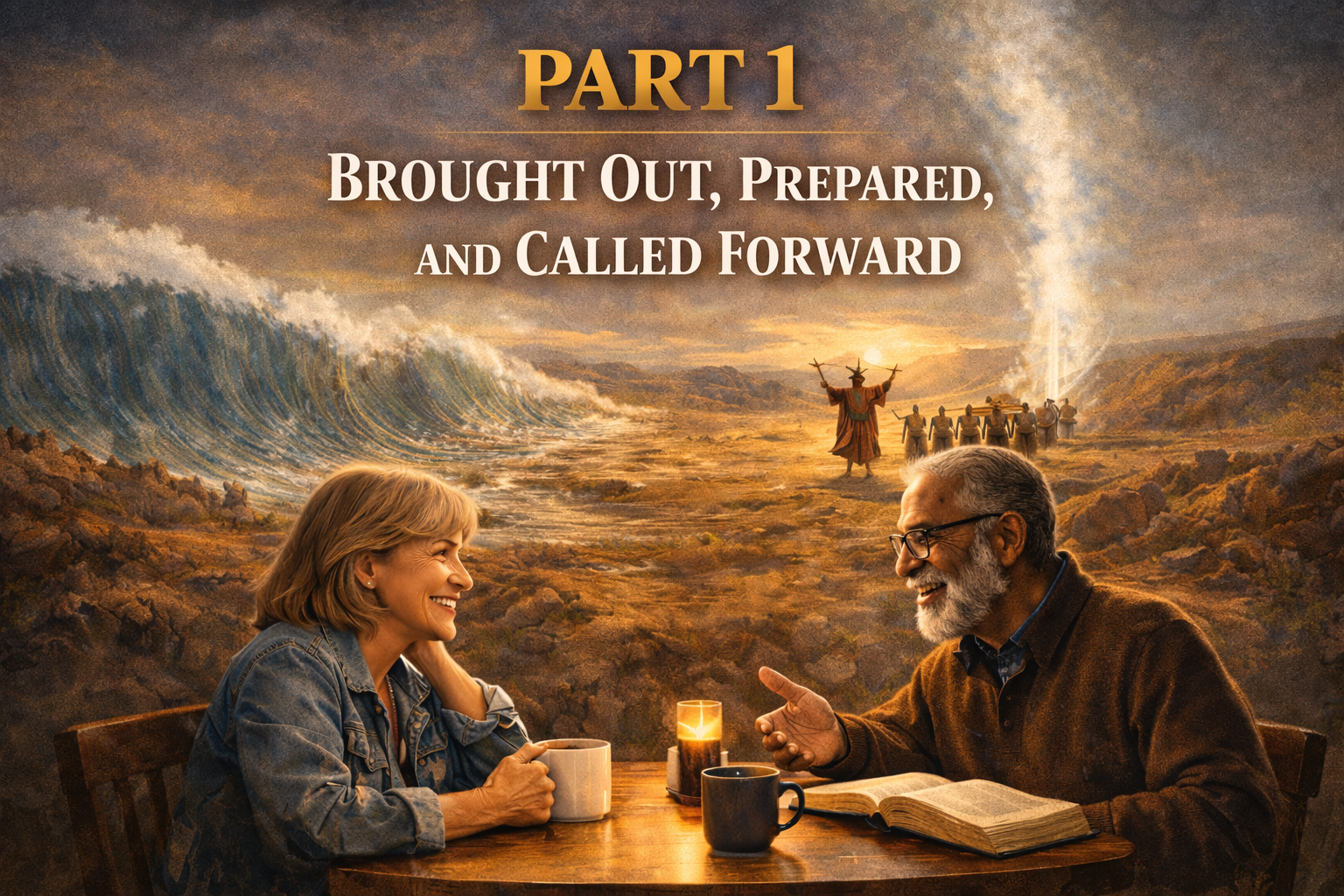
The late afternoon crowd at The Shepherds Cafe had thinned to a quiet murmur. Sunlight stretched across the wooden floor, and the soft clink of cups and saucers blended with the low hum of conversation from a table in the corner. Barbara sat near the window with a warm mug in both hands, looking thoughtful. Across from her sat Jeremiah, steady as ever, his Bible resting open beside his coffee.
Barbara broke the silence first.
“I have been thinking about Moses and Joshua again,” she said. “Not just about what they did for Israel, but what Christians are supposed to learn from them. It feels like there is more there than just history.”
Jeremiah gave a slow nod. “There is. A great deal more. Their lives are not just records of old events. They show us how God works with His people. Moses and Joshua had different assignments, but together they teach us a pattern Christians still need.”
Barbara leaned forward slightly. “Then tell me where it starts.”
“It starts,” Jeremiah said, “with this lesson: being delivered by God is not the same thing as being finished by God.”
Barbara smiled faintly. “That sounds like one of those lines meant to stop a person in their tracks.”
“It should,” Jeremiah replied. “Think about Israel. God brought them out of Egypt by His mighty hand. That was a stunning act of deliverance. But once they came out, God did not leave them without direction. He shaped them. He instructed them. He corrected them. He taught them how to live as His people.”
Barbara nodded. “So the lesson for Christians is obvious. Salvation is not an excuse for spiritual laziness.”
“Exactly,” Jeremiah said. “The Lord does not save people so they can remain undisciplined and unchanged. He saves them to transform them. Too many people talk as if grace means there are no obligations. But grace does not cancel obedience. Grace calls us into it.”
Barbara looked down into her mug for a moment. “That is one of the problems of our time, isn’t it? People want rescue without surrender. They want forgiveness without formation.”
Jeremiah’s eyes sharpened with approval. “That is exactly the problem. Moses teaches us that once God brings His people out, He begins preparing them for what comes next.”
Barbara looked back up. “The wilderness.”
“The wilderness,” Jeremiah said. “And that is a lesson Christians often resist. We do not like waiting seasons. We do not like testing, delay, or correction. But God often prepares His people before He places them.”
Barbara gave a quiet laugh. “You say that as if you know I do not enjoy waiting.”
Jeremiah smiled. “I say it because none of us do. But look at Israel. God did not take them straight from slavery into settled strength without first teaching them dependence, reverence, patience, and trust. The wilderness was not pleasant, but it was not pointless either.”
Barbara sat back, thinking. “I can see that in life. There have been times when I wanted the Lord to move much faster than He did. Later I could see I was not ready when I thought I was.”
“That is often how it works,” Jeremiah said. “Christians need to remember that delay is not always denial. Sometimes it is preparation. Sometimes God is doing deep work in a person before giving them a larger responsibility.”
Barbara turned that over in her mind. “So Moses teaches us that God forms His people. What does Joshua add?”
Jeremiah rested one hand on the table. “Joshua teaches us that there comes a time when faith must move forward.”
Barbara smiled. “Crossing the Jordan.”
“Yes,” he said. “Israel could not stay at the border forever. There was a moment when they had to step into what God had set before them. And Christians need that lesson badly. Some people are always studying, always discussing, always thinking, but never moving. They camp beside obedience instead of walking in it.”
Barbara laughed softly. “That is painfully accurate.”
Jeremiah gave a slight grin. “Faith is not meant to admire the will of God from a distance. Faith obeys it. Joshua had to lead the people forward. That took courage.”
Barbara’s expression grew more serious. “And courage is not always dramatic, is it?”
“No,” Jeremiah said. “Usually it is very plain. Courage is often choosing obedience while still feeling fear. It is speaking truth when silence would be easier. It is serving when you feel tired. It is standing firm when compromise would cost less. It is trusting God enough to step forward even when the outcome is not fully visible.”
Barbara repeated his words carefully. “Trusting God enough to step forward.”
Jeremiah nodded. “That is what Joshua had to do, and that is what Christians must still do. The Lord’s people are not called merely to admire His promises. They are called to walk in faithful obedience.”
Barbara glanced down at the open Bible. “That also means we should stop waiting until we feel perfectly confident.”
“Correct,” Jeremiah said. “If we wait until there is no fear, we may wait forever. The issue is not whether there is fear. The issue is whether we trust God more than we trust our own uncertainty.”
Barbara sat quietly for a few moments before speaking again. “Something else stands out to me. Moses and Joshua were very different, but both were essential.”
Jeremiah nodded. “That is another lesson Christians need. Faithful servants do not all look alike. Moses was one kind of leader. Joshua was another. Moses was used to bring the people out and form them under God’s law. Joshua was used to bring them in, lead battles, and settle the inheritance. Same Lord. Same people. Different assignments.”
Barbara smiled. “So Christians should stop trying to force every servant of God into the same mold.”
“Exactly,” Jeremiah said. “The Lord uses different people in different ways. Some are especially suited to teaching. Some to shepherding. Some to organizing. Some to strengthening others quietly over time. The question is not whether your assignment looks like someone else’s. The question is whether you are faithful in the one God has given you.”
Barbara’s expression softened. “That is encouraging, actually.”
“It should be,” Jeremiah said. “Too many Christians waste time comparing roles when they should be fulfilling them.”
Barbara looked out the window and watched the golden light settle lower across the street. “Then maybe that is part of the message here. God’s work is bigger than one servant, but every servant still matters.”
Jeremiah smiled warmly. “That is very well said.”
Barbara lifted her mug again, though it had nearly gone cold. “Then Part One of the lesson, if we were putting it that way, would be this: God brings His people out, forms them through hardship, and calls them to step forward in courage.”
Jeremiah leaned back in his chair. “That would be a strong beginning.”
Barbara gave him a knowing look. “A beginning means there is more.”
“There is,” Jeremiah said. “Because once God’s people move forward, they still have to learn how to live faithfully where He has placed them.”
And with that, the conversation deepened.
Part 2: Holiness, Stewardship, and Faithfulness for the Long Road
Barbara set her mug down and folded her hands. “All right,” she said. “Then what comes after courage? What else do Moses and Joshua teach us?”
Jeremiah’s expression turned more solemn. “They teach us that God’s people cannot live carelessly and expect peace.”
Barbara nodded slowly. “You are thinking about Achan.”
“I am,” Jeremiah said. “Israel had seen God give them victory at Jericho, but then came defeat at Ai. Why? Because sin was hidden in the camp. That event is one of the clearest reminders in Scripture that holiness matters.”
Barbara’s face grew serious. “That is not a lesson people enjoy hearing.”
“No,” Jeremiah replied, “but it is one they need. Christians live in a time when sin is often softened, excused, renamed, or treated like a private matter. But Scripture does not speak that way. Hidden sin always has consequences. It affects conscience, homes, witness, congregations, and spiritual strength.”
Barbara gave a slow nod. “So one lesson is that the people of God cannot make peace with what God condemns.”
“Exactly,” Jeremiah said. “Moses taught Israel the holiness of God. Joshua had to enforce the seriousness of that holiness in practice. Christians need both. We need instruction, and we need the courage to deal honestly with sin.”
Barbara was quiet for a moment. “There is another part of Joshua’s story that people often skip over. After the battles, there is all that detail about dividing the land.”
Jeremiah smiled. “And yet that part matters a great deal.”
“Why?” Barbara asked.
“Because conquest was not the final goal,” Jeremiah said. “Settlement was. Israel did not merely need dramatic victories. They needed ordered life. Families needed inheritance. Tribes needed boundaries. The Levites needed their places. Cities of refuge had to be established. That tells us something important about God. He is not only interested in rescuing His people from danger. He is also interested in teaching them how to live faithfully over time.”
Barbara’s eyes brightened. “So for Christians, it is not enough to have big spiritual moments. We also need daily faithfulness.”
“That is exactly it,” Jeremiah said. “Many people want the breakthrough, but not the stewardship that follows. Yet the Christian life is not built on occasional excitement. It is built on steady obedience. God cares how we live in our homes, how we use our resources, how we conduct ourselves in the church, how we manage responsibilities, and how we walk day by day.”
Barbara smiled. “You are saying faith is not only proven in the crisis. It is proven in the routine.”
Jeremiah gave a slight nod. “Very often, yes. A great many Christians imagine faithfulness only in terms of dramatic sacrifice. But much of real faithfulness is quieter than that. It looks like persistence, discipline, sound judgment, prayer, repentance, service, and consistency.”
Barbara traced one finger lightly along the edge of her mug. “That makes me think of how easy it is for people to begin well and then drift.”
“That is why remembering matters,” Jeremiah said. “Joshua understood that. The memorial stones at the Jordan were not decoration. They were reminders. Israel needed to remember that God had brought them across.”
Barbara looked up. “Christians need memorials too, though not necessarily made of stone.”
“We do,” Jeremiah said. “We remember through Scripture. Through worship. Through prayer. Through the Lord’s Supper. Through telling the next generation what God has done. A forgetful people become unstable. Gratitude fades, reverence fades, and then compromise grows.”
Barbara gave a quiet sigh. “And comfort can make that worse.”
Jeremiah pointed toward her gently. “Yes. That is another hard lesson. We tend to think hardship is the great danger to faith, and it certainly can be. But prosperity can be dangerous too. Israel was warned not to enter the land, enjoy houses they did not build and fields they did not plant, and then forget the Lord. Christians face the same danger. Blessings can become spiritual traps if gratitude disappears.”
Barbara looked down and shook her head slightly. “That is painfully true. People pray hard when they are desperate, and then grow casual when life becomes easier.”
Jeremiah’s voice remained calm. “Which is why Christians must guard the heart in every season, not just in suffering.”
Barbara looked at him thoughtfully. “What about leadership? That still seems important in this story.”
“It is,” Jeremiah said. “Moses prepared Joshua. Joshua led the people. That teaches Christians that one generation must prepare the next. The work of God is never meant to stop with one set of hands.”
Barbara smiled softly. “That may be one of the biggest lessons of all.”
“It is certainly one of the most neglected,” Jeremiah said. “Older Christians should be strengthening younger ones. Mature believers should be helping newer believers grow. Leaders should be preparing future leaders. Parents should be teaching children. Truth must be passed on deliberately, not assumed.”
Barbara nodded. “Because if it is only admired and not handed down, it weakens.”
“Yes,” Jeremiah said. “And the book of Judges shows the danger clearly. It does not take many years for a people to lose spiritual clarity when faith is no longer taught with conviction.”
The room around them had grown even quieter now. Someone near the counter stacked plates. The light outside had begun to fade into evening.
Barbara spoke more softly. “Then Joshua’s final call makes even more sense. ‘Choose you this day whom ye will serve.’”
Jeremiah’s eyes settled on her with approval. “Yes. After all the victories, after all the inheritance, after all the evidence of God’s faithfulness, the real issue remained the same: would the people stay loyal to the Lord?”
Barbara nodded. “So outward success is not the same as inward faithfulness.”
“Exactly,” Jeremiah said. “A people can be settled in the right place and still have wandering hearts. Christians need to hear that. It is possible to sit in sound worship, hear truth regularly, and still let the heart drift. That is why covenant loyalty, steadfastness, and daily devotion matter.”
Barbara sat back, reflecting on everything they had said. At length, she spoke.
“Then the lessons for Christians seem clearer now. God does not merely save us from bondage. He shapes us. He teaches us. He calls us to courage. He requires holiness. He expects stewardship. He wants His truth remembered and passed on. And He still asks every generation whom they will serve.”
Jeremiah smiled. “That is a strong summary.”
Barbara gave a small laugh. “You say that like I just passed a test.”
“You did,” he said dryly.
She laughed again, then grew serious. “There is one more thing I see in Moses and Joshua. Neither man did everything. Moses had his assignment. Joshua had his. One did not replace the value of the other.”
Jeremiah’s expression warmed. “That is one of the most comforting truths in the whole discussion. Christians are not called to do everything. They are called to be faithful in what God has assigned them. Moses did not enter Canaan, but his work still mattered greatly. Joshua did not stand before Pharaoh, but his work mattered too.”
Barbara nodded slowly. “That helps remove both pride and discouragement.”
“It does,” Jeremiah said. “Pride says everything depends on us. Discouragement says that if we cannot do everything, then what we do not matter. Moses and Joshua prove both ideas false. God’s work is larger than any one servant, but every faithful servant still has a meaningful place in it.”
Barbara wrapped both hands around her mug again. It was no longer warm, but she seemed not to notice. “Then perhaps the lesson Christians need most is simply this: be faithful in your assignment, and trust God with the rest.”
Jeremiah closed his Bible gently. “Yes. Be faithful in preparation. Faithful in courage. Faithful in holiness. Faithful in stewardship. Faithful in remembrance. Faithful in helping the next generation. And faithful in the place God has given you.”
Barbara rose from her chair as Jeremiah stood with her. The evening had settled outside, and the lights of The Shepherds Cafe now glowed softly against the darkening street.
As they made their way toward the door, Barbara paused.
“Jeremiah,” she said, “do you think that is why these stories still matter so much? Because they remind us that God is always doing more than getting His people out of trouble?”
Jeremiah opened the door and held it for her.
“Yes,” he said. “He brings His people out so He can bring them forward. And once He brings them forward, He teaches them how to live as people who belong to Him.”
Barbara stepped into the cool evening air and smiled to herself. The stories of Moses and Joshua no longer felt like distant history. They felt near. They felt searching. They felt alive.
And as she walked away from The Shepherds Cafe, one thought settled in her heart and stayed there:
God does not simply call His people to start well. He calls them to live faithfully all the way through.