When I think about church growth, I have to correct something that many of us—including myself at times—can misunderstand. We can unintentionally treat baptism as the goal, focusing on getting someone to that decision. But biblically, baptism is not the destination—it marks the start of a life that must be continually transformed. Paul describes this in Romans 12:2 as the “renewing of the mind.” That kind of change doesn’t happen in a single moment; it happens through a continual surrender to God’s will. Jesus didn’t call people to a moment—He called them to a life of following Him.
That is why the mission must be defined carefully. In Matthew 28:19–20, Jesus commands us to go and make disciples, teaching them to observe all that He commanded. That language goes far beyond a one-time response. It speaks to a process—teaching, shaping, correcting, and walking with someone as they grow. If we stop at the point of baptism without continuing that work, we have not finished the mission Christ gave us.
I’ve also had to rethink what we mean by “growth.” Sometimes what looks like progress is simply people moving from one congregation to another. Seats fill up, attendance looks stronger, but the kingdom hasn’t actually expanded. The New Testament presents something different—growth happens when the lost are reached and transformed. When our focus shifts toward attracting those who are already part of the body somewhere else, we are no longer doing the work of evangelism. We are redistributing, not growing.
Scripture also reminds us that growth does not ultimately come from us. In 1 Corinthians 3:6–7, Paul explains that he planted and Apollos watered, but God caused the growth. That is a necessary correction. It keeps us from trusting in methods, trends, or strategies to produce results. Our responsibility is to be faithful in teaching and living the truth. God is responsible for the increase.
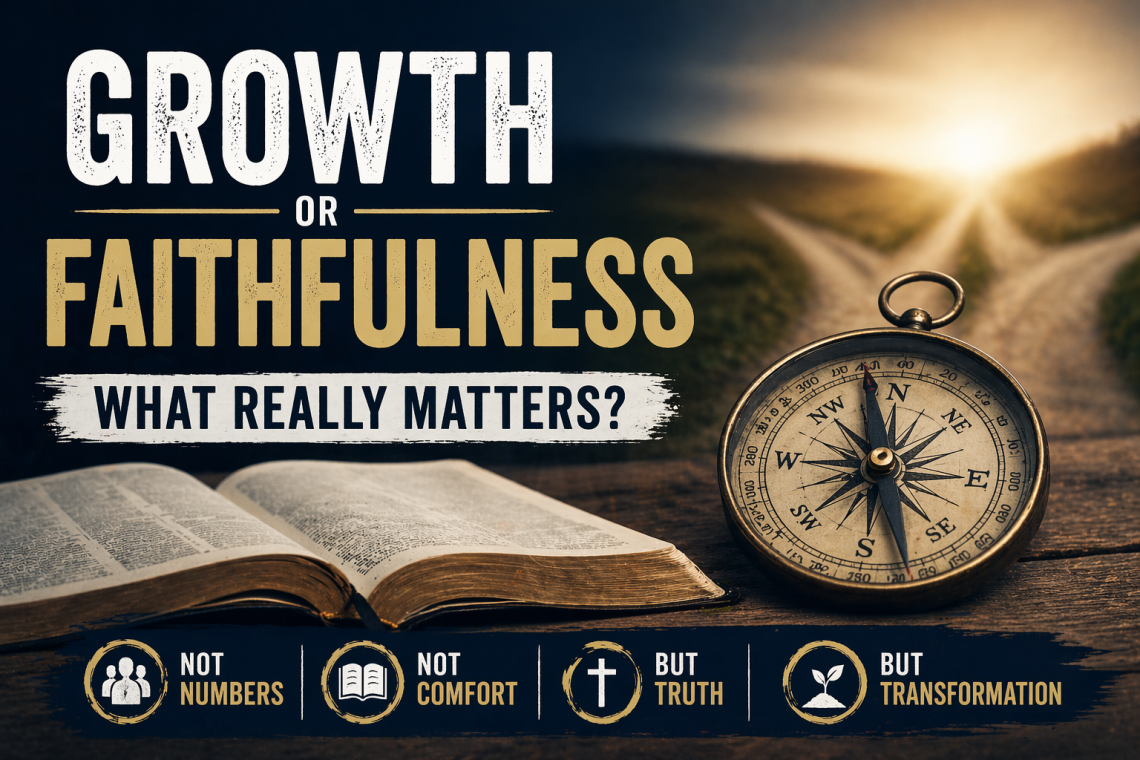
I’ve seen what happens when churches begin to prioritize numbers over truth. Teaching becomes lighter. Difficult subjects are avoided. The focus shifts toward keeping people comfortable. For a time, it may appear successful. But over time, conviction weakens, understanding becomes shallow, and stability is lost. Paul warned about this very thing in 2 Timothy 4:2–4, when he said that people would not endure sound doctrine but would seek out teachers who tell them what they want to hear. That warning is not theoretical—it is playing out in real time.
On the other hand, I’ve seen congregations that chose to remain faithful, even when it meant slower growth or even loss in numbers. They continued to teach the truth clearly. They continued to call people to repentance and commitment. And while they may not have grown quickly, they grew deeply. The members were grounded, active, and committed to the work. That kind of strength is not measured by attendance—it is measured by faithfulness.
That’s why I believe the real strength of a congregation isn’t found in how many people are present, but in how many are truly committed. Paul said in Romans 1:16 that he was not ashamed of the gospel. That’s the standard. Not popularity. Not comfort. But conviction. If I’m honest, I have to ask myself: do I want truth, even when it challenges me, or do I prefer what is easier to hear?
The truth is, real growth costs something. Scripture never presents discipleship as easy. In Romans 12:1, we are called to present ourselves as living sacrifices. That means giving ourselves fully to God—not just when it’s convenient, but in every part of life. Churches that avoid that message may grow faster, but they will not grow deeper.
So what does real growth actually look like? It looks like believers taking responsibility to reach the lost—having intentional conversations, opening their homes, studying Scripture with others, and walking with them as they learn to follow Christ. It looks like a congregation committed to teaching the full truth of God’s Word, even when it is uncomfortable. And it looks like trust—trust that if we remain faithful, God will bring the increase in His time.
At the end of the day, I have to come back to a simple but honest question: am I chasing numbers, or am I committed to faithfulness? Because if growth comes at the expense of truth, it isn’t growth—it’s compromise. I would rather stand with a faithful few who are fully committed to Christ than be part of a crowd that slowly drifts away from Him.
And if we are faithful—truly walking with Him, teaching His word, and living it out—growth is not something we have to manufacture. It is the natural result of that faithfulness, because God Himself gives the increase.